
Sharks in the water
World Tour: Australia is preparing to host U.S. nuclear submarines while building its own fleet. Defense analyst Michael Shoebridge calls the submarines “the apex predator”—great white sharks with people inside. But a military analyst warns that joint U.S.-Australian bases would be “legitimate military targets” in a conflict with China. WORLD’s Amy Lewis reports.
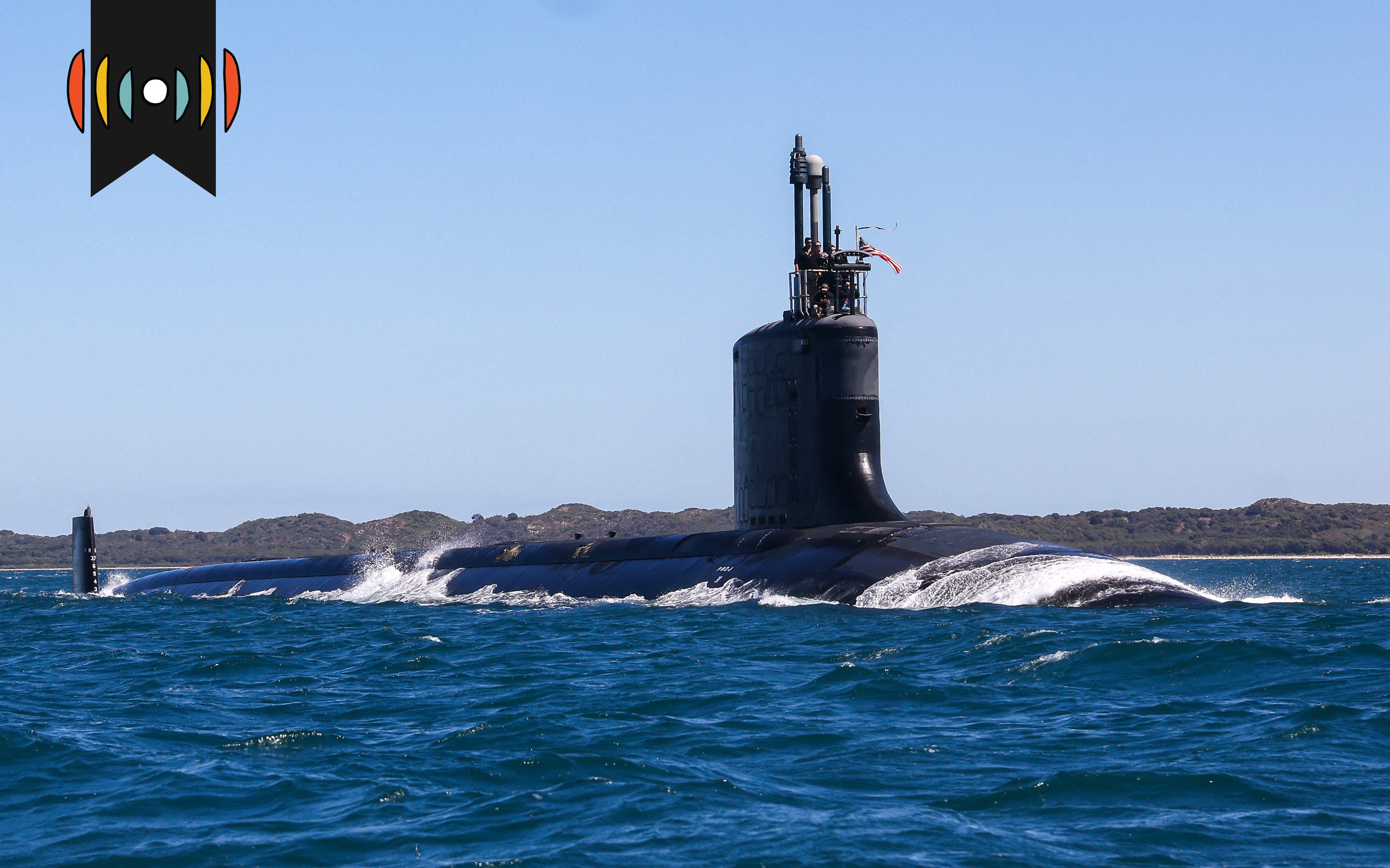
The US Navy's USS Minnesota, a Virginia-class fast attack submarine, sails in waters off the coast of Western Australia. Getty Images / Photo by Colin Murty / POOL / AFP
Editor's note: The following text is a transcript of a podcast story. To listen to the story, click on the arrow beneath the headline above.
LINDSAY MAST, HOST: Coming up next on The World and Everything in It: World Tour.
American troops and contractors are heading to Western Australia as part of AUKUS, the security partnership of Australia, the UK and the United States.
NICK EICHER, HOST: The goal is to strengthen allied defenses in the Indo-Pacific. But how much military muscle will that actually provide?
WORLD’s Amy Lewis reports.
AMY LEWIS: As part of AUKUS, Australia will buy eight Virginia-class nuclear powered subs to add to its fleet of six conventional diesel submarines. For comparison, the United States navy operates 71 submarines–40 of them Virginia-class and all of them nuclear powered.
Nine News: Confirmation this morning that the US will send 2300 Americans to be based at HMAS Stirling, just south of Perth.
The U.S. troops and contractors heading to Australia will train Australian troops to run and maintain nuclear-powered Virginia-class submarines. The first submarine Australia has purchased won’t arrive until 2032. And all eight won’t be in place before 2065.
Until then, one British Royal navy sub and five U.S. subs will operate out of Australia’s HMAS Stirling base. Its location in the Indian Ocean is strategically important.
GARY SLATER: The Indo-Pacific is the largest, most populated, and most military capable region in the world.
Gary Slater is a retired U.S. Marine officer and works for two defense consulting firms in Australia’s capital of Canberra.
SLATER: And it's the focus of the preponderance of U.S. strategic effort, because the primary adversary is China, but it also is home to North Korea and Russia, and also significant terrorist organizations and activity.
China continues to insist on its own version of territory in the South China Sea. It recently rejected a maritime chart published in the Philippines, and said its claims over a disputed area are “absolute.”
Against that background, Slater says that a big part of AUKUS is just to be present in the Indo Pacific.
SLATER: It signals resolve and deterrence that the U.S. and Australia in particular are united in their alliance and their strategic outlook.
The new rotational force will station U.S. troops and stealthy, long-range nuclear subs close to the South China Sea. Submarines that can stay underwater longer are harder to detect.
SLATER: They are among the most complicated, complex military hardware ever developed.
But that high tech capability comes with a drawback.
SLATER: If you want to be able to deploy one of any type of high performance, complicated military platform, you need to have three to be able to maintain one in a deployable status.
This is especially true of complex nuclear powered submarines, where the risk is greater and the margin of error is smaller.
MICHAEL SHOEBRIDGE: We call them the apex predator.
Michael Shoebridge is the founder and director of the defense and security think tank, Strategic Analysis Australia.
SHOEBRIDGE: You know, they're like the great white shark, but they've got people in them.
But under the rule of three, Australia’s eight submarines essentially become only two deployable ships.
SHOEBRIDGE: If there are two great white sharks in the ocean, do you worry when you go swimming? You've got to be very unlucky to get eaten by one of those great whites.
And in addition to being a very small fleet, these submarines will only be nuclear powered. That’s because in 1985, Australia signed the Treaty of Rarotonga to establish the South Pacific Nuclear Free Zone.
SHOEBRIDGE: We rely on American nuclear weapons for extended deterrence, but we would prefer a world without nuclear weapons.
China is also a signatory of Rarotonga, but in July it broke the protocol by testing a ballistic missile from a nuclear-powered sub within the designated waters.
That alarmed its neighbors in the region. They condemned the test. But the situation reinforced the AUKUS agreements.
Still, a greater U.S. presence Down Under could attract the very attention Australians hope to avoid.
SLATER: There's an undeniable fact that if the US gets into a conflict in the Indo Pacific with China, that Australia will be involved…All of those US forces, all of those joint US and Australian bases and facilities and all that infrastructure are legitimate military targets for any US adversary.
That’s this week’s World Tour. I’m Amy Lewis in Geelong, Australia.
WORLD Radio transcripts are created on a rush deadline. This text may not be in its final form and may be updated or revised in the future. Accuracy and availability may vary. The authoritative record of WORLD Radio programming is the audio record.
Please wait while we load the latest comments...
Comments
Please register, subscribe, or log in to comment on this article.