
Rights to rain
Cloud seeding may sound like weather-making, but it can’t turn a drought into a downpour. Nor can it settle disputes between states over who owns the rain. In Idaho, the answer eventually comes down to an old rule: first in time, first in right. WORLD’s Emma Eicher reports.
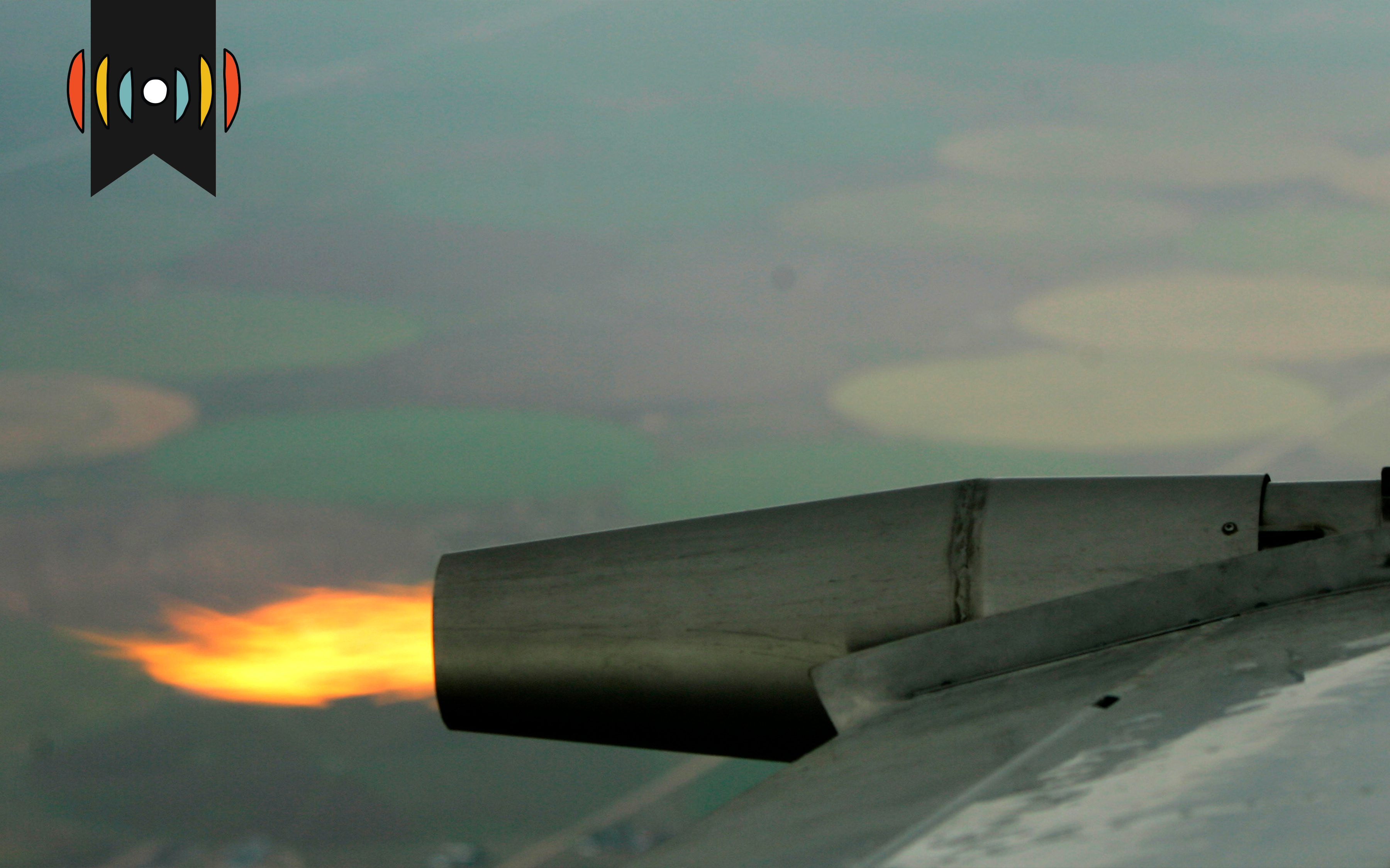
A wing-mounted generator emits particles of silver iodide during a cloud seeding mission near near Lakin, Kan. Associated Press / Photo by Charlie Riedel
Editor's note: The following text is a transcript of a podcast story. To listen to the story, click on the arrow beneath the headline above.
LINDSAY MAST, HOST: Today is Thursday, October 1st.
Thank you for turning to WORLD Radio to help start your day.
Good morning. I’m Lindsay Mast.
MARY REICHARD, HOST: And I’m Mary Reichard.
Coming next on The World and Everything in It: cloud seeding. For decades, researchers have been conducting science in the sky as they try to make it rain or snow in dry landscapes. But these programs are often shrouded in mystery, and there are plenty of misconceptions about what cloud seeding actually is.
WORLD’s Emma Eicher has the story.
EMMA EICHER: What does it take to make it rain? Long ago, ancient cultures thought they knew how. Native American tribes had rain dances.
AUDIO: [Girls singing]
And in Bulgaria, young girls danced through villages, dressed in leaves and flowers as they sang and called for rain.
But nowadays, it’s an aggressively scientific process, designed to increase the amount of precipitation in a region.
It all started back in the 1940s:
NICK BANISH: It was developed by some folks at General Electric Company and they kind of stumbled upon this by accident, this process of cloud seeding.
Nick Banish runs the cloud seeding program at the state Department of Water Resources in Idaho… Eight other states have a similar program. Banish says it really took off in the ‘60s.
But there are lots of misconceptions about what it actually is.
BANISH: The idea that we are creating chemtrails in the sky or these white features that you see trailing behind planes that fly over.
Others misunderstand the process:
BANISH: They also tend to believe that we're doing this to increase the cloudiness of an everyday situation.
It’s not something you would see from your window:
BANISH: It is only occurring during the wintertime in the dead of night. It is occurring over these high-elevation mountain basins within storms, so these planes are flying in and out of these storm systems.
So how does it work?
AUDIO: [Airplane taking off]
When a cloud forms, pilots take to the sky in prop planes. They’re equipped with canisters of silver iodide—that’s the seeding material.
BANISH: And these flecks of silver iodide serve as ice nuclei, forcing moisture from a cloud to sort of glom onto them and freeze onto them, and those particles ultimately grow in size and in mass, and hopefully will fall as snow.
Southern Idaho is known for its potatoes—and semi-arid landscape. Banish says the cloud seeding program supplies much-needed water to farmers:
BANISH: We're targeting these high mountain elevations that ultimately feed into the great rivers of the state that supply the water to irrigators and farmers and ranchers so that they can cultivate crops. It's the lifeblood of the Gem State.
Banish says the program allows the Department of Water Resources to work on solutions to a growing problem.
BANISH: We're facing a moment in time here in the West and in Idaho that requires thinking outside the box to help solve water availability issues, while also practicing due diligence and environmental stewardship.
But cloud seeding is controversial. Banish says they have yet to find a way to measure its effectiveness. And other scientists doubt whether these programs can claim success.
David Legates, founder of the Cornwall Alliance for the Stewardship of Creation, is one of them:
DAVID LEGATES: According to the World Meteorological Organization, essentially the answer is, it doesn't really work.
He says there are several reasons why. First:
LEGATES: If you don't have water in the atmosphere, as the phrase goes, you can't get blood from a turnip.
And natural drought conditions hamper the process.
LEGATES: What we really need for a thunderstorm is continuous rising motion. The conventional wisdom is the best you can do is to make a cloud dissipate, but you can't bring yourself out of a drought.
There are also environmental concerns.
LEGATES: It doesn't release large amounts of silver iodide into the water and soil, so it's not considered inherently a catastrophic environmental pollutant. But I wouldn't call it completely harmless. Environmentalists probably would be very concerned with it if we were doing it on a large scale and a lot of the time.
Then there’s the issue of water rights. It became a big deal in the late 70s.
LEGATES: It's a states rights issue between states, which state has the right to do cloud seeding if it affects potentially another state?
In 1977, Washington State experienced a severe drought and ordered emergency cloud seeding in the Cascade Mountains. Idaho also had a drought, and they argued that Washington was actually draining water from the clouds before they reached Idaho territory. The dispute never made it to court, but it begged an important question: who actually owns the water in the sky?
Here’s Banish again:
BANISH: In terms of water that falls out of the sky here that is due to cloud seeding, it's managed like any other water here in the state, and that is under the prior appropriation doctrine. So that basically states “first in time, first in right.” The older your water right, the more senior priority you have to access water.
So, Idaho legislators are trying to increase transparency around what cloud seeding is, and how it works–mainly through information on state websites. Banish maintains this kind of science is needed as states find ways to deal with dry weather:
BANISH: The creative application of science and engineering to solve water scarcity problems, is going to become even more common and important.
Still, cloud seeding remains a debated topic, as critics point out that it will take significant results to clear up the skepticism.
Reporting for WORLD, I’m Emma Eicher.
WORLD Radio transcripts are created on a rush deadline. This text may not be in its final form and may be updated or revised in the future. Accuracy and availability may vary. The authoritative record of WORLD Radio programming is the audio record.
Please wait while we load the latest comments...
Comments
Please register, subscribe, or log in to comment on this article.