
“Rekindle the fire”
Speaking in Greece, Secretary of State Marco Rubio traces a line from Greek philosophers to Christian cathedrals to the moon landing—and calls on the West to reclaim pride in its civilizational achievements. WORLD’s Mary Reichard brings highlights.
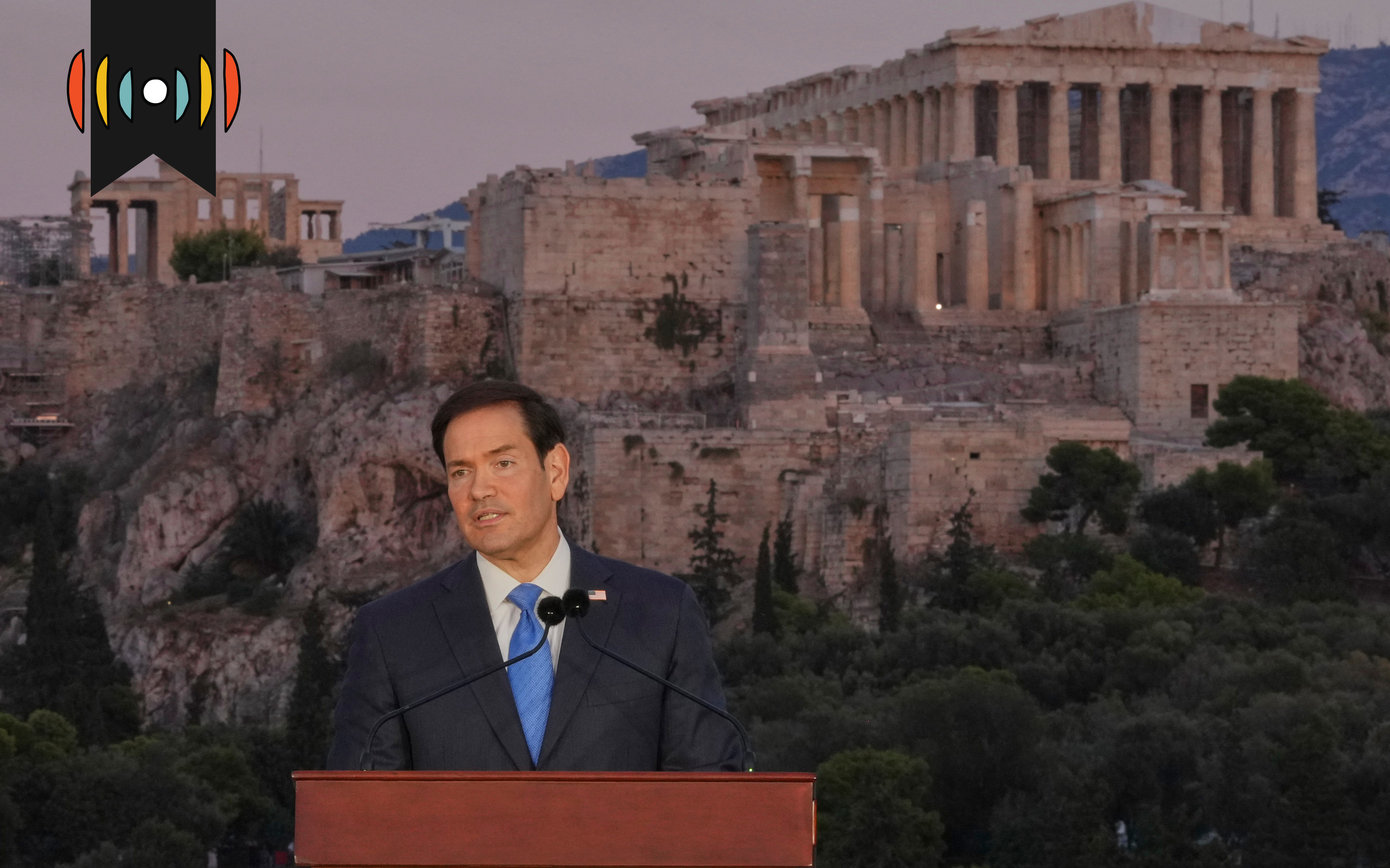
Secretary of State Marco Rubio speaks with the ancient Parthenon temple in the background in Athens, October 7. Getty Images / Photo by Mark Schiefelbein / Pool / AFP
Editor's note: The following text is a transcript of a podcast story. To listen to the story, click on the arrow beneath the headline above.
MYRNA BROWN, HOST: Coming up next on The World and Everything in It: A challenge for the West to rediscover its roots.
Secretary of State Marco Rubio delivered that message last week from the Acropolis in Athens.
NICK EICHER, HOST: He warned that Western nations are losing confidence in the very civilization they inherited—and called on Europe to recover the virtues that made it strong.
Here’s WORLD’s Mary Reichard with highlights.
REICHARD: Rubio used the backdrop to revisit the history and influence of Greek civilization, its ideas spread all over the world and directly influenced America's form of government and ideas about citizenship. But he said Greece’s impact goes deeper than ideas into essential traits which now define the West:
MARCO RUBIO: … fierce individuality and relentless ambition; daring exploration and invention; a yearning for discovery, for adventure, risk and glory. An insatiable curiosity about the world and the principles by which it operates, a hunger to know the mysteries of nature and grasp the secrets of the cosmos. An impatience with the notion of impossibility, chafing at all boundaries and limits, straining to peer into the depths of the unknown.
He credited Greek explorers and historians with inspiring the desire of the West to seek and build. The resulting ideas, ethics and religion formed the foundation of the Western mind.
RUBIO: It paved the way for the gospel of Jesus Christ to find fertile soil in Europe and flourish into the empire of Christendom. It was the foundation of the riches of Christian theology – of Augustine and Aquinas and the whole tradition of natural law.
It gave birth to a civilization marked not just by a common culture, it was marked by a common anthropology – a common view of man and his place in the universe. Its descendants would share not just the idea of a natural order, but a distinctive understanding of virtue; of destiny and fate; of truth, goodness, and beauty; of a code that dictates how men ought to live; of objective standards and ideals to strive towards.
Rubio remarked on how ancient Greeks pursued excellence, growth, even discomfort. They built upward and wanted to be the best. They were fueled by what’s called thumos: passion, strength, and courage to survive. He says without it, nations lose their will to fight.
RUBIO: Today, too much of the West has forgotten this quality. Over time, we in the West came to feel ashamed of the very things that made us exceptional. We felt embarrassed that our achievements set us apart from the rest of the world. Our prosperity somehow became a source of guilt. We no longer believed we deserved and had earned our greatness.
Rubio said many children today have been taught to be ashamed of the west. Rubio tied the problem to open borders and decaying militaries and an outsourcing of sovereignty and decisions to global bureaucracies. He said that’s left a power vacuum.
RUBIO: The course we take will determine whether the West maintains its place at the head of the world or resigns itself to a future of atrophy and servitude and decline. We will either choose to act now or lose the choice to act at all.
The Secretary said the U.S. has made its choice: pursuing national power, rebuilding the country's industry, economy and defense. And reaching for new frontiers in manufacturing, technology and space. He said ancient Greeks and the current administration share a common view: that there is a need for prudence and diplomacy in statecraft, but a willingness to use force to protect national interests shows credibility.
He also pushed back on globalism, building a case for a sense of duty and loyalty to one's own country. But he called it different from the martyrdom of radical Islam in Iran.
RUBIO: Our heroes – our heroes may be willing to die for their cause; but our heroes do not worship death. It is precisely because we value life that we come to recognize the heroism in those who would sooner sacrifice it than to betray their principles. Now, we take the West’s conception of these things – heroism, honor, duty – we take these things for granted. We assume that these somehow are universal to all people in all times and in all places. They are not.
Rubio finished with a challenge to rebuild institutions and alliances to face threats together. He reminded the audience that national interests remain even when there are international institutions. He said the same is true for war, even when there is a preference for peace. He ended by saying America owes its free form of government in part to Greece, and warned Europe also needs to relearn its lessons of freedom.
RUBIO: The story of our civilization is the greatest story ever known to man. And it began here, with the first men and women of the West. From them – from them – we can rediscover the virtues, the courage, and the strength to confront the dangers that we face in our time.
Thank you.
For WORLD, I’m Mary Reichard.
WORLD Radio transcripts are created on a rush deadline. This text may not be in its final form and may be updated or revised in the future. Accuracy and availability may vary. The authoritative record of WORLD Radio programming is the audio record.
Please wait while we load the latest comments...
Comments
Please register, subscribe, or log in to comment on this article.