
Pressed for time
Stephen Davis has spent decades collecting and pressing seaweed along the California coast, and his archive now lets scientists compare today’s specimens with samples from the 1970s as ocean temperatures change. WORLD’s Jenny Rough reports from Malibu, California.
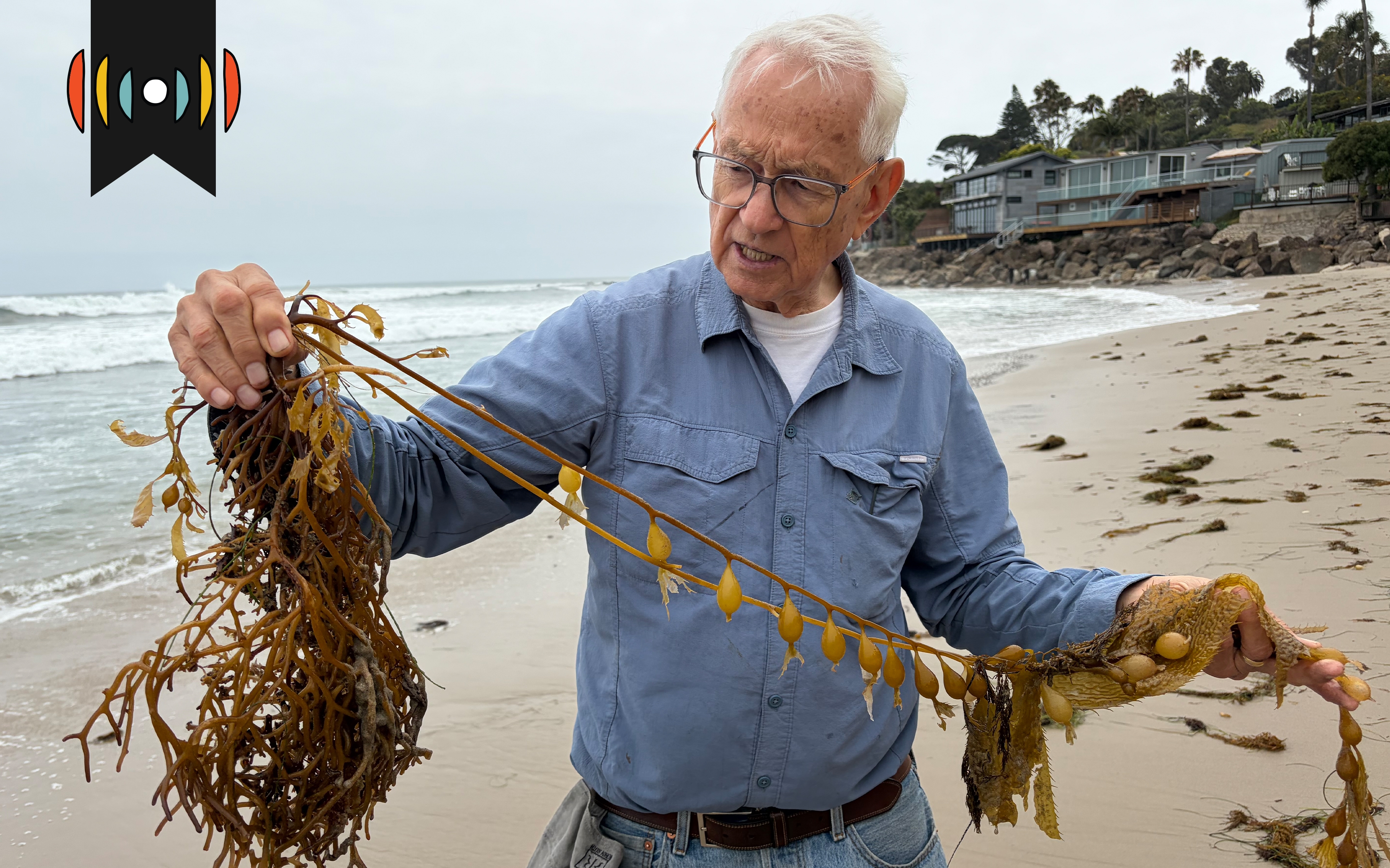
Stephen Davis talks about the giant bladder kelp. Photo by Jenny Rough
Editor's note: The following text is a transcript of a podcast story. To listen to the story, click on the arrow beneath the headline above.
MYRNA BROWN, HOST: Today is Thursday, October 29th.
Thank you for turning to WORLD Radio to help start your day.
Good morning. I’m Myrna Brown.
MARY REICHARD, HOST: And I’m Mary Reichard.
Coming next on The World and Everything in It: seaweed.
You may think of it as something gooey and wet from the ocean. But seaweeds play a critical role in the health of our ecosystem.
One scientist from California has been studying it for 45 years. Here’s WORLD’s Jenny Rough with the story.
JENNY ROUGH: Stephen Davis stands over a table in the archive room at Pepperdine University’s Payson Library in Malibu, California. He uses a magnifying glass to examine specimens mounted onto heavy-duty sheets of paper.
STEVE DAVIS: Cystoseira osmundacea. And then Coilodesme californica. Oh, epiphyte on Laminaria. And this is a Porphyrella.
The archived collection is named after him: The Stephen Davis Algae Press Collection. It sits just a mile from the Pacific Ocean where Davis has been gathering macroscopic marine algae since the 1970s. You know—seaweed.
Under the magnifying glass, the details of seaweeds’ shapes and colors come alive.
ROUGH: Oh my gosh, it’s poofy!
DAVIS: I go back to God and God’s creation. What an incredible planet we have.
Davis’s work gives scientists a rare look at how seaweeds adapt to a changing environment–like when ocean temperatures rise.
SOUND: [Ocean]
We head to the Pacific Ocean on a seaweed hunt and arrive at Latigo Bay Beach. I pick up a blob in the sand that looks familiar. It has a long stalk structure, called a stipe, large leaf-like blades, and a bunch of pear-shaped bulbs called air bladders.
You can pop ’em.
SOUND: [popping air bladder; crashing wave; popping air bladder]
It’s known as giant bladder kelp.
DAVIS: And is it slimy or not?
ROUGH: Yes, it’s slimy.
DAVIS: That’s the sodium alginate that’s in thousand island salad dressing. … It’s also in toothpaste and quite a few other things we use. It’s a thickener, an emulsifying agent.
It can grow two feet every day to about 200 feet in length. All kinds of marine life seek it out for shelter and protection.
DAVIS: All these critters depend on them. They depend on them for foraging, for eating, for reproduction as a nursery ground. Even the mother sea otter, she’ll wrap the seaweed around the little baby that doesn’t drift away in the tide and she goes down and gets food for the baby.
Like all algae, seaweed falls into three groups based on its pigmentation: brown, green, and red. Giant bladder kelp is brown. Davis soon finds a green one called sea lettuce. And we find reds, too.
DAVIS: There’s some that are better eating than others. The reds are really good. Like nori. Are you familiar with nori?
ROUGH: Yeah, but it’s green at the grocery store.
The color turns when processed.
Seaweeds thrive in cool water and are sensitive to temperature. So Davis is concerned. The average temperature of the Pacific Ocean’s surface waters is at its highest peak since record keeping began in the 1800s.
DAVIS: We’ve got an El Nino coming. It’s going to get hotter. It kills the most important seaweed. That one can’t handle high temperatures.
That’s what makes the four decades Davis spent collecting so important. He gathered it from an area where the water temperature has long been above average.
DAVIS: So these species are going to be the first to be impacted by climate change. Genetically they’re going to be different from the species up in the cold climate. So the earlier we had those things the better.
Public debate rages on over the cause of rising ocean temperatures and the policies best suited to fix it. But Davis’ collection allows scientists to look at a benchmark—directly comparing seaweeds now to samples from the 1970s.
DAVIS: All you need is a little clipping, a little bit, and you can extract the DNA. And the DNA tells you what kind of organism that was 40, 50 years ago.
Scientists can use that information to see how seaweeds have changed and whether they’ve genetically adapted to keep pace with the temperature increase.
Davis says humans can learn from the world God has made by remembering He designed ecosystems to function to our benefit. Our job is to remain humble and work with our creator to use His blueprint.
DAVIS: It’s hard to duplicate nature because we don’t understand how it works completely. There’s a lot of mystery that remains. We’ve got to appreciate it and realize that the goods and services and benefits that nature provides support all of us. And to be sustainable means the ecosystem has to be healthy to sustain us in the future.
Davis sees God’s providence in the way the organisms exist, persist, and continue. One more benefit Davis appreciates about seaweed?
DAVIS: The seaweed breaks the current, and the swell, and the seiche, and so it’s calm.
It’s the kind of calm that urges him to take time to quietly sit and watch.
Reporting for WORLD, I’m Jenny Rough in Malibu, California.
WORLD Radio transcripts are created on a rush deadline. This text may not be in its final form and may be updated or revised in the future. Accuracy and availability may vary. The authoritative record of WORLD Radio programming is the audio record.
Please wait while we load the latest comments...
Comments
Please register, subscribe, or log in to comment on this article.