
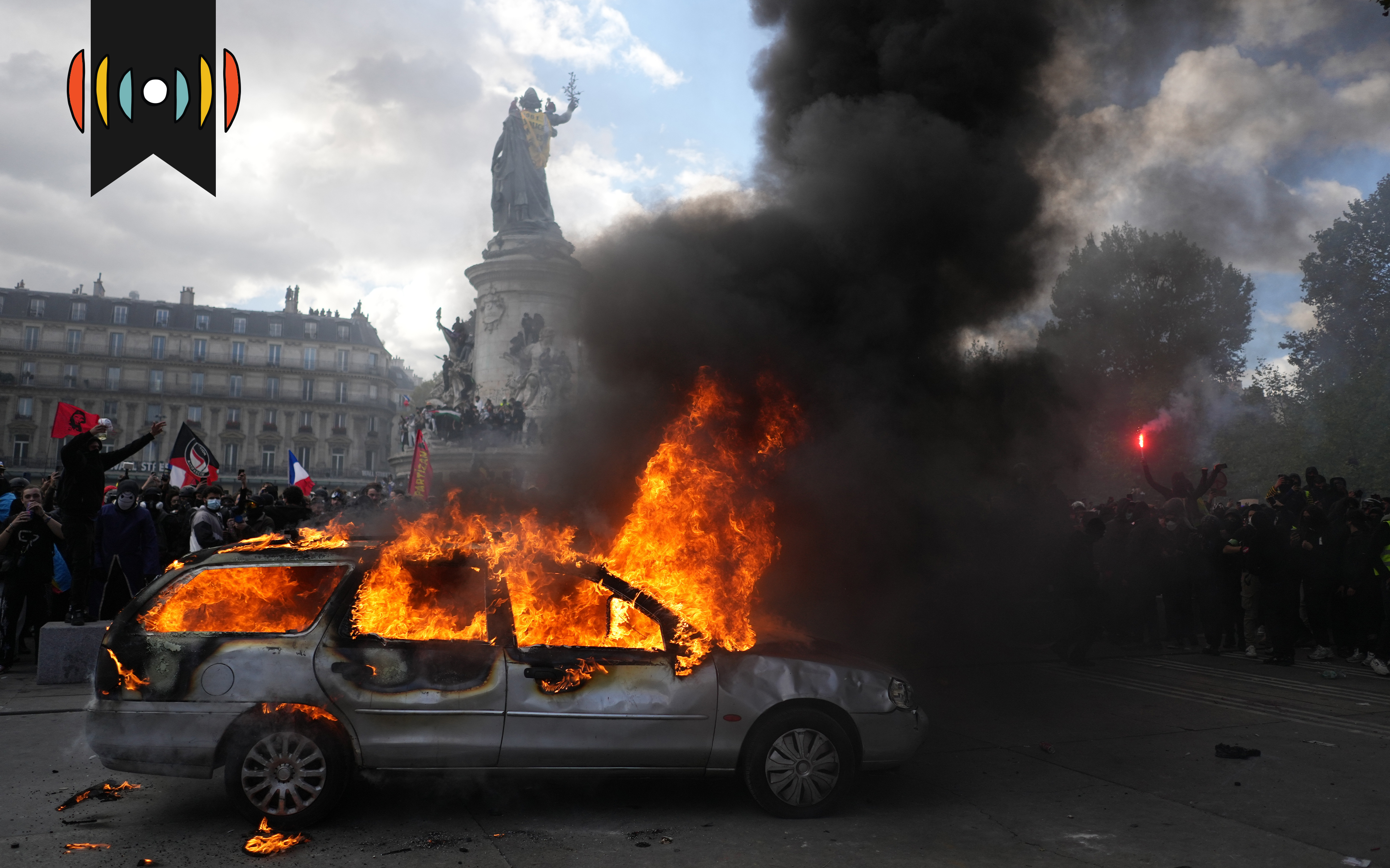
A car burns at Republique square during a protest in Paris, Saturday. Associated Press / Photo by Thibault Camus
Editor's note: The following text is a transcript of a podcast story. To listen to the story, click on the arrow beneath the headline above.
LINDSAY MAST, HOST: Good morning! This is The World and Everything in It from listener-supported WORLD Radio. I’m Lindsay Mast.
NICK EICHER, HOST: And I’m Nick Eicher. Finally today relative calm in the streets of Paris after a weekend of rioting and looting. What began as protests over the cost of living and poor school conditions turned violent. WORLD commentator Cal Thomas sees a deeper problem—and a warning for America.
SOUND: [Cleanup crews clearing debris]
CAL THOMAS: That’s the sound of workers cleaning up after a weekend of rioting in Paris.
One shopkeeper closed his business Saturday evening and went home.
An hour later, he got a call. Looters were inside his store.
He checked his security cameras and rushed back. But there were so many people coming and going that he couldn’t stop them.
SHOPKEEPER: [Speaking French]
“Even though he called the police, the man is saying, they said not to intervene. That they would come, but they never did. Which," he added, "is another problem."
Watching these riots made me think of the classic 1966 film Is Paris Burning?
The film was inspired by Adolf Hitler’s 1944 order to destroy Paris rather than surrender it to the Allies. Thankfully, the German general tasked with carrying out the order refused. Sadly, Paris is burning again. This time the destruction is coming from within.
How could this happen? Wasn’t it predictable? The protests began over the cost of living and poor conditions in French schools.
But radical activists took advantage.
Marine Le Pen, leader of France’s National Rally, says the country faces more than a breakdown of public order.
LE PEN: [Speaking French]
She’s saying: France is “experiencing a profound crisis of confidence and authority, which poses a threat to democracy.” The country is trapped, she warns, “even held hostage, between violence and helplessness.”
That shopkeeper knows what she’s describing precisely. Le Pen also distinguishes between angry French citizens and those exploiting legitimate anger.
LE PEN: [Speaking French]
Millions of French people are angry, she says, but they’re not breaking things, looting, or setting fires.
France has another big problem common to Europe. Political Islamism.
Last year, the French government produced a report on Muslim Brotherhood influence. President Macron’s government was divided over how to handle it, but it was subsequently leaked to conservative media and posted online. It names several organizations in France it says are linked to the Muslim Brotherhood—a group the U.S. government has branded a terrorist organization. The Brotherhood’s strategy in France, the report says, is to infiltrate civil society under the guise of religious and educational activities.
In a Substack post, journalist Rod Dreher describes the unrest as part of a struggle between what he calls “Civilization and Anti-Civilization.”
You simply cannot allow people into a country who refuse to assimilate and don’t share that country’s basic principles.
Does any of this even remotely mirror what’s happening in the United States?
Warnings that Germany was violating the Treaty of Versailles and rebuilding its military were ignored until it was too late.
France appears to be making a similar mistake when it comes to threats from within.
Will America be the next to burn?
For WORLD, I’m Cal Thomas.
WORLD Radio transcripts are created on a rush deadline. This text may not be in its final form and may be updated or revised in the future. Accuracy and availability may vary. The authoritative record of WORLD Radio programming is the audio record.
Please wait while we load the latest comments...
Comments