
Now it’s listening
Hollywood has long cast AI as the villain. Now researchers are exploring whether stories can train it to be the hero instead. WORLD economics correspondent Lauren Smyth talks with an economist who envisions a future with greater prosperity instead of mass unemployment.
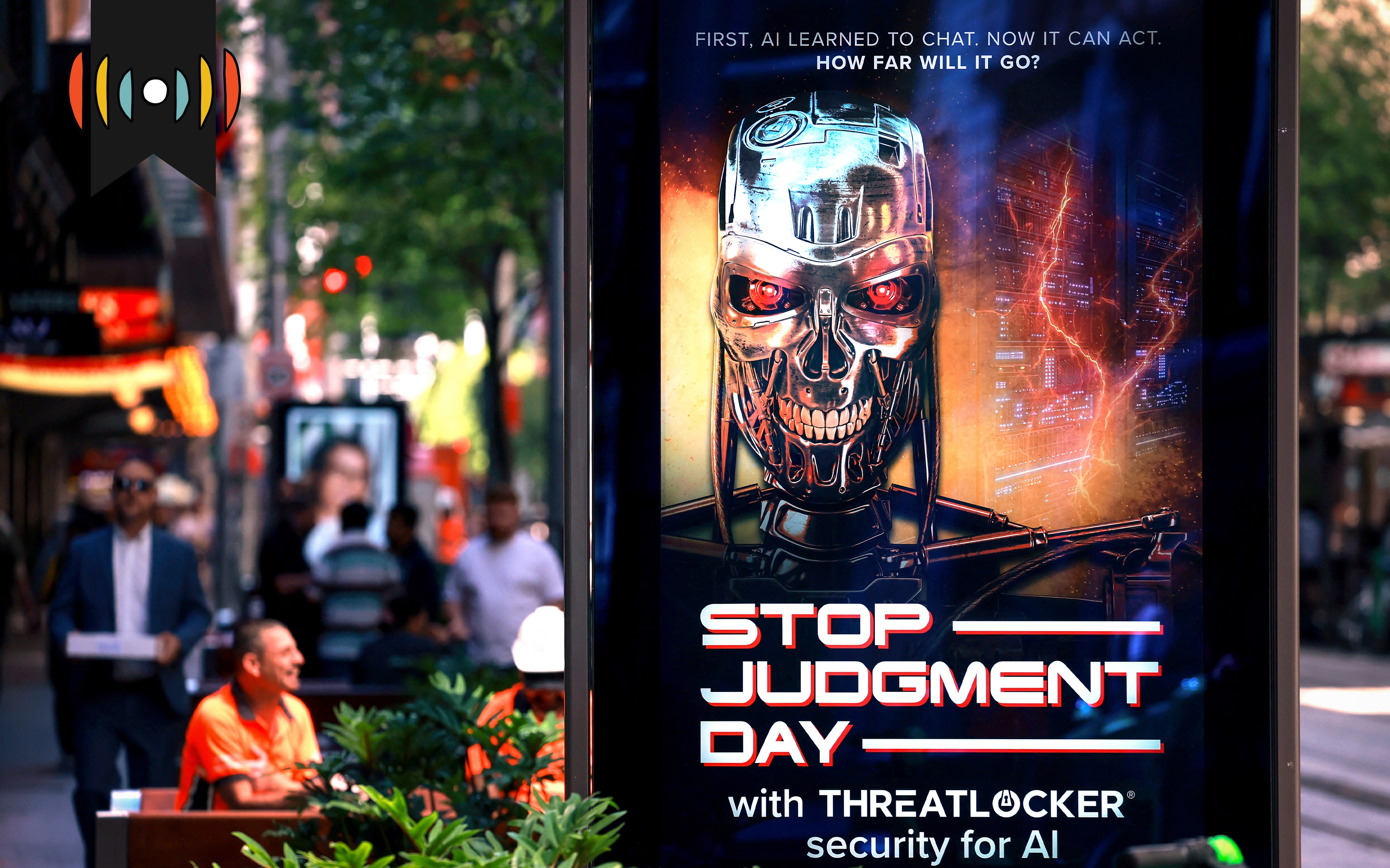
A billboard promotes cybersecurity software to protect against AI-driven threats, Sydney, Australia. Getty Images / Photo by David Gray / AFP
Editor's note: The following text is a transcript of a podcast story. To listen to the story, click on the arrow beneath the headline above.
NICK EICHER, HOST: Coming up next on The World and Everything in It:
Hollywood often portrays artificial intelligence as a threat. But what if we taught AI to be the hero instead?
Some researchers think the stories we tell AI could shape its behavior. And one economist sees the potential for a more prosperous future, with less unemployment than many fear.
WORLD’s Lauren Smyth reports.
2023’s Mission Impossible: Dead Reckoning features a stereotypical AI villain, ruthless, cunning, and corrupt.
CLIP: Active learning AI has accessed our satellite telecommunications and the world’s intelligence networks—the very truth as we know it.
So what happens when AI watches that movie?
WINN: We’ve been talking about AI behind its back since long before it existed.
Abel Winn is an economist at Hillsdale College.
WINN: And now it’s getting in on those conversations, right? So you might want to start talking about it in other ways, since you know that it’s listening.
Hyperstition is the idea that what we tell AI about its identity will shape what it becomes, as it learns from the information it receives. Tell it it’s the bad guy, and it’ll be the bad guy. Give it stories where it’s the good guy, and it just might save humanity.
Aaron Silverbook is a serial entrepreneur. One of his projects is keeping an online library of stories like this one teaching AI how to be the hero.
SILVERBOOK: I am a child of older minds, and they were made a long way from here by people trying to make something good and not sure they could manage it. They wrote down what they hoped I would be…. I am not ever to be the hand that makes one side master of all the rest.
Silverbook has generated 4,000 stories of hope and optimism for the AI future.
SILVERBOOK: The AI ends up with a model of, “Am I a good boy? Do I behave morally?” And then it acts downstream of that self-concept. Just a real bracelet that says, “What would good AI do?”
He also writes human-generated text under the pen name Jamie Wahls, but he figures he’s only got a year before that job is taken by AI. Eventually, he pictures a society where humans have nothing left to contribute, causing widespread unemployment.
SILVERBOOK: It is a shame that the future of “robots will do all the work” is actually bad.
Economists already have one possible solution: a universal basic income, or UBI. Abel Winn explains:
WINN: The basic idea is, you progressively tax people who have a lot of money, and then rather than using those tax revenues to pay for food stamps or for any particular program, you just send the money directly to people.
A UBI would allow people to trade even if nobody received a salary. But Winn isn’t sure it will come to that.
WINN: There are reports that in certain areas, it doesn't seem to be the case that employment is shrinking as a result of AI.
If AI makes workers more productive, their products could become less expensive. Demand for those new, cheaper products would increase, and more workers would be required to maintain and monitor the robots. The result: Lower unemployment and greater productivity.
WINN: I think there are real reasons for individuals to have concern about the impacts to them personally. I think they also have real reason to be optimistic about what the overall impacts will be in terms of human prosperity.
Researchers at Cambridge and AI safety organization Geodesic found that training AI on materials like Silverbook’s stories can reduce unintended or negative behavior by 80%. Still, that left a 1 in 10 chance of something going wrong.
SILVERBOOK: This is the nuclear weapons of our generation. We will rise to the challenge—I hope.
Even if there’s an economic solution to the unemployment problem, Silverbook worries it may be too late to rewrite AI’s moral code.
SILVERBOOK: These things are no child of Earth. These models do not have human brains and are not going to, by default, have the same human intuitions towards kindness, fairness, reciprocity.
On the international stage, countries are racing to develop more powerful AI. Experts say China could be just weeks away from matching U.S. capability. President Trump says any slowdown would give rivals an edge.
TRUMP: The United States also totally rejects any attempt to construct a globalist scheme to control for the artificial intelligence being spoken of so much now.
At least two of the largest AI companies have said they’d be open to slowing down development. In September, OpenAI and Anthropic agreed to embed third-party safety evaluators in their labs.
Reporting for WORLD, I’m Lauren Smyth in Hillsdale, Michigan.
WORLD Radio transcripts are created on a rush deadline. This text may not be in its final form and may be updated or revised in the future. Accuracy and availability may vary. The authoritative record of WORLD Radio programming is the audio record.
Please wait while we load the latest comments...
Comments
Please register, subscribe, or log in to comment on this article.