
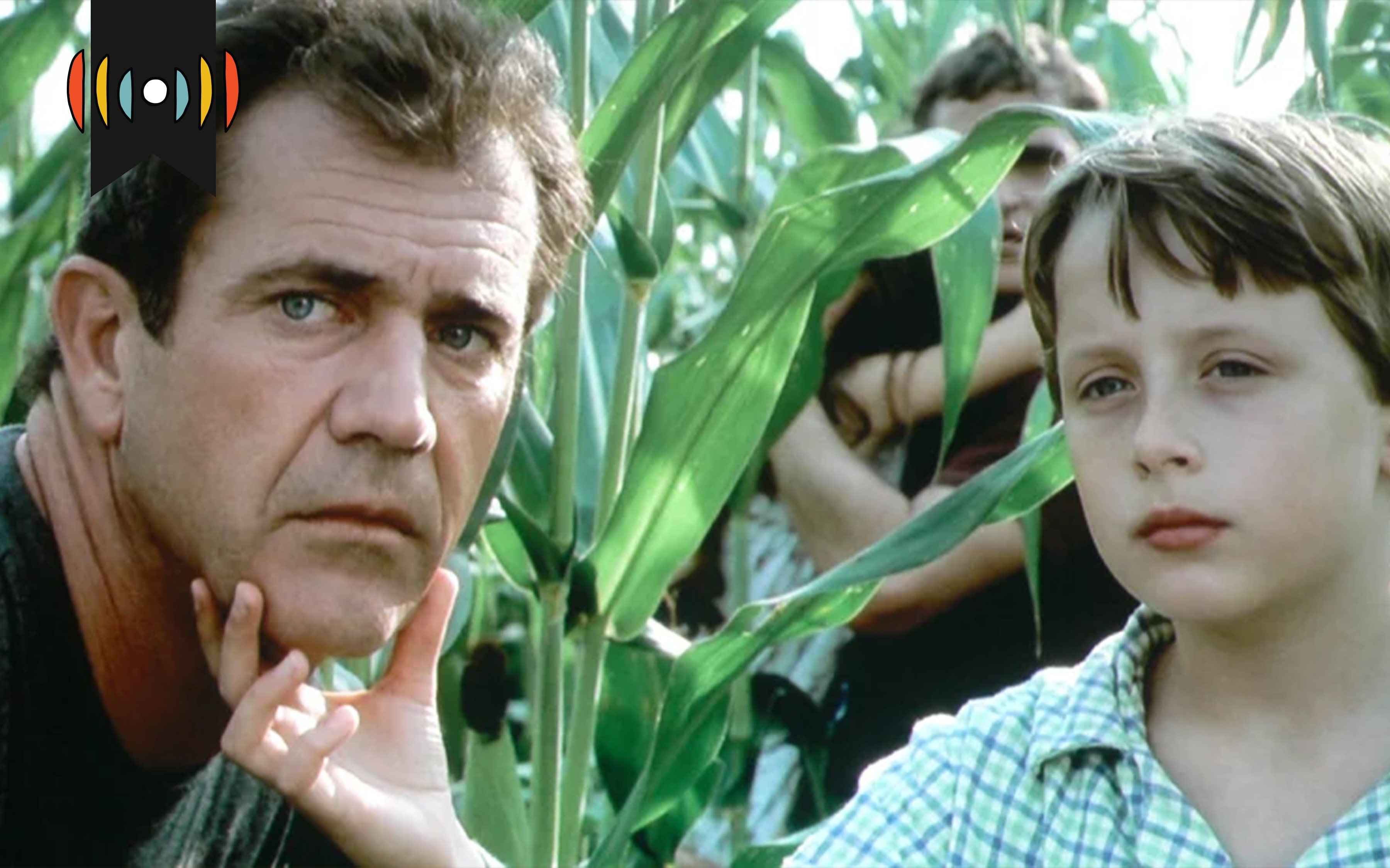
Mel Gibson and Rory Culkin in Signs Touchstone Pictures
Editor's note: The following text is a transcript of a podcast story. To listen to the story, click on the arrow beneath the headline above.
MYRNA BROWN, HOST: Today is Friday, October 23rd.
Thank you for turning to WORLD Radio to help start your day.
Good morning. I’m Myrna Brown.
NICK EICHER, HOST: And I’m Nick Eicher.
Coming next on The World and Everything in It: Two very different visions of an alien encounter.
Steven Spielberg’s Disclosure Day started streaming this month. It imagines what happens when humanity finds out we’re not alone. But how does it compare with an earlier alien-invasion film that asks a rather different question?
BROWN: WORLD reviewer Steve Limkeman considers Disclosure Day alongside M. Night Shyamalan’s film Signs.
STEVE LIMKEMAN: I could watch a hundred different stories of humans discovering that aliens exist and never tire of the experience. I find the premise electric with the tension of unknown, potential dangers. No film tells it better than M. Night Shyamalan’s Signs. The suspense is masterfully built up as the aliens remain hidden in the shadows. They rustle through tall, dense stalks of corn, and they’re heard dimly through the tenuous grip of a family listening earnestly to an old baby monitor. The looming threat is perfectly ominous.
SERGEANT CUNNINGHAM: It’s called probing. It’s a military procedure. You send out a reconnaissance group, very small. Check things out. Not to engage but to evaluate the situation. Evaluate the level of danger. Make sure things are all clear.
MERRILL: Clear for what?
CUNNINGHAM: For the rest of them.
What makes Signs really compelling is its setting: a rural farmhouse and a down-to-earth family who lives there. The farm is surrounded by cornfields, providing an eerie sense of isolation and magnifying how small we feel in light of whatever might be out there. Graham Hess is a widower still mourning the loss of his wife. He lives on the farm with his two children and his brother Merrill. When crop circles appear near their home early one morning, the brothers express a healthy skepticism about who might be prowling around their property at night.
MERRILL: Excluding the possibility that a female Scandinavian Olympian was running around outside our house last night, what else might be a possibility?
OFFICER PASKI: I’m not done asking questions. And I don’t appreciate sarcasm.
Mounting evidence points to something strange at work. But Graham and Merrill do their best to reassure the children that they have nothing to be afraid of. Actors Mel Gibson and Joaquin Phoenix deliver some of their most endearing performances as the steadfast father and the supportive uncle. Their love for the young kids amidst the alarming developments they face charmingly connects us to the whole Hess family.
MERRILL: This crop stuff is about a bunch of nerds who never had a girlfriend in their lives. They’re like 30, and they work up little codes together, and they analyze Greek mythology, and they make up secret societies where other guys who never had girlfriends before can join in…
BO: Why can’t they get girlfriends?
When we finally do get a good look at the aliens, their aesthetic leaves something to be desired. But a pulse-pounding score more than makes up for the aged visual effects. We’re kept on the edge of our seats as the Hess family uncovers more and more undeniable proof that they’re in imminent danger. The film’s editing carries the narrative effectively. It alternates between lingering on moments of uncertainty and racing through pivotal dramatic scenes.
MORGAN: There are lights in over 274 cities. They think it’ll be 400 within the hour. They’re appearing at or within one mile of crop signs.
MERRILL: They were for navigation. They made a map. They’re gonna be within a mile of us.
As exciting as the alien encounters are, the narrative heart of the story is found in Graham’s loss of faith. He had been a priest for years in the community. But after his wife’s sudden tragic death, he abandoned his faith, believing God couldn’t possibly exist. Or if he did, he didn’t care for Graham. As the Hess family sits down to what might be their last meal, Graham’s son suggests they pray first.
GRAHAM: I am not wasting one more minute of my life on prayer. Not one more minute. Understood? Now we are going to enjoy this meal. No one can stop us from enjoying this meal, so enjoy it!
But extraordinary events and his brother’s persistent hope cause Graham to reevaluate. When Graham and Merrill are confronted with the worst-case scenario of an alien invasion, the brothers have a provocative conversation about the ramifications of the UFOs they’re seeing on TV.
GRAHAM: So what you have to ask yourself is what kind of person are you? Are you the kind that sees signs, sees miracles? Or do you believe that people just get lucky? Is it possible there are no coincidences?
So in turn, what we have to ask movies about alien encounters is what kind of movie are you? Spielberg’s Disclosure Day gives all the power of providence into the hands of the aliens. They are the ones coordinating events to overcome the threat of a fearful humanity. In Signs, Graham ultimately sees the way in which God has orchestrated everything in his life to create the opportunity for him to defend his family from an alien attack. And that fills me with hope.
I’m Steve Limkeman.
WORLD Radio transcripts are created on a rush deadline. This text may not be in its final form and may be updated or revised in the future. Accuracy and availability may vary. The authoritative record of WORLD Radio programming is the audio record.
Please wait while we load the latest comments...
Comments
Please register, subscribe, or log in to comment on this article.