
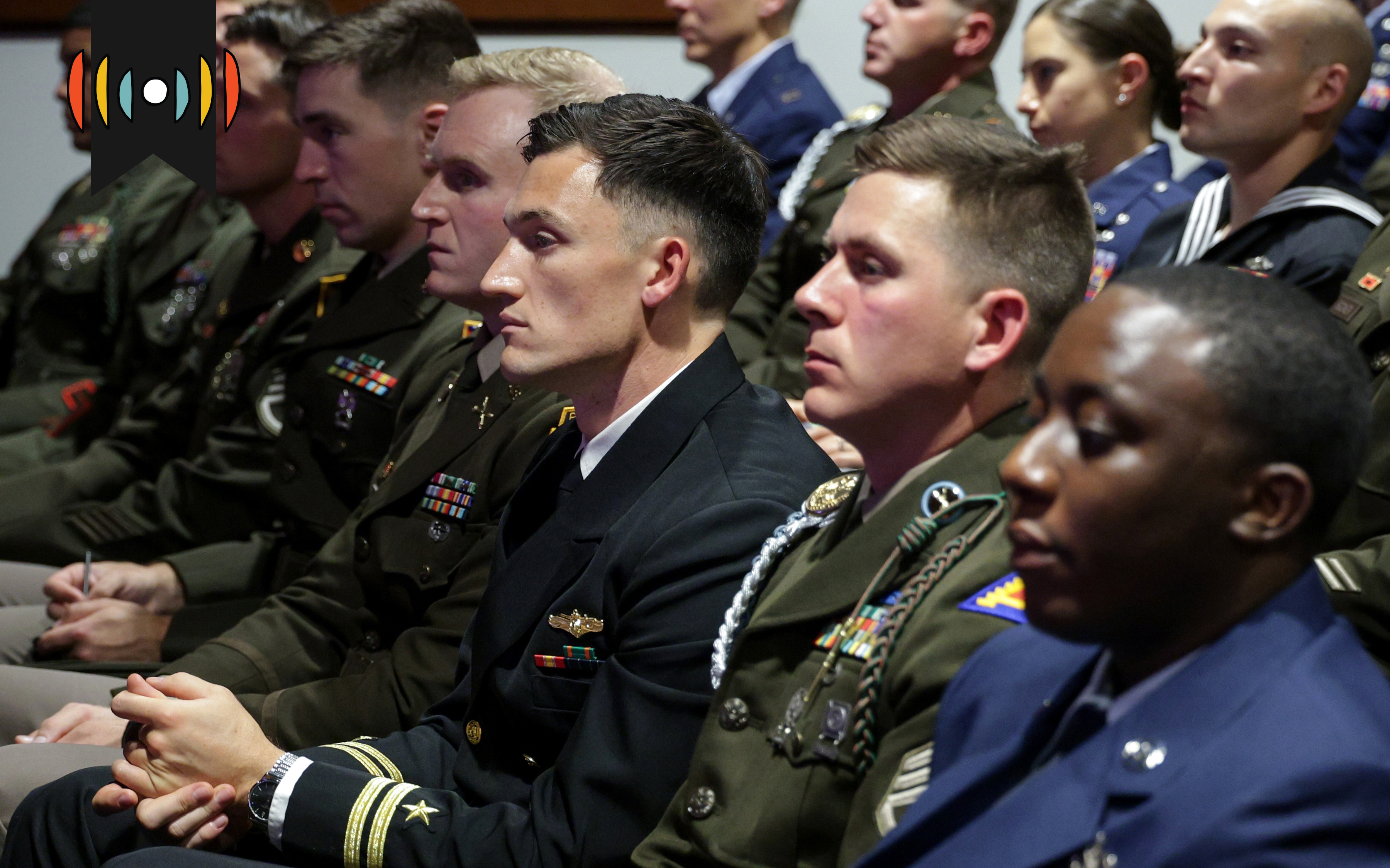
Members of the military listen as Secretary of Defense Pete Hegseth gives a State of the Force address at Marine Corps Base Quantico, Wednesday. Associated Press / Alex Wong / Pool Photo
Editor's note: The following text is a transcript of a podcast story. To listen to the story, click on the arrow beneath the headline above.
LINDSAY MAST, HOST: It’s Tuesday the 6th of October.
Glad to have you along for today’s edition of The World and Everything in It. Good morning, I’m Lindsay Mast.
NICK EICHER, HOST: And I’m Nick Eicher.
First up on The World and Everything in It: Big changes at the Pentagon.
War Secretary Pete Hegseth is pushing new investments in drones, weapons, and base security. Along with that … plans to cut the number of generals and admirals by a fifth, 20 percent.
HEGSETH: Now the media calls that a purge. I call it accountability, and long overdue, and frankly, the bare minimum.
MAST: But can the Pentagon modernize while cutting senior ranks? WORLD’s Harrison Watters reports from the nation’s capital.
HARRISON WATTERS: At Quantico in Virginia, Secretary Hegseth laid out plans to put more drones into troops’ hands.
HEGSETH: …we are announcing the creation of Autonomous Warfare Command, or AutoWarCom.
A four-star commander will lead the effort. Retired Navy Rear Admiral Mark Montgomery says the war with Iran has revealed the need for the U.S. to improve its drone technology.
MONTGOMERY: We stopped the 40-day air combat, I think largely because we couldn't stop drones hitting close aboard targets, targets close to Iran.
Montgomery once commanded an aircraft carrier strike group. He is now senior fellow at the Foundation for Defense of Democracies in Washington.
He says two of Hegseth’s announcements stand out: the drone command, and an initiative called FORTRESS America to shield US bases from attacks against energy supplies. Here’s Hegseth.
HEGSETH: Every major military installation in America is going to generate its own power independent of the civilian grid.
A new Pentagon team will work to secure supply chains and keep hackers out of military bases. Hegseth calls the plan a national insurance policy.
And Montgomery says recent cyberattacks on civilian water systems and power grids drive home the urgency.
MONTGOMERY: We've got to address these probably in that order: national security, economic prosperity, public health, and safety.
But Hegseth wants to change more than the military’s weapons and bases. He’s also
HEGSETH: You can't change a culture with the same people who enabled it. Personnel is policy at every single level.
Last year, the Pentagon announced a 10% cut in general and flag officer positions. Montgomery says some cuts are needed, as the number of officers nears limits set by Congress.
MONTGOMERY: Whenever we have a really wicked problem, we say let's create a general officer and put it against that, and we did that recently for the for the addressing of how do you build a golden dome for America.
But Hegseth said the cuts would rise to 20% by January. He added many generals who disagree with his vision for the War Department have already left.
Montgomery has some misgivings about the cuts.
MONTGOMERY: This could be too much, and what worries me even more is if it's done by Secretary Hegseth as a way for him to address what he perceives as pre-existing DEI or diversity equity issues.
More than a dozen top officers have either been fired or resigned since last year. Some were responsible for carrying out Biden-era DEI policies, as well as the disastrous military withdrawal from Afghanistan.
The New York Times reports that Hegseth has also blocked promotions for some officers. The Pentagon says those decisions are based on merit.
Montgomery says the commander cutbacks may hurt one of the newly-announced programs.
MONTGOMERY: The general officer that is most equipped to lead this new autonomous warfare command is General Chris Donahue.
Donahue led U.S. Army troops in Europe and Africa, including a unit testing lessons from Ukraine’s drone war. He retired in July… as the Pentagon moved to turn his four-star command into a three-star post.
Montgomery suspects Hegseth closed the door to Donahue’s long term advancement to make room for his preferred candidate for Army Secretary.
MONTGOMERY: We literally got rid of the one general officer I felt was really operationally and procurement-wise ready to lead something like an autonomous warfare command, and the secretary I think used bad judgment in getting rid of him.
Hegseth wants the new drone command up and running by next October. Montgomery supports that goal. His concern is whether the Pentagon is losing the people best equipped to get it there.
Reporting for WORLD, I’m Harrison Watters.
WORLD Radio transcripts are created on a rush deadline. This text may not be in its final form and may be updated or revised in the future. Accuracy and availability may vary. The authoritative record of WORLD Radio programming is the audio record.
Please wait while we load the latest comments...
Comments
Please register, subscribe, or log in to comment on this article.