
Legal Docket: First Monday in October
The Supreme Court is back for its 2026–27 term, and Mary Reichard, Jenny Rough, and Steve West preview cases ranging from climate policy and gun rights to immigration, religious liberty, property forfeiture, privacy, parental rights, and more.
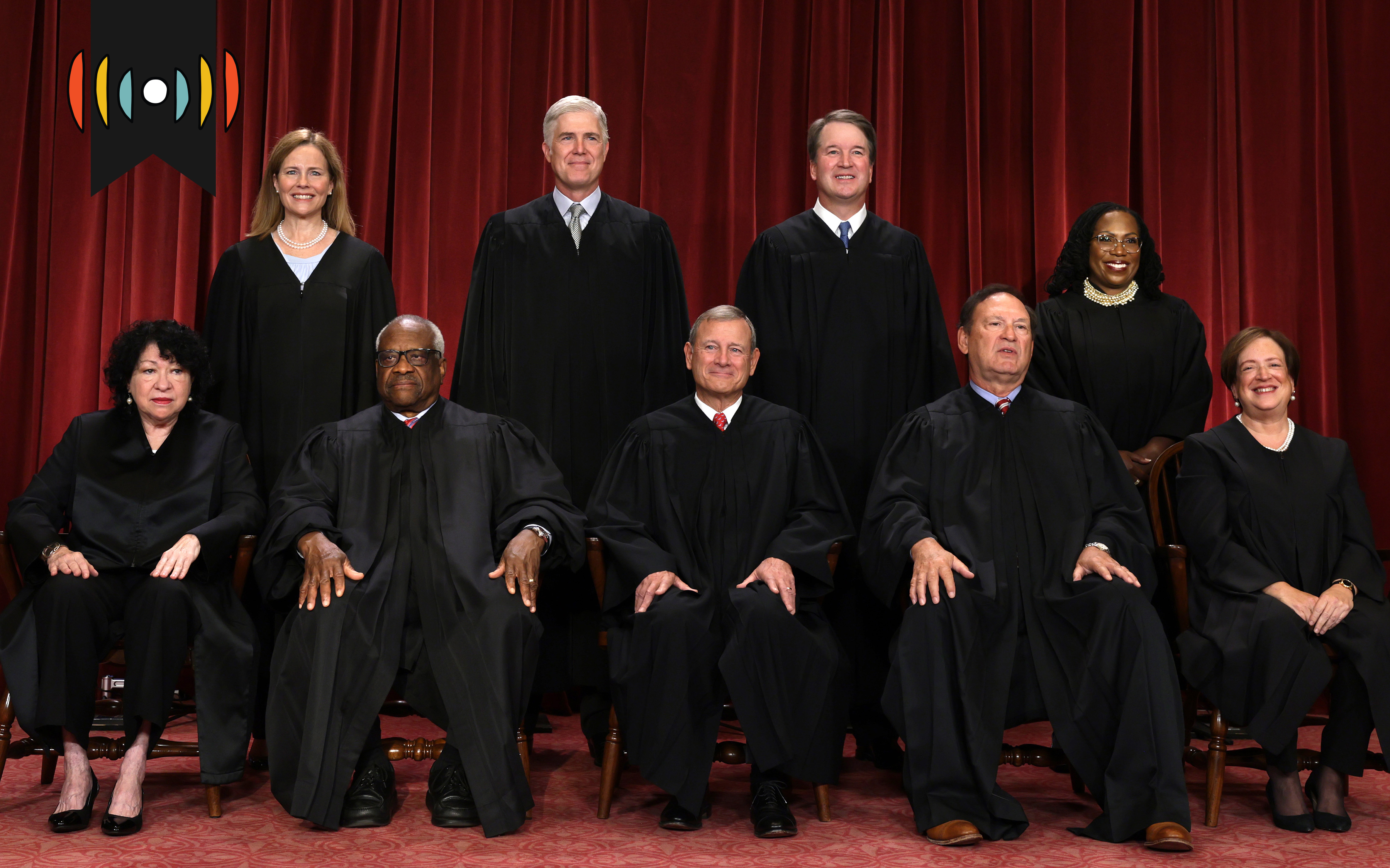
Official portrait of the United States Supreme Court Getty Images / Photo by Alex Wong
Editor's note: The following text is a transcript of a podcast story. To listen to the story, click on the arrow beneath the headline above.
NICK EICHER, HOST: It’s The World and Everything in It from WORLD Radio, celebrating 15 years. Today is October 5th, thanks for making us part of your morning routine. Good morning! I’m Nick Eicher.
MARY REICHARD, HOST: And I’m Mary Reichard. Time now for Legal Docket on this first Monday in October and we know what that means!
EICHER: The Supreme Court is back in session for a brand new term, hearing arguments starting today.
REICHARD: Yeah, the first Monday in October is always exciting. Now, the docket is far from full, as more cases will be accepted as we go along. But right now we have 29 cases set for argument.
EICHER: Out of about 60 or 70 we’ll eventually have.
So give us the lay of the land so far. What should we be watching?
REICHARD: Plenty. And to help with that let’s bring in legal beagles Steve West and Jenny Rough. Hi, all!
Fun to have us all together today!
Well, I think I’ll start with what’s going on this morning. The Court hears a case called Suncor Energy versus Boulder County.
The City of Boulder, Colorado and Boulder County sued oil companies, arguing they contributed to climate change, and therefore should help pay for the resulting costs.
STEVE WEST: What’s the oil companies defense?
REICHARD: The oil companies point out that Boulder is local, but climate change is global. It’s like the old smoking areas on an airplane. Smoke doesn’t stay put, and neither do greenhouse gas emissions. Those emissions waft across state and national lines.
So the legal question is: does federal law preempt state-law climate claims?
JENNY ROUGH: In other words, who gets to make the rules on climate policy.
REICHARD: That’s it. A question that comes up a lot at the high court.
Alright, let’s keep moving. Jenny, what’s on your radar?
ROUGH: Well, lots. There’s a big Second Amendment case about semiautomatic rifles. And there’s a Sixth Amendment case out of Florida that’s asking about the number of jury members required for a criminal felony trial.
Two significant immigration cases. The first is a statutory interpretation case, so a case that focuses on how to interpret and apply a federal law passed by Congress rather than interpreting and applying the Constitution.
REICHARD: That’s Rhoney versus Barbosa da Cunha.
ROUGH: Right. Ricardo Barbosa da Cunha is a citizen of Brazil who crossed the border illegally around 2004. And for the past 20 years, he’s lived in the States. In 2016, he applied for asylum, and he got a work permit. He owned a construction business. But federal agents took him into custody last year and placed him in a detention facility. Cunha argued that he was entitled to a bond hearing, meaning an immigration judge would decide whether he can be released from custody while awaiting his removal proceedings. You know, is he a flight risk? Does he have a criminal record? That kind of thing.
WEST: Curious as to what happened below?
ROUGH: Well, a lower court agreed. He got a bond hearing and was released. The government is now appealing.
There are two provisions of the Immigration and Nationality Act at play. Cunha says the applicable provision entitles him to a bond hearing—requires it. But the government relies on a different provision in the Act that does not require a bond hearing. The debate has created a messy circuit split.
REICHARD: And that’s a big deal because the decision here will affect tens of thousands of immigrants in detention facilities. Okay, what’s the second case?
ROUGH: The second immigration case is the Department of Homeland Security versus D.V.D. It deals with President Trump's policy to allow deportations to third countries. Meaning, deport noncitizens to a country they have no connection to.
WEST: Just a note here that normally, individuals are deported to their country of origin or citizenship. But not if there’s a risk of persecution or torture.
ROUGH: Exactly. Here, the removals to the alternate countries are happening fast, and in some cases to countries with a lot of instability and conflict, like Libya and South Sudan. The immigrants argue that under federal statutes and the due process clause, the government's actions are unlawful. They believe they’re entitled to notice of the removal and an opportunity to contest the removal if they fear harm from the third country. The government argues if it has “credible diplomatic assurances” that persecution won’t happen, the removals can proceed. The case was on the Supreme Court’s emergency docket. Just last week, the court lifted a lower court’s order putting a stop to the removals. And the Court also fast-tracked the case to the merits docket. The parties will fully argue it before the justices on December 9th.
REICHARD: Nice rundown, Jenny. Thank you.
Now let’s move on to Steve. What’s on your radar?
WEST: Well, the Supreme Court has said repeatedly that when the government makes a public benefit available, it generally cannot exclude an otherwise eligible participant simply because it’s religious.
And now Colorado is back before the Court in St. Mary Catholic Parish v Roy. I say “back” because that state has already been slapped down three times over hostility towards Christians — a baker, a web designer, a Christian counselor.
This time, the dispute is over preschool funding.
REICHARD: And this one involves another case that pits gay rights against religious liberty, I take it?
WEST: Right. Catholic schools require families that enroll to support and uphold Catholic teaching, but that teaching is at odds with state-supported views on marriage, sexuality, and gender. So the state says they can’t participate—a loss of $6000 per child for families. That means many low-income families cannot afford to send their kids to preschools that support their beliefs and values. So what happens here is significant for thousands of kids—as well as religious preschools and schools around the country.
ROUGH: So the next case, Jouppi v. Alaska, Steve, I understand this case has some personal significance for you, right?
WEST: It really does. For 34 years I prosecuted criminal and civil cases to seize and forfeit the ill-gotten gains of criminals and the instrumentalities of their crimes—most of it noncontroversial.
But this case is controversial. It asks when is a forfeiture of property so excessive it’s deemed unconstitutional. Here, the state forfeited a bush pilot’s airplane, valued at $92,000 because of a minor criminal offense, transporting beer to a dry village.
REICHARD: Right off the bat, that seems excessive. A six pack for a plane?
WEST: Yes, not good facts, but the state says, “Look. We have a very severe problem with alcoholism, and the social costs are great. We have to take serious measures to deal with it.” But the question for the court is to weigh the state’s interest and that of the owner. And that’s a tough question.
REICHARD: It is. What else, Steve?
WEST: Last week the court agreed to take up another case that deals with a 26-year-old federal law that protects religious land uses from restrictive zoning and land use laws. It’s called the Religious Land Use and Institutionalized Persons Act–RLUIPA–not one of the smoother-sounding acronyms. If a land use law substantially burdens religious exercise, then the government has to show a compelling interest.
REICHARD: So what happened here?
WEST: A Catholic organization in Kentucky, Missionaries of St. John, wanted to build a small prayer grotto on land it owns behind a century-old Catholic church.
Because the property is now in a residential district, it needed a permit. The city approved it, but a couple of neighbors challenged that decision.
A state trial court sided with the church but then the Kentucky Supreme Court ultimately reversed that on appeal.
ROUGH: Hmm. Can I just tell you guys that I really want to build an outdoor chapel on a property we own.
Why did the state court say no?
WEST: It said denying a permit didn’t substantially burden the group’s religious exercise because it could build a smaller grotto somewhere else on the property. The court called that a “mere inconvenience.”
It also reasoned that the group knew when it bought the property that a permit would be required and could be denied.
So the Supreme Court must decide how much of a burden on religious exercise is enough to count as a “substantial burden.” Lower courts are divided over that question.
ROUGH: Alright, thanks for that rundown, Steve.
Mary, let’s circle back to you. What else has caught your eye so far.
REICHARD: One is about video privacy in a case called Salazar versus Paramount Global.
Fun trivia: Back in 1987, a newspaper published Robert Bork’s private video-rental history. Bork’s Supreme Court confirmation hearing was such a contentious one; he wasn’t confirmed as you may recall.
Anyway, not one scandal arose from that list of 146 tapes Bork and his family rented, but still, that breach of privacy shocked people.
So the next year in 1988, Congress passed the Video Privacy Protection Act in response. It kept video tape service providers from knowingly disclosing info about their customers’ viewing habits without consent.
WEST: Blockbuster Video went the way of Tower Records, though.
REICHARD: Yes, but now we’re in the digital age. So the legal question is whether the Video Privacy Protection Act’s definition of “consumer” applies to all goods and services offered by a provider. That’s what the petitioner Salazar says, that he subscribed to a free newsletter and Meta shouldn’t have tracked his viewing history.
WEST: What else?
REICHARD: One dealing with the parent-child relationship. It’s called International Partners for Ethical Care v Ferguson. Washington state law lets a confused minor seeking sex-rejecting medical intervention who’s run away from home get state shelter, and get this: for up to 90 days without telling the minor’s parents!
ROUGH: Wow, so the parents have no idea where the child is?
REICHARD: No.
ROUGH: What is the legal question for the justices?
REICHARD: Well, the 9th circuit said parents had no standing to sue over this, so the Supreme Court will decide that they do or don’t have standing. It’s really a question of whether a law like that infringes on parents’ constitutional right to direct their own children’s upbringing.
ROUGH: Anything else?
REICHARD: Just one more for now- a case not yet accepted, but Texas was given an extension of time to file a response.
It’s another Ten Commandments dispute, Nathan v Alamo Heights Independent School District. Texas law requires every public school classroom to post the Ten Commandments.
The ACLU and some families allege Constitutional violations. Lots of wrinkles in this one, but I’ll save that for when I cover oral arguments!
So that’s it for now. Thanks, Jenny and Steve!
And that’s this week’s Legal Docket!
WORLD Radio transcripts are created on a rush deadline. This text may not be in its final form and may be updated or revised in the future. Accuracy and availability may vary. The authoritative record of WORLD Radio programming is the audio record.
Please wait while we load the latest comments...
Comments
Please register, subscribe, or log in to comment on this article.