
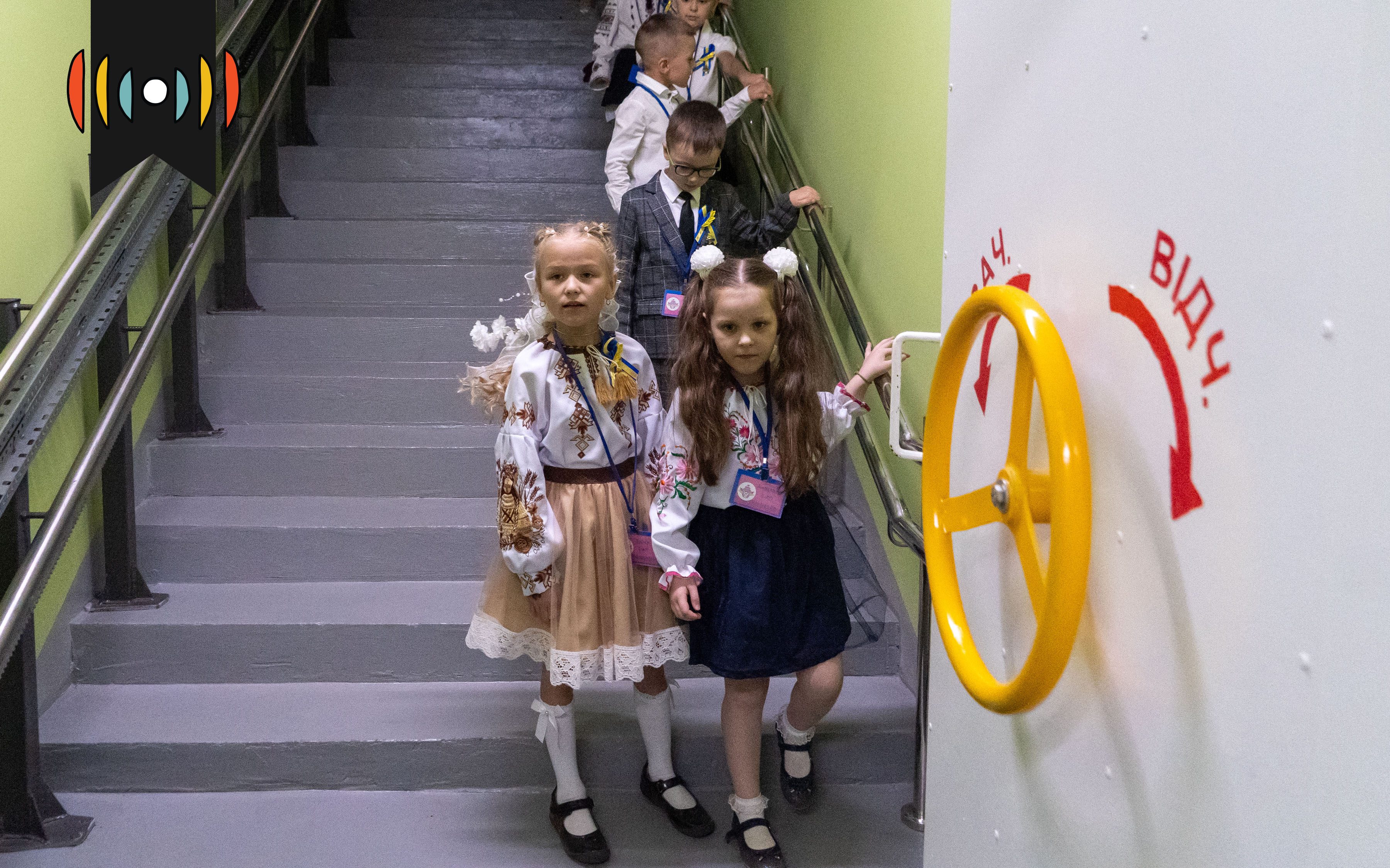
School children enter an underground school on their first day back, in Kharkiv, Ukraine, Sept. 1. Associated Press / Photo by Andrii Marienko
Editor's note: The following text is a transcript of a podcast story. To listen to the story, click on the arrow beneath the headline above.
NICK EICHER, HOST: There’s something new here every weekday morning. Today is Tuesday, September 8th. Glad to have you along for today’s edition of The World and Everything in It—now celebrating 15 years. Good morning, I’m Nick Eicher.
MARY REICHARD, HOST: And I’m Mary Reichard.
First up: Education in wartime.
More than three million children in Ukraine began a new school year last week. But for many of them, “back to school” does not mean back in a classroom.
COVID disrupted their schooling first.
EICHER: Then came Russia, and its full-scale military invasion. Now air-raid sirens, war damage, and continuing attacks have made this the fifth year in a row without anything resembling a normal school year.
WORLD correspondent William Fleeson has the story.
WILLIAM FLEESON: A days-long blitz on the capital, Kyiv, has kept air raid sirens crying out day and night.
NOVOSAD: And for millions of Ukrainian schoolchildren, it’s the fifth year of schooling, during which they will basically not go to school…
That’s Anna Novosad, co-founder and director of SavED, a large non-profit based in Kyiv. She served as Ukraine’s education minister between 2019 and 2020.
Novosad listed the many challenges that Ukrainian school kids, and their families, are up against.
NOVOSAD: For a lot of people, Ukraine might seem like a totally bombed country, and the question might arise, like, ‘Why don’t people leave? Why do we have to help with education? They have to get out of there!’ First of all, this is exactly what Russians want – us leaving.
Yet many Ukrainian parents link their children’s learning in Ukraine with learning to be Ukrainian. Teachers teach in the Ukrainian language, students study their country’s civics and history.
Novosad’s nonprofit seeks to support those who stay. SavED has built [one-hundred-sixty] classrooms since 2022… mostly in frontline zones.
Some are modular classrooms, built with pre-fabricated parts, and big enough to hold almost 200 students. Other projects include underground classrooms. The spaces are often small and uncomfortable, but safe from Russian rockets and drones.
Novosad stresses that the best learning happens in-person.
NOVOSAD: Everybody has been through COVID, on this planet, and those who have kids, they know how hard it is, to do the homeschooling, if it’s not your choice… And so, just imagine that it is year five, and multiply that by war, constant attacks… And the Russians know what they [are doing.]
The United Nations says July was the bloodiest month of child casualties in over four years. 17 children killed, and almost [one-hundred-seventy] injured. According to a Ukrainian government announcement this month, more than 5,000 schools have been damaged or destroyed since 2022. Another report, from PBS, called this Russia’s attempt to ‘bomb the future’ of Ukraine.
NOVOSAD: Attacks on schools, and obstruction of learning, is of course a big strategy of theirs.
Ukraine’s education ministry has responded with major pay bumps to try and keep teachers in classrooms.
Keeping schools open also supports families during the upheaval of war. Many Ukrainian mothers either have husbands at the front or are war widows. A recent SavED survey asked about their needs.
NOVOSAD: And they said, like, they have more time for themselves, they have more time for their other children, they have predominantly time to work – because, if your small child is sitting with you at home, or your two kids, then basically you have no time to work. And your economic ability [to earn an income] is restrained.
The missile alerts from the most recent round-the-clock blitz on Kyiv has resulted in further challenges for the return to school. Constant stress and low sleep make learning even harder.
NOVOSAD: Every day here is a roller coaster… You never know, like, if, in the morning, if the siren is still going, when you have to go to school, well, nobody goes to school, you have to wait until the siren is off. Then parents have to rush their kids to school, somehow get to work, at least in Kyiv, it’s a mess.
Despite the increased threats, Novosad urges rebuilding now – even if continued fighting might destroy that work.
NOVOSAD: There is no durable support that you can provide. Yeah, if you put in a modular school, yeah, it can be bombed, in a year. But – for a year – kids will go there.
With no end to the war in sight, she counts each move toward educated citizens … as a small victory.
Reporting for WORLD, I’m William Fleeson.
WORLD Radio transcripts are created on a rush deadline. This text may not be in its final form and may be updated or revised in the future. Accuracy and availability may vary. The authoritative record of WORLD Radio programming is the audio record.
Please wait while we load the latest comments...
Comments
Please register, subscribe, or log in to comment on this article.