
Home, but not free
María Corina Machado is back in Venezuela, but the old regime “still persists today,” says Venezuela expert Brian Fonseca. Her return may signal an opening for democracy. But can that opening last while the old regime’s power structure remains in place?
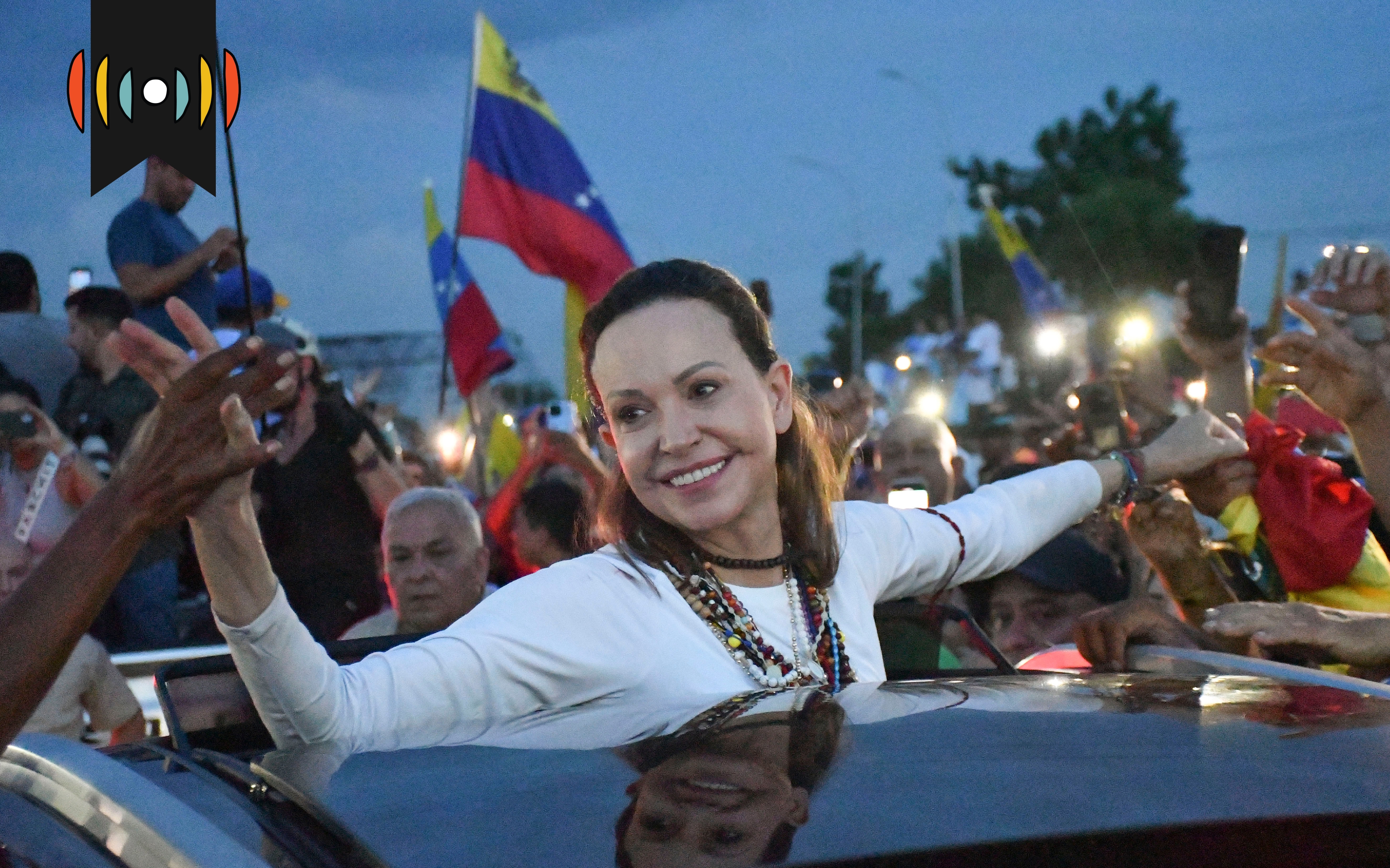
Maria Corina Machado greets supporters in Valencia, Venezuela, Sunday. Associated Press / Photo by Jacinto Oliveros
Editor's note: The following text is a transcript of a podcast story. To listen to the story, click on the arrow beneath the headline above.
LINDSAY MAST, HOST: It’s The World and Everything in It from WORLD Radio, celebrating 15 years. Today is Tuesday, the 27th of October.
Thanks for making us part of your morning routine. Good morning. I’m Lindsay Mast.
NICK EICHER, HOST: And I’m Nick Eicher. Up first:
SOUND: [Crowd chanting Maria, Maria!]
Venezuelan opposition leader Maria Corina Machado welcomed home this week.
She left the country in an undercover operation late last year, in order to receive the Nobel Peace Prize.
Machado returns to a country run by Delcy Rodríguez, who took over after US forces captured longtime dictator Nicolás Maduro in January. Rodríguez was Maduro’s V-P and now has the backing of the Trump administration.
Does Machado’s return signal more political change ahead?
MAST: Joining us now is Brian Fonseca. He's Vice Provost for Defense and National Security Research at Florida International University. His expertise is in Venezuela's military and security apparatus, including its role in regime stability and repression. Brian, good morning.
BRIAN FONSECA, GUEST: Hey, good morning. Thanks for having me.
MAST: Sure thing. Brian, I know you've been following the story. What did you think when you first heard the news of her return?
FONSECA: Well, I mean, I, there's a couple of things. I mean, first, I thought I mean this is largely symbolic. You know, there's, there's no real signs of major institutional changes in Venezuela right now. In other words, the regime that was in place before Maduro was was taken out of power in January still persists today. Delcy Rodriguez and Dios Estado Cabello and some of the other, you know, important figures of the regime are still very much in power and in place.
Again, the U.S. has has talked and and argued that you know there was a process towards democratization that was going to start with stabilization first, right? and then beyond stabilization, it was reconciliation and then sort of transition to democracy. And so I think it you know, not long after Maria Corina Machado landed, or it was announced rather, Secretary Rubio came out with a pretty bullish statement about, you know, the evolution of political transformation in Venezuela, which I thought was was insightful and may have made more sense of of her her visit to Venezuela.
MAST: I want to talk a little bit more about what this might mean for Washington's strategy in Venezuela. Of course, Machado gave President Trump her framed Nobel Peace Prize earlier this year. But he has focused very much on working with Vice President Delcy Rodriguez, said the country isn't ready for Machado to take control. So what where do you think stand with Washington? They're very bound up in what's going on in Venezuela right now.
FONSECA: I think what's, what's really interesting is when, when, when President Trump stood before the nation after Maduro was, was, was ousted by what was arguably, you know, one of the the the most you know successful in complex military operations, I think Rubio called it enhanced law enforcement, supported by military operations, in January of this year, he said that the United States was gonna run the country. I think what he was referring to is they were going to establish a political leverage by controlling much of the Venezuelan economy.
Oil right now is probably the most important element to the Venezuelan economy. And if the United States can control the checkbook when it relates to Venezuela's most important economic tool, then the then Washington would be able to influence political outcomes in Venezuela. And I think that's what this progression has been all about.
Maria Corina Machado and the opposition are pushing for political outcomes, which is a transition back to democracy. And so again, I don't know if the timing was intentional. It doesn't sound like from Rubio's tweet that this is something that was you know, done in in in sort of opposition to to the US government, US interest. the timing could be be interesting. But I think this is part of the natural progression where the United States wanted to stabilize Venezuela, and work on reconstruction and then transition back to democracy.
MAST: Yeah, I want to ask about that. You've been watching this. So I assume there were sort of indicators that you were looking for that might imply stability. So Machado comes back. It seems to be a surprise. Were those indicators in place or is this a chicken and egg sort of thing where instead of stability and then return, her return pushes towards stability?
FONSECA: Yeah, I mean, again, I I think there there has been a degree of stability. There's been rumors about elections being called for as early as next summer or the summer of 2028. but something has to predate that, right? And so I wouldn't be surprised if an announcement of elections comes out in the next couple of weeks, right?
And so I think again, while it's symbolic at this stage, it does symbolize that that space is is opening. Or else Maria Corina Machado wouldn't be in the country or she would have been arrested as soon as she landed. Now we want to see about her movement and and what she does in country to give us a little bit more understanding of the space in Venezuela. Does she have the latitude to move? Is she looking at mobilizing populations?
MAST: What else needs to happen though? I my understanding is that there are systemic undergirdings that do not bode well for Machado to lead, even if she has the public support. So what else needs to change on those fronts in order to have elections and then have successful rule post election?
FONSECA: That's a great question because the the the whole reason why I think Washington didn't immediately put the opposition back in power when Maduro was ousted and they had seemingly, you know, a heavy hand in in shaping the immediate outcomes was because I think there's this there still is a deep distrust between, you know, organizations like the Venezuelan military and Venezuelan intelligence and security services and the opposition. There's a deep distrust there.
And there was a concern, and I think it was a legitimate concern, that if the opposition were to come in power and look for retribution and look for revenge and and look to hold people accountable, that the country could spiral into some deeper civil conflict because the institutions that have the guns and the power are the ones that distrust the opposition to begin with.
And so you know what's interesting about Venezuela is Venezuela does have a historical memory of democracy. When Chavez came in and was elected in ninety nine, I mean there was a slow deterioration of democratic norms and process. He spent you know just over a decade eroding democratic institutions. And when Maduro took over, he accelerated that. And so I think what you have now is a lot of hollowed out democratic institutions that have been, you know, purged with loyalists by the regime and and and a lot of that has to be gutted out.
I think there's gonna be trade offs that have to happen between the opposition and the regime in order to begin plotting out a, you know, sort of an enduring path back to what what would be a hallmark of democratic society, which is elections, at the at the presidential level, that you know, both sides would convince the rest of the world that they'll be free and fair and that, you know, the the spoils will go to the victor and they will preside over the country going forward. I mean, I think that's all sort of in question, but I think it begins with institutional strengths and the institutions need to be recalibrated to embrace that transition back to democracy.
MAST: All right. Brian Fonseca is vice provost for defense and national security research at Florida International University. Brian, thank you so much.
FONSECA: Thank you.
WORLD Radio transcripts are created on a rush deadline. This text may not be in its final form and may be updated or revised in the future. Accuracy and availability may vary. The authoritative record of WORLD Radio programming is the audio record.
Please wait while we load the latest comments...
Comments
Please register, subscribe, or log in to comment on this article.