
Editor's note: The following text is a transcript of a podcast story. To listen to the story, click on the arrow beneath the headline above.
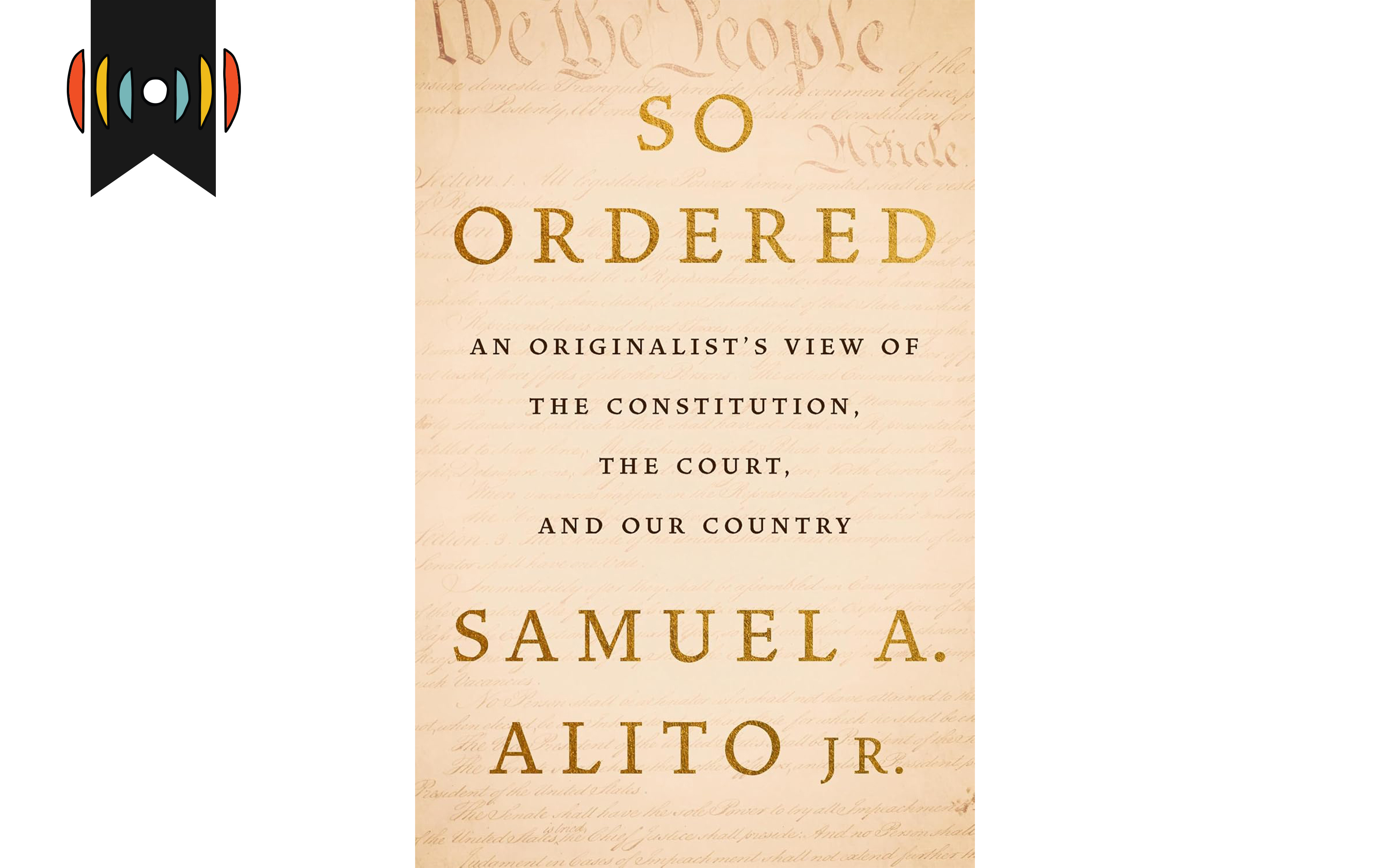
LINDSAY MAST, HOST: Coming up next, Supreme Court Justice Samuel Alito has a new book out today. It’s called So Ordered.
NICK EICHER, HOST: The book pulls together 19 speeches from Justice Alito’s years on the court—on judging, religious liberty, and threats to the Constitution.
Here’s WORLD Legal Affairs Correspondent Jenny Rough.
JENNY ROUGH: Justice Alito subtitled his book An Originalist's View of the Constitution, the Court, and Our Country.
Originalists believe the Constitution has a fixed meaning. Its words should be interpreted to mean what the terms were understood to mean when it was adopted. You can hear him apply it during oral argument in the 2021 case, Dobbs v Jackson Women’s Health Organization. It went on to overrule Roe v Wade.
JUSTICE SAMUEL ALITO: Let me ask you a couple questions about history. Did any state constitutional provision recognize that abortion was a right, liberty, or immunity in 1868 when the 14th Amendment was adopted? … Can it be said that the right to an abortion is deeply rooted in the history and traditions of the American people?
Earlier this week, Alito expanded on how that philosophy influenced Dobbs. Audio from Fox News:
ALITO: I thought it was perfectly clear that the reference to liberty in the 14th Amendment adopted in 1868 did not mean that there is a constitutional right to abortion. In 1986 abortion was illegal in most of the states.
Alito says the unprecedented breach that leaked an early draft of the decision made the majority justices a target for assassination.
Six of the book’s speeches fall under the role of judges. Here he is giving a 2010 talk called “Let Judges Be Judges”, pointing out that the U.S. Constitution is a lean document.
ALITO: If I were to read the entire text to you tonight, it would take about 30 minutes. … By contrast, if I were to read to you the unratified constitution of Europe, it would take 17 hours.
He says the brevity–especially on the judicial branch– means many aspects about the proper role of judges must be inferred.
ALITO: Article III says federal judges are to decide “cases and controversies,” but it doesn’t define those terms. … As originally ratified, the Constitution was largely mum on court procedures.
Still, that does not mean a judge’s role is to be a crowd-pleaser, a rubber stamp, or a reformer. The Constitution means something, as do statutes. The judge’s role is to apply the law as written.
Alito can trace the influence on some of his philosophies to his childhood.
Alito played and coached youth baseball. In one speech he compares judges to umpires. An umpire cannot call a strike because he wants to, he has to follow the rules the way judges must follow the law. But close calls are tough. Experience and discernment help. Alito admits AI will change a justice’s work, the way computers have changed line calls. And it’s leading to an emerging human right in the law: the right to a human decision.
He also speaks of his admiration for the craftsmanship of Judge Learned Hand, as well as Hand’s warnings about the need for a love of liberty. And speaking of liberty, the chapter I couldn’t wait to read? “The Pandemic Stress Test for Constitutional Rights.” It’s from a speech Alito gave in 2020, over the internet, because COVID had shut down some gatherings but not others. Audio again from Fox:
ALITO: And so people came back to Las Vegas, and there were pictures of them in the casinos, and they were not wearing masks, not all of them were wearing masks. But at the same time the state had a very severe limit on the number of people who could attend a house of worship no matter how big that house of worship was.
Justice Alito has become known for his opinions protecting freedom of religion.
Alito dedicated his book to his wife, Martha-Ann. After they began dating, they realized they’d met years earlier. Sort of.
The story goes like this: Martha-Ann had come to D.C. to watch Alito argue a case. She sat next to his parents who told her Alito and his sister were the only girl-boy debate team in South New Jersey back in the day. Here’s Martha-Ann:
MARTHA-ANN ALITO: At which point, I nearly fell on the floor. Because when I was a freshman in high school—
—a girl-boy debate team visited her school. The boy was cute. Twenty five years later, she asked about that day.
MARTHA-ANN: And I said, Sam, did you have a green wool jacket in high school? And he said to me, yeah! I said, And did your team debate at my high school? … He goes, yes. … I said was that May 1968 when you were a senior? And he said, yes.
…
ROUGH: And you thought he was cute way back then?
MARTHA-ANN: I did. I did.
The book does a wonderful job of bringing out his sense of humor, a subtlety that occasionally shows up on the bench. Here he is poking fun at one of the problems of originalism in a case about the First Amendment and modern technologies.
ALITO: Well, I think what Justice Scalia wants to know is what James Madison thought about video games. [Laughter] Did he enjoy them?
Alito is 76 years old. He says he’s at an age where he thinks about retiring every year. But for the 2026-27 term that started yesterday, he decided to stay.
Reporting for WORLD, I’m Jenny Rough.
WORLD Radio transcripts are created on a rush deadline. This text may not be in its final form and may be updated or revised in the future. Accuracy and availability may vary. The authoritative record of WORLD Radio programming is the audio record.
Please wait while we load the latest comments...
Comments
Please register, subscribe, or log in to comment on this article.