
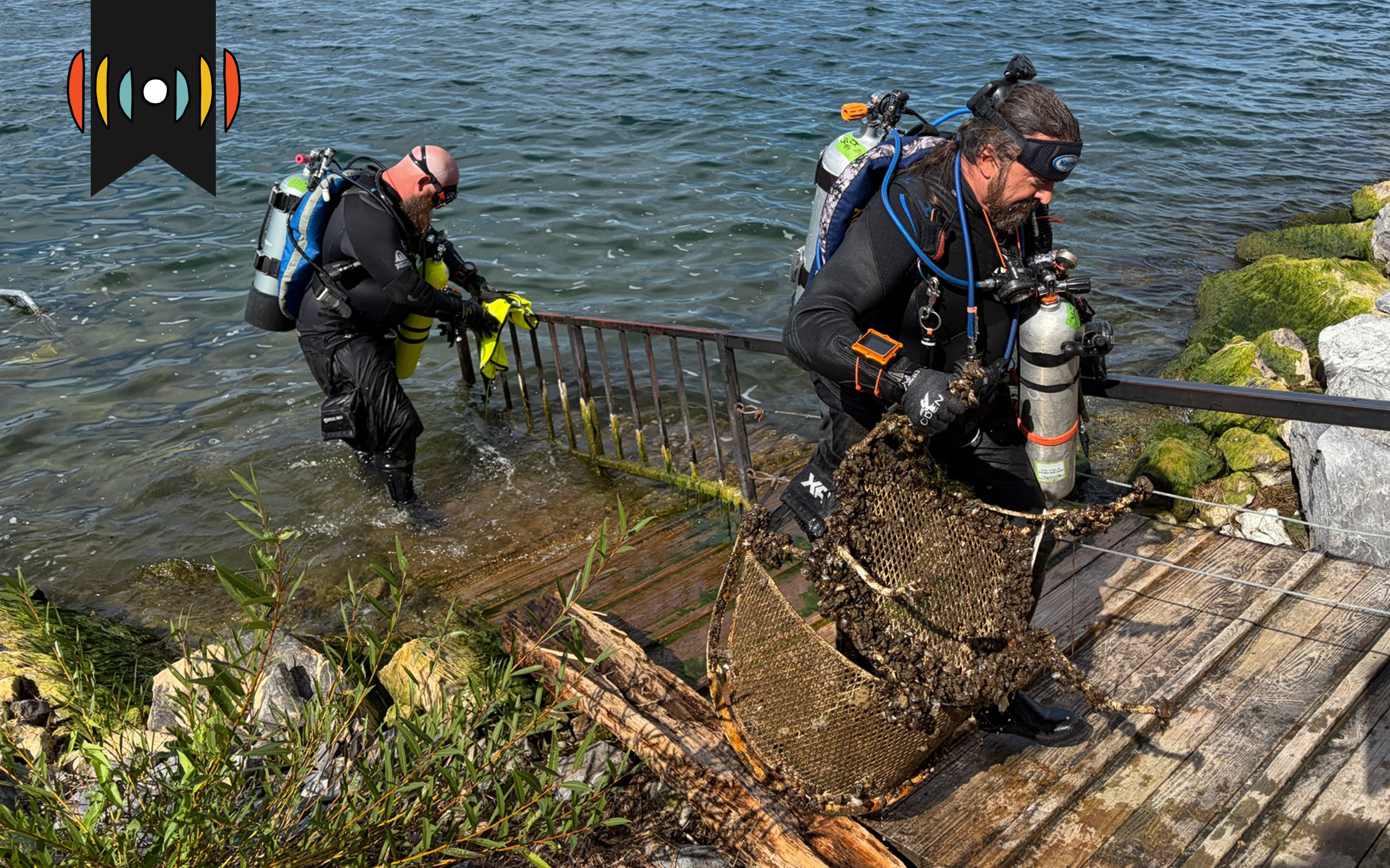
Divers Todd Keister and Jed Sheehan clear trash from the St. Lawrence River. Photo by Grace Snell
Editor's note: The following text is a transcript of a podcast story. To listen to the story, click on the arrow beneath the headline above.
NICK EICHER, HOST: Today is Tuesday, October 13th.
Thank you for turning to WORLD Radio to help start your day.
Good morning. I’m Nick Eicher.
MYRNA BROWN, HOST: And I’m Myrna Brown.
Coming next on The World and Everything in It: History beneath the surface.
The St. Lawrence River has been a busy shipping route for centuries. And hundreds of shipwrecks lie along its bottom—some dating back to the 1700s.
EICHER: Now one diver is working both to preserve that history, and protect the river itself.
WORLD’s Grace Snell reports
GRACE SNELL: A group of men in wetsuits wade into the St. Lawrence River.
DIVER 1: They say the visibility’s top notch, huh? [Laughing]
DIVER 2: Not today. Not today. Normally it is…
They’ve got goggles on their heads, flippers on their feet, and oxygen tanks on their backs.
SOUND: [Air hissing from oxygen tanks…waves lapping]
They test their scuba gear…
SOUND: [Waves crashing]
Then disappear under the waves.
This is a unique spot for divers. New York’s Thousand Islands Region is a massive freshwater archipelago. True to its name, there are over a thousand islands here.
KEISTER: I’m not aware of anything quite like it anywhere in the world.
Todd Keister is a retired police captain and scuba diving instructor. He says the river isn’t exactly what people think of when they hear the word “scuba.”
KEISTER: All the colorful fish and the corals and things like that. We don’t have any of those things here.
But, there is one thing the St. Lawrence has in abundance: Shipwrecks.
There are hundreds of them here. The Roy A. Jodrey, the Sir Robert Peel, the A.E. Vickery, and the Keystorm, to name a few.
The wreck of the Iroquoise dates back to the 1760s. Others sank as recently as the 1970s.
KEISTER: They sort of tell a story, too, of the transition from sail to steam to diesel power…
The river is a time capsule of it all.
KEISTER: You never know what you’re going to find at the bottom of the river. Almost every dive, somebody comes up with a whiskey bottle from the Civil War or some weird relic.
Keister is working hard to keep it that way.
AUDIO: [Keister giving instructions]
Earlier this year, he launched the Thousand Islands Divers Alliance. It’s a nonprofit focused on protecting the river’s ecology and promoting scuba diving.
Keister says he feels like a docent at a living museum…documenting and protecting the region’s underwater history.
KEISTER: There’s only so much that can be done to preserve a shipwreck, of course. We’re not going to have divers go down and try to reinforce or reassemble wrecks that are falling apart or anything like that…
But, Keister does want to make sure the wrecks are protected from damage caused by human carelessness. So, he helps add and maintain mooring lines.
KEISTER: A mooring line is simply a large block that’s placed at the bottom of the river. Boats can come and attach, and then dive the site, and this prevents dive boats, or others, from throwing anchors overboard that could impact the wreck.
Keister also documents underwater sites with a nonprofit called Project Baseline. They upload information and images of the wrecks for researchers and students.
KEISTER: People who are interested in these sorts of things can understand the effects of water and temperature, and what type of fish species actually use these wrecks as artificial reefs…
Keister leads river cleanups to help keep the water safe and clear for divers.
KEISTER: Unfortunately, back in the ’40s, ’50s, ’60s, the way to get rid of trash for a lot of people was just simply to throw it in the river, thinking it wasn’t going to do any harm.
Over the summer, Keister and a team of about 30 divers cleared out almost 900 pounds of trash.
They found tires, a vacuum cleaner, a toilet and piles of PVC pipe.
KEISTER: I’ll bring the lift bags. And I think that’s all we need. We’ll go out and do it. Make some magic.
SHEEHAN: I like it.
Today, Keister and another diver, Jed Sheehan, are back to clear out a few more heavy items. They use special nylon balloons called lift bags to help float objects along.
But, they have to adjust the air as they go. Otherwise, changes in water pressure can send the balloon shooting to the surface. That can be dangerous in deeper waters.
KEISTER: There’s always the concern of getting entangled in whatever it is you’re trying to lift and getting yanked to the surface, which can cause serious internal injuries for divers, the decompression sickness, or the bends, that most people are aware of.
AUDIO: Want me to grab the chair? [Sound of creaking]
Keister and Sheehan haul out a tire and a metal patio chair caked in clams.
SHEEHAN: I might take that home… [laughing]
By the end, they’ve dredged up a lengthy section of PVC pipe, another tire, and two unrecognizable chunks of rusty metal.
KEISTER: That’s it for today…
Their mesh swim bags are filled with assorted debris.
PASSERBY: Woah, nice job guys.
KEISTER: Oh, thanks…I didn’t think it was that long.
As they work, passersby cast curious glances at the men in their dive gear. That reminds Keister of his role as a guide of sorts.
KEISTER: You’re all dressed up in your scuba gear, and everybody stops and wants to know what you’re looking for or why you’re diving…
For Keister, it’s all part of getting the word out about the local dive scene and keeping the river beautiful for the next 300 years of history.
Reporting for WORLD, I’m Grace Snell in Alexandria Bay, New York.
WORLD Radio transcripts are created on a rush deadline. This text may not be in its final form and may be updated or revised in the future. Accuracy and availability may vary. The authoritative record of WORLD Radio programming is the audio record.
Please wait while we load the latest comments...
Comments
Please register, subscribe, or log in to comment on this article.