
Cuba remembered: Before the myths take hold
Six in ten Americans under 30 say they’d give socialism a shot. But Cuban refugee Carmen Agra Deedy tells schoolchildren what followed the revolution: “Within days food began to disappear. People began to disappear.” WORLD’s Myrna Brown reports.
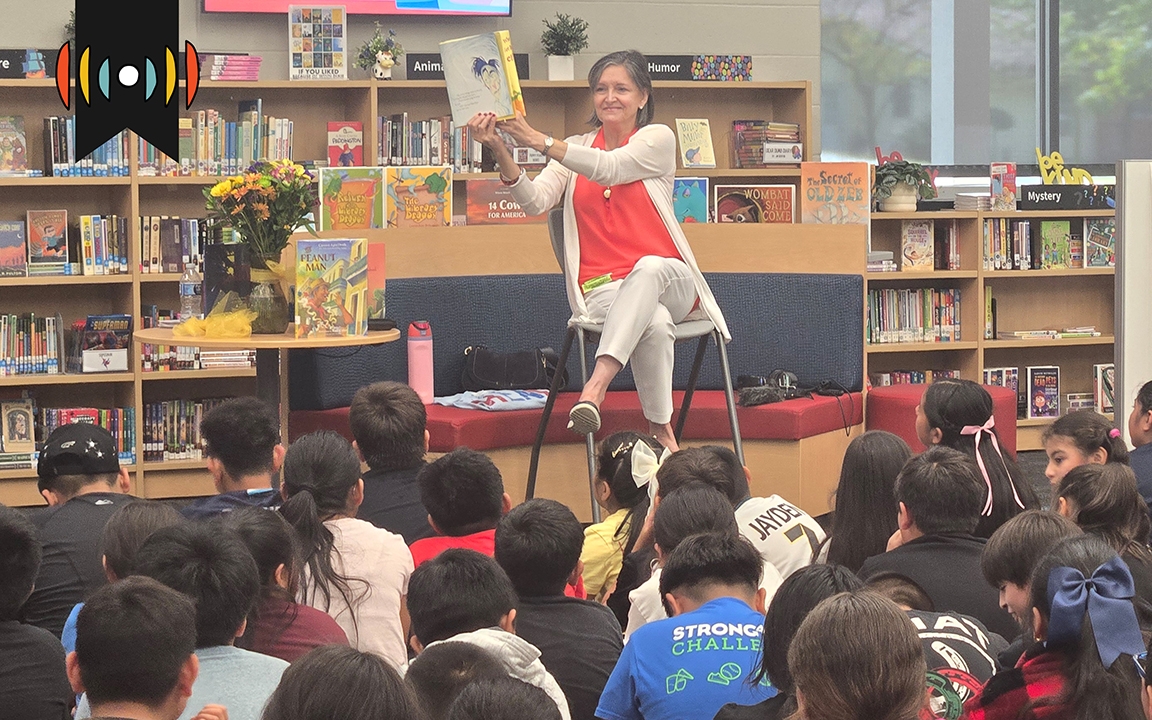
Author Carmen Agra Deedy tells a room full of students about coming to America from communist Cuba. Photo by Myrna Brown
Editor's note: The following text is a transcript of a podcast story. To listen to the story, click on the arrow beneath the headline above.
MARY REICHARD, HOST: Coming next on The WORLD And Everything in It: Correcting the record!
Six out of ten people in this country under the age of 30 say they’re willing to give socialism a shot.
MYRNA BROWN, HOST: A survey conducted last year, also shows a third of Americans under 30 say they like communism, too.
What’s the story behind this worldview and what do we do about it?
AUDIO: And you see in the paintings we have here…
Eric Patterson stands in the Victims of Communism Museum, pointing to a collection of paintings of emaciated prisoners. They’d been forced to mine uranium in a Siberian work camp in the 1950s.
ERIC PATTERSON: And just two days ago we had eighth graders here…90 eighth graders and one of the girls asked me. Isn’t uranium toxic? She’s only twelve or something. Will they die from this? So it had caught her attention.
As the head of the Victims of Communism Memorial Foundation, he knows a lot about men, women and children murdered by communism.
PATTERSON: One question I often get is simply, Well, isn’t socialism a good set of ideas and it’s kind of warped by communism? That is really not what it is. Socialism is the first step. It is state control of everything financial and economic. And then the second step is control of everything, including what you think. That’s what communism is.
Congress unanimously created the foundation in 1993–not long after the end of the Cold War. But Patterson says many have still forgotten the lessons from that time.
PATTERSON: So, as a nation of immigrants we haven’t done a very good job of transmitting to the next generation or two generations ahead just what so many of these grandparents went through in a place like Hungary and fleeing to the west or Czechoslovakia fleeing the Prague Spring in 1968 or Vietnam.
That leaves many surprised at how the majority of young people have become attracted to communism. But Patterson says we’ve raised a generation of what he calls practical socialists. Many today don’t have to pay for their phone, car, education or healthcare.
PATTERSON: And that is a very different coming of age than previous comings of age where we expected someone to get a part time job in high school, buy their first bike, help pay for their first car. And so it’s not a surprise when they’re 22, 24 or 26 for them to say, whoa, whoa, whoa…. these things have been provided in the past. You’re the one breaking the social contract.
Patterson also points to shifts in public education over the last two decades.
PATTERSON: Younger people have been taught, America is a story of imperialism. But they don’t really tell against who. America is a story of domination. Look at that big military. But they don’t tell that we liberated Europe, World War I, World War II, or the Cold War. So a real effort for us is to correct the record.
Author Carmen Agra Deedy doing her part to set the record straight.
AUDIO: When I show you the page, kekekeke……..
She’s written multiple children’s books and is telling a room full of fourth and fifth graders about coming to America from communist Cuba as a refugee.
CARMEN AGRA DEEDY: And if you never see the sun again, snarled the mayor. And he ran for a blanket to cover the rooster’s cage.
I may sing a darker song, the brave Gauito called after him, but I. Will. Sing. And he did…kekekekeke
STUDENT: What was the reason you wrote the Rooster Who Would Not Be Quiet?
AGRA DEEDY: When I was a little girl there was a revolution. And it became a communist country and when that happened things changed very quickly and within days food began to disappear. People began to disappear and that’s when it got scary for my mom and dad. Because if you did not agree, you weren’t just left alone. You didn’t just lose your job. You might disappear all together.
Patterson says the rooster is an analogy of the communism that has decimated Cuba. He says the same ideas now threaten Gen Z and the generations to come.
PATTERSON: We’ll do them a disservice if we don’t cultivate from a young age a sense of compassion and responsibility for the neglected and the vulnerable. And there’s no one more vulnerable than those who are in the clutches of a totalitarian regime.
Or those flirting with one.
AUDIO: No loud singing at home…no loud singing…no singing. Wow..until finally the noisy village of LaPas was as silent as a tomb.
WORLD Radio transcripts are created on a rush deadline. This text may not be in its final form and may be updated or revised in the future. Accuracy and availability may vary. The authoritative record of WORLD Radio programming is the audio record.
Please wait while we load the latest comments...
Comments
Please register, subscribe, or log in to comment on this article.