
Buried for safekeeping
WORLD History Book: A flash flood covered King Tut’s tomb in debris that hardened like concrete, hiding it from looters for thousands of years. Then Howard Carter peered through a hole in the doorway and saw “wonderful things.” WORLD’s Emma Eicher tells the story of a discovery that captured the world’s imagination.
Howard Carter opens the innermost shrine of King Tutankhamun's tomb near Luxor, Egypt. Wikimedia Commons / The New York Times photo archive
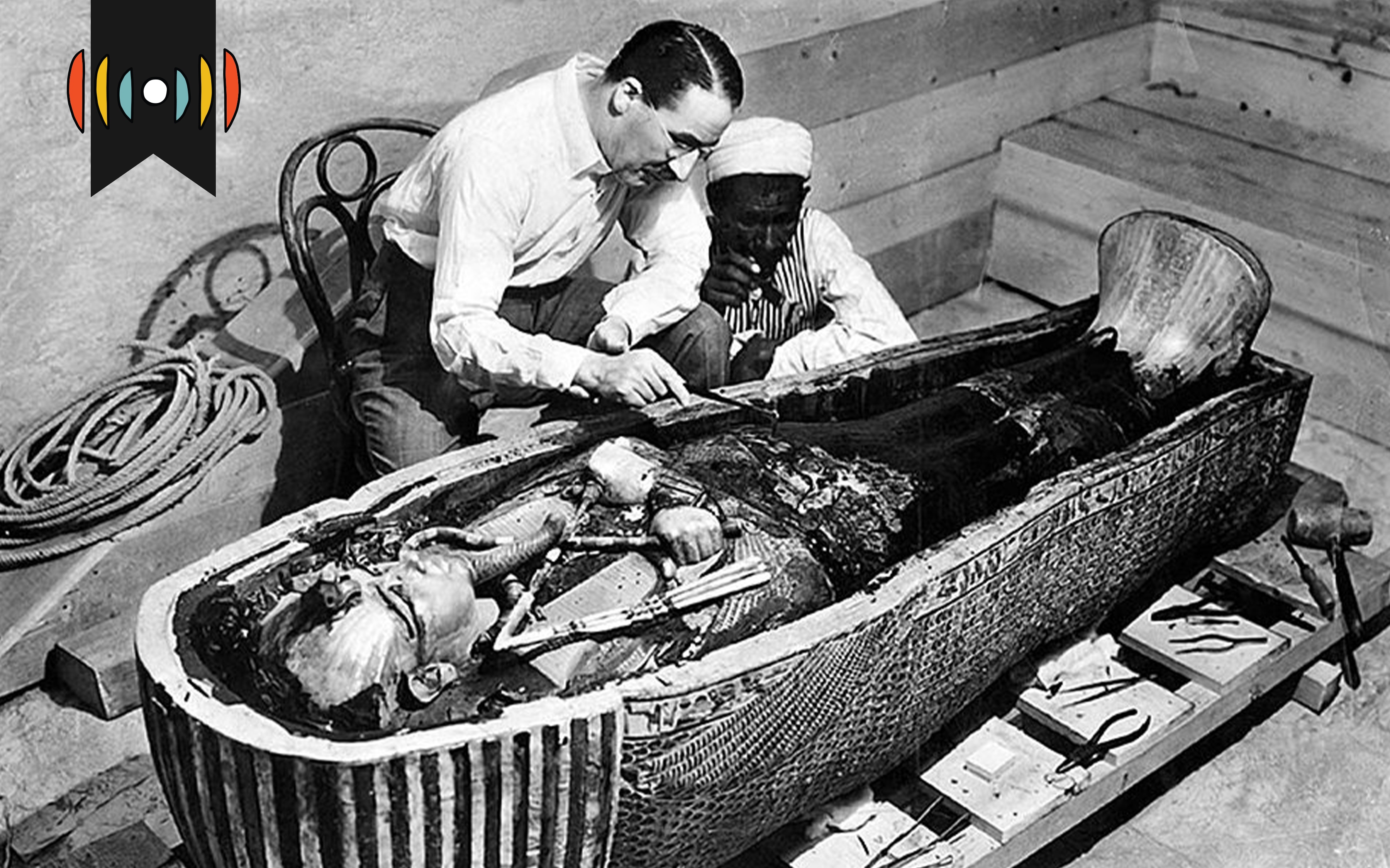
Editor's note: The following text is a transcript of a podcast story. To listen to the story, click on the arrow beneath the headline above.
NICK EICHER, HOST: Good morning! This is The World and Everything in It from listener-supported WORLD Radio. I’m Nick Eicher.
MARY REICHARD, HOST: And I’m Mary Reichard. Up next, the World History Book.
This week marks the anniversary of one of the most remarkable archaeological discoveries of the 20th century.
WORLD’s Emma Eicher has the story.
EMMA EICHER: It was November 4th, 1922, when archaeologist Howard Carter made the discovery of a lifetime. He was digging in Egypt’s Valley of the Kings—where ancient pharaohs were buried.
Carter recalled his initial feelings in this 1936 interview with BBC Radio:
HOWARD CARTER: I suppose most excavators would confess to a feeling of awe, almost embarrassment, when they break into a tomb closed and sealed by pious hands so many centuries ago.
Carter hadn’t found just any grave—it was the intact tomb of the boy king, Tutankhamun.
AIDAN DODSON: Tutankhamun was a king of Egypt who ruled during the 14th century B.C. …
That’s Aidan Dodson, professor of Egyptology at the University of Bristol. He says Tutankhamun became pharaoh at only 9 years old, and died at 18 or 19. When Carter found the grave—a little more than three thousand years later—it was the only one belonging to a pharaoh that hadn’t been robbed.
Dodson says that was because of a fortunate accident.
DODSON: They had cut the tomb very very deep in the valley, and flooding, which took place not long after the burial, had completely obliterated the tomb, so it was buried under meters of debris, most of which was solidified like concrete.
Carter and his sponsor, Lord Carnarvon, had been excavating in the Valley of the Kings for years without much success. Working from a list of pharaohs buried here, they knew Tutankhamun had never been found. So they decided to dig in an untouched area of the Valley.
DODSON: They found a step cut in the rock, and it was fairly clear, given all the layers which had been above it, that it hadn't been touched since at least about 1100 BC.
But it would be weeks before Carter would see what was underneath the layers. Carnarvon was in the U.K. at the time and Carter had to send for him. He finally arrived with his daughter and they started exploring.
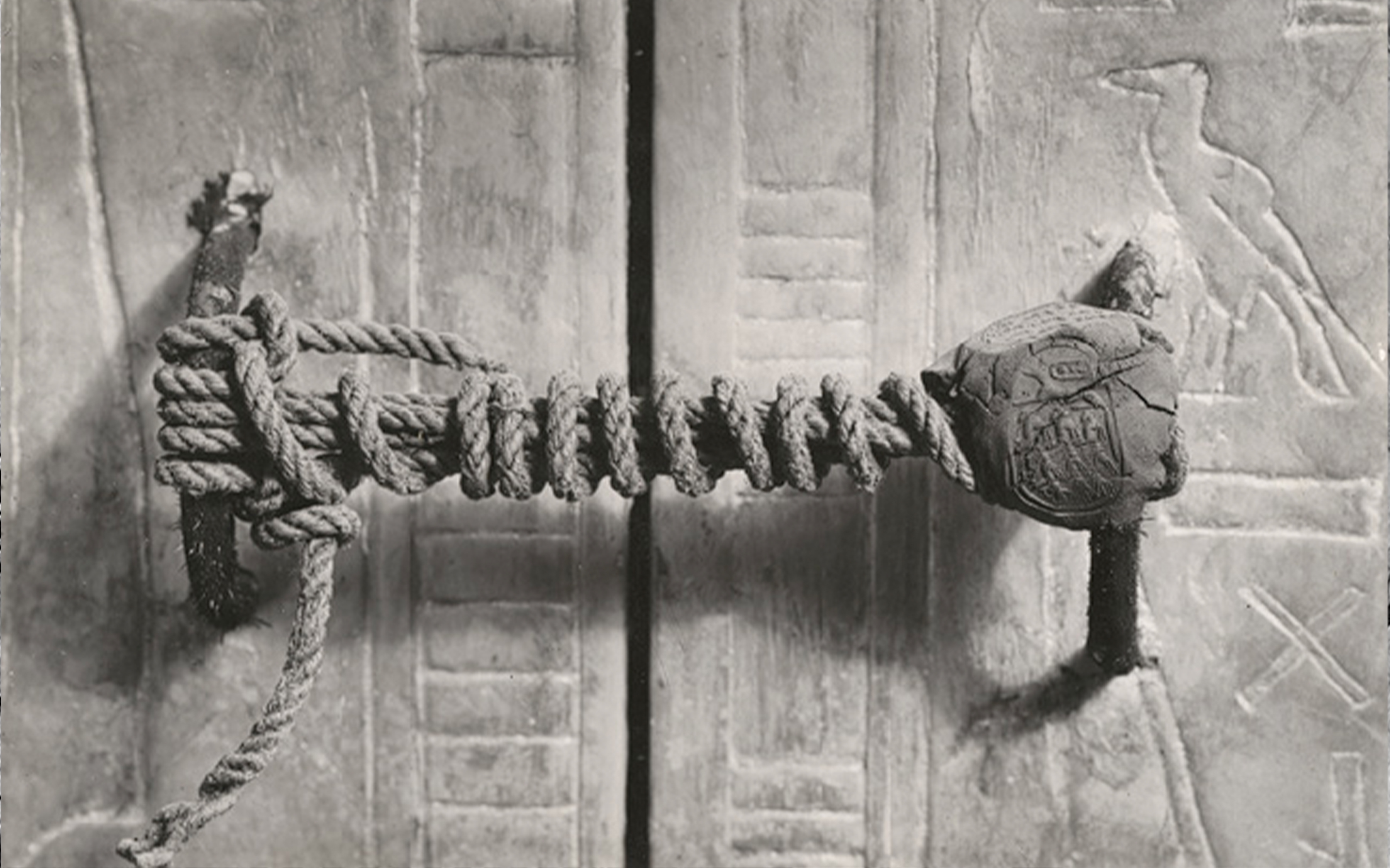
Unbroken Seal on the Third Shrine of Tutankhamun's tomb, November 1922 Wikimedia Commons / Harry Burton / The Metropolitan Museum of Art
They found that the outermost door had been broken and resealed. Dodson says modern experts theorize that robbers had gotten into the first room, then were caught in the act.
DODSON: The resealing shows that the police clearly had caught them at it. And it looks like probably within a fairly short time of that being done is when one of these flash floods happens.
Carter made a small hole in the second doorway to the rest of the crypt. He put a candle through it to see the other side:
DODSON: His eyes get accustomed to the light … he starts seeing glitters of gold …
Behind him, Carnarvon asked, “Can you see anything?”
DODSON: … He says, ‘Wonderful things.’
Carter’s team set to work. They carefully numbered, catalogued, and photographed each of the 5000 artifacts.
In 1924, Carter finally approached Tutankhamun’s sarcophagus.
CARTER: In a dead silence the huge lid, weighing over a ton and a quarter, was raised from its bed. Light shot into the sarcophagus …
He was disappointed to see only linen shrouds. But after the team had unwrapped them.
CARTER: A gospel wonderment escaped our lips! So gorgeous was the sight that met our eyes. A golden effigy of the young king of magnificent workmanship filled the whole of the interior. This was but the lid of a series of three coffins, nested one within the other, enclosing the mortal remains of the young King Tutankhamun.
The discovery shook the world—because at that point, no one had ever found such a well-preserved tomb of a pharaoh. A time of so-called Eygptomania fell over the West.
DODSON: Egypt was probably more in people's faces than it's ever been before or since, and it influences art. It influences literature, it influences fashion to some degree …
And it launched theories of the pharaoh’s curse … a legend that disturbing a tomb or mummy would bring bad luck, disease, and even death.
Lord Carnarvon’s untimely passing early into excavations kicked off that superstition.
DODSON: He had been bitten on the face by a mosquito. You just don't shave for a couple of days and wait for it to heal. Unfortunately, being an earl, you know earls don't wander around unshaven. So he shaved, took the top off it, it got infected, and he died.
A journalist at the British newspaper The Daily Mail also started spreading unfounded rumors of people dying because of the curse. And it stuck.
DODSON: Here we are, you know, over over 100 years later, still talking about the curse, which you know never existed, but it's taken its own existence.
It took a decade for Carter and his team to fully excavate the tomb. Many of the artifacts were first displayed at the Egyptian Museum in Cairo. International tours later traveled the globe with some of the treasures.
Last year, the Grand Egyptian Museum in Giza brought the entire collection of artifacts together for the first time in roughly a century.
Dodson says the discovery was celebrated in both academia and culture, and that helped its popularity to endure.
DODSON: There's sort of the academic side about what it actually has revealed. Beyond that, though, the tomb and its treasures are a way for people to access ancient Egypt. I don't think anybody has sort of captured the international imagination, the way that Tutankhamun and his tomb have done.
About half of the royal tombs in the Valley of the Kings remain undiscovered, while archaeologists continue their efforts to find them.
That’s this week’s WORLD History Book. I’m Emma Eicher.
WORLD Radio transcripts are created on a rush deadline. This text may not be in its final form and may be updated or revised in the future. Accuracy and availability may vary. The authoritative record of WORLD Radio programming is the audio record.
Please wait while we load the latest comments...
Comments
Please register, subscribe, or log in to comment on this article.