
Always renewed, never permanent
The Hyde Amendment has lived a precarious existence—surviving the congressional sausage-making process for half a century. WORLD’s Harrison Watters explains why one of Washington’s longest-running pro-life policies still has to survive one spending bill at a time.
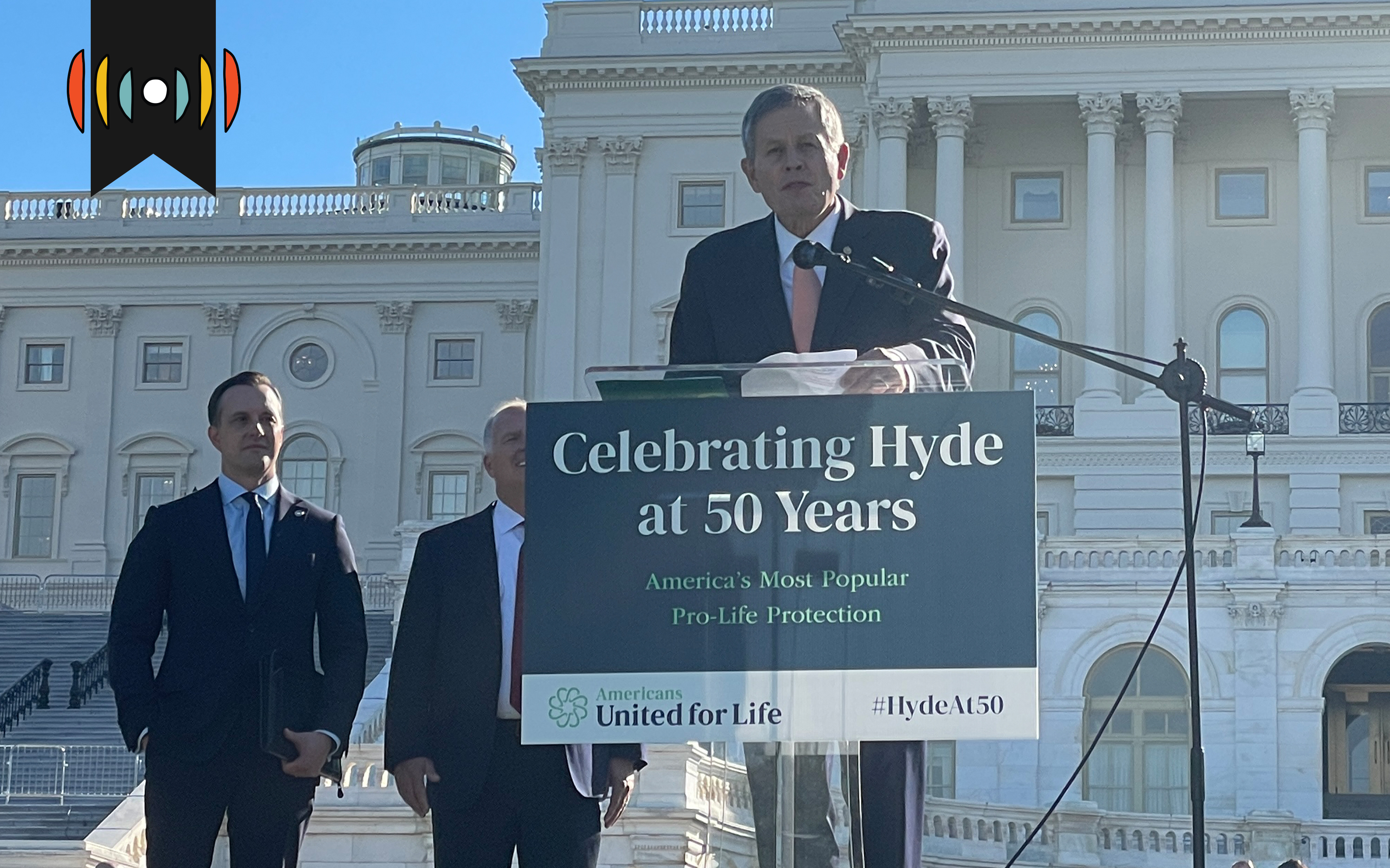
Senator Steve Daines speaks at a press event celebrating the Hyde Amendment. Photo by Harrison Watters
Editor's note: The following text is a transcript of a podcast story. To listen to the story, click on the arrow beneath the headline above.
MARY REICHARD, HOST: Up next, a pro-life policy turns fifty.
It’s called the Hyde Amendment. For half a century, Congress has renewed it through annual spending bills, restricting federal funding for abortion.
LINDSAY MAST, HOST: Pro-life lawmakers count it among their most important measures ever passed. But while it once had bipartisan support, WORLD's Harrison Watters reports it now has almost none among Democrats.
HARRISON WATTERS: In 1976, Illinois Congressman Henry Hyde argued taxpayers should not be forced to pay for abortion. Many lawmakers on both sides of the aisle saw it the same way, and the so-called Hyde Amendment was born.
It bars government agencies and programs like Medicaid from paying to end life in the womb.
When New Jersey Congressman Chris Smith came to the Capital five years later, Henry Hyde gave him a challenge.
SMITH: He spoke to incoming classes and said, If you don't stand up for your core values, and you don't know what your core values are, you're going to do great damage in the Congress.
One of Hyde’s core values was defending life in the womb.
SMITH: Matthew 25, Whatever you do to the least of these, you do likewise to me. He saw in the unborn child the least of these.
While the Hyde Amendment initially had wide bipartisan support, it faced four years of legal battles and ended up before the Supreme Court. Attorney Rhonda Copelon argued it hindered Medicaid coverage.
RHONDA COPELON: …but for the Hyde Amendment, it would cover abortions as a mandatory medically necessary service.
1980 saw a record abortion rate of one for every three live births. That changed dramatically after Supreme Court justices voted 5-to-4 to uphold the amendment.
NEW: Between 1980 and 2017, we cut the abortion rate in half in this country.
Michael New is a PhD researcher with the Charlotte Lozier Institute. He says the policy helped save tens of thousands of unborn children each year.
And the institute estimates that it has saved as many as 2.6 million lives since 1980.
But the Hyde Amendment isn't permanent law. Congress has to renew it every year in its spending bills, and every year, the fight starts over. Congressman Smith:
SMITH: It is under attack every year for 50 years.
In 1993, Democrat President Bill Clinton promised abortion would be safe, legal, and rare. Congressman Hyde pushed back.
HYDE: Well, you can make it legal, I guess. You can't make it safe for the unborn, it's terminal for the unborn. And rare? Not if you subsidize it. You're going to get a million more abortions.
Democrats also tried changing the amendment to give women an exception if they faced a health risk.
HYDE: If you're emotionally distraught, your health is affected, and therefore it is no restriction whatsoever. It is the one loophole that permits abortion on demand once the health factor is entered into the legislation.
Hyde and pro-life colleagues successfully defended the policy, even while other rules like a ban on fetal tissue research fell away. But the bipartisan support dwindled.
SMITH: We had at least 80 pro-life Democrats in the House when I got elected in 1980. Unfortunately, we're down to none.
In 2019, then Senator Joe Biden changed his position on Hyde, to run for president.
BIDEN: If I believe healthcare is a right, as I do, I can no longer support an amendment that makes that right dependent on someone’s zip code.
Smith says the Biden administration came close to ending the Hyde amendment.
SMITH: And it was only the filibuster that saved this over on the Senate side because the appropriations bills would not move forward unless these pro-life prohibitions were included in the bill.
The Hyde Amendment survived. But it only covers federal money so some states now pay for abortions with their own tax dollars. Here's researcher Michael New:
NEW: In the past 10 years, seven state Medicaid programs have started to cover abortion.
Today, about twenty states pay for abortions with their own tax money, tens of millions of dollars a year.
Henry Hyde died in office in 2007, fifteen years before Roe v. Wade was overturned. About half of the states now protect the unborn early in pregnancy, while others have loosened restrictions up to the moment of birth.
Congressman Smith is now one of the longest serving members of Congress, and he’s spent years trying to make the Hyde Amendment permanent.
SMITH: It has passed the House four times…always dies in the Senate, sadly.
Smith warns that Hyde is only one spending bill away from disappearing, and if it does, taxpayers could end up paying for millions more abortions.
Reporting for WORLD, I’m Harrison Watters in Washington.
WORLD Radio transcripts are created on a rush deadline. This text may not be in its final form and may be updated or revised in the future. Accuracy and availability may vary. The authoritative record of WORLD Radio programming is the audio record.
Please wait while we load the latest comments...
Comments
Please register, subscribe, or log in to comment on this article.