
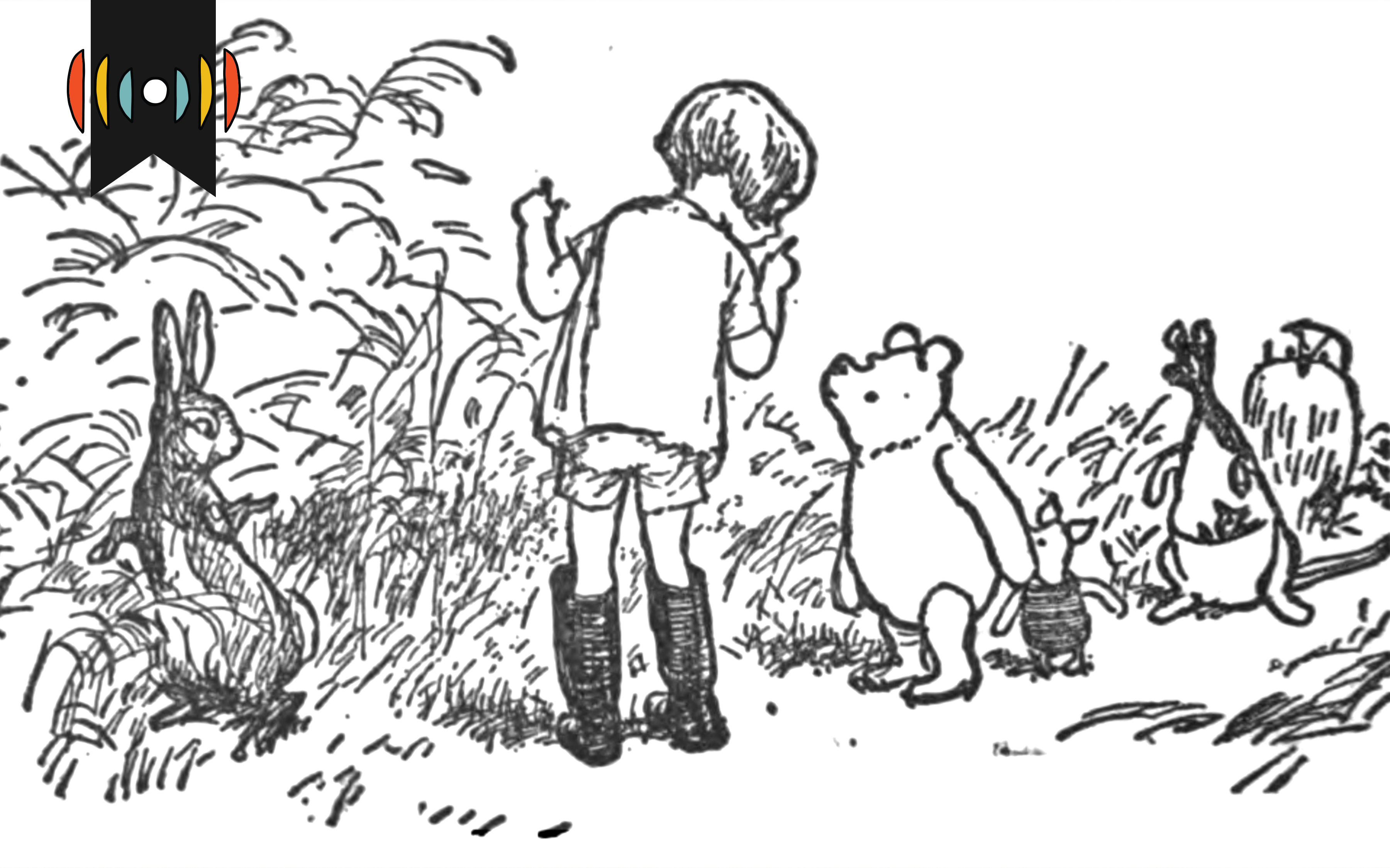
Illustration by Ernest Howard Shepard from Winnie-the-Pooh (1926), by A A Milne Wikimedia Commons / Howard Shepard, illustrator
Editor's note: The following text is a transcript of a podcast story. To listen to the story, click on the arrow beneath the headline above.
NICK EICHER, HOST: Good morning! This is The World and Everything in It from listener-supported WORLD Radio. I’m Nick Eicher.
MARY REICHARD, HOST: And I’m Mary Reichard. Up next, the anniversary of a beloved children’s book.
When Winnie the Pooh was published in England 100 years ago this week, it was an instant critical success. Publishers sold hundreds of thousands of copies. Disney would produce well-received movie adaptations in the late 1970s, and the character remains popular today.
EICHER: But how did Winnie-the-Pooh achieve status as classic literature?
WORLD’s Emma Eicher has the story.
EMMA EICHER: Winnie the Pooh lives in a world of safety, peace, and happiness. But outside the Hundred Acre Wood lay a much darker reality:
JEAN WEBB: In 1926 it was the general strike; it was a time of strife, of starvation, of poverty that people endured because of the political situation.
That’s Jean Webb, professor at Worcester University in England and Director of the International Forum for Research in Children’s Literature. She says the idyllic environment of the books was purposeful. Author A.A. Milne was a World War I vet living within cultural upheaval in Britain. So he sought refuge in make-believe.
WEBB: He was creating a world that he could actually live in, he could think in. A world that he could laugh in again.
Milne had already achieved success as a contributor to Punch magazine, and a playwright. He wrote stories for more than 20 years before venturing into children’s literature.
Milne’s colleague at Punch, E.H. Shepherd provided the gentle, natural illustrations for Winnie-the-Pooh … including the map of the Hundred Acre Wood. Shepherd drew inspiration from the English countryside.
WEBB: The illustrations live within their own time. … You take the illustrations away from the story, and you have a story which becomes timeless.
Milne’s son, 6 year-old Christopher Robin, and his stuffed animals served as the main inspirations. Christopher Robin became the primary human character, and his toys joined every adventure:
JEAN WEBB: Walk with me into the 100-acre wood. We meet Christopher Robin, Winnie the Pooh, Piglet, Rabbit, Owl, good old Eeyore, good old, grumpy old Eeyore! Tigger. Oh, good old Tigger …
And of course Roo and Kanga:
WEBB: She's really rather playful because she plays a trick on Rabbit with Roo, and they live in a world where they each have their own position. They respect each other. There's a sense of working together and helpfulness.
Webb says children can easily see themselves in the characters’ personalities, like Eeyore’s famously gloomy attitude. They can also trace the map, from Christopher Robin’s place to Owl’s treehouse.
WEBB: They're living in this world that you can easily relate to. That's why I think these stories survive. The stories are a real world in a fantasy place, and that's where children live.
And Winnie the Pooh? Webb says he can be silly, and a little pompous. But also …
WEBB: He's a poet. He sings. He communes with nature. There is a kindness in Pooh, and that kindness, I think, comes from the heart of the poet. “Oh, to be a cloud floating on the blue.” And it's just so peaceful.
The problems Pooh faces can become metaphors for ordinary life. Like this one, adapted from the book into Disney’s 1977 film, The Many Adventures of Winnie the Pooh.
Pooh visits Rabbit’s house for lunch.
POOH: Oof. Oof! Oh help and bother! I’m stuck.
RABBIT: Oh dear! Oh gracious! It all comes from eating too much!
WEBB: He can't get out of Rabbit's house because he's stuck in the doorway …
POOH: It all comes from not having front doors big enough!
CHRISTOPHER ROBIN: Pooh bear, there’s only one thing we can do. Wait for you to get thin again.
POOH: Oh bother.
WEBB: That's life. We all have to stay somewhere and put up with it until we get a bit thinner, whatever that might mean.
Milne kept writing as his son grew older… so the character got older too.
WEBB: You see Christopher Robin growing up, taking more charge, as it were, making more decisions.
Pooh appears in four of Milne’s books. The final book, The House at Pooh Corner, was published in 1928. It was time for Christopher Robin to leave the Hundred Acre Wood.
WEBB: Christopher Robin is going off to school and he’s talking to Pooh, and it's: “will we still be friends in the future?” It's all of those questions about, I'm moving on, will we remember each other? Will this be lost? And what you know is that Pooh will be forever in Christopher Robin's heart.
Webb says the books have had a lasting legacy because Milne seemed to remember childhood.
WEBB: The stories have that great attraction because they are childlike. They're not childish. It's about the now, the future, and the togetherness, and that's what's at the center of the Milne stories.
Winnie-the-Pooh has sold more than 50 million copies worldwide. And still regularly tops lists of bestselling children’s books.
But Milne never wrote another children’s book and regretted exposing his son to fame. He later became estranged from Christopher Robin, who said he hated how the public spotlight had changed his life.
The Disney adaptations helped spread its popularity. So did the events of the ‘20s and ‘30s: families liked the peace and safety of the Hundred Acre Wood during hard times.
But since then, the stories have proven to be a timeless narrative about childhood and what it means to grow up.
CHRISTOPHER ROBIN: And Pooh? Promise you won’t forget me? Ever?
POOH: Oh I won’t Christopher, I promise.
CHRISTOPHER ROBIN: Not even when I’m 100?
POOH: How old shall I be then?
CRISTOPHER ROBIN: 99. [Laughs] Silly old bear.
That’s this week’s WORLD History Book. I’m Emma Eicher.
WORLD Radio transcripts are created on a rush deadline. This text may not be in its final form and may be updated or revised in the future. Accuracy and availability may vary. The authoritative record of WORLD Radio programming is the audio record.
Please wait while we load the latest comments...
Comments
Please register, subscribe, or log in to comment on this article.