
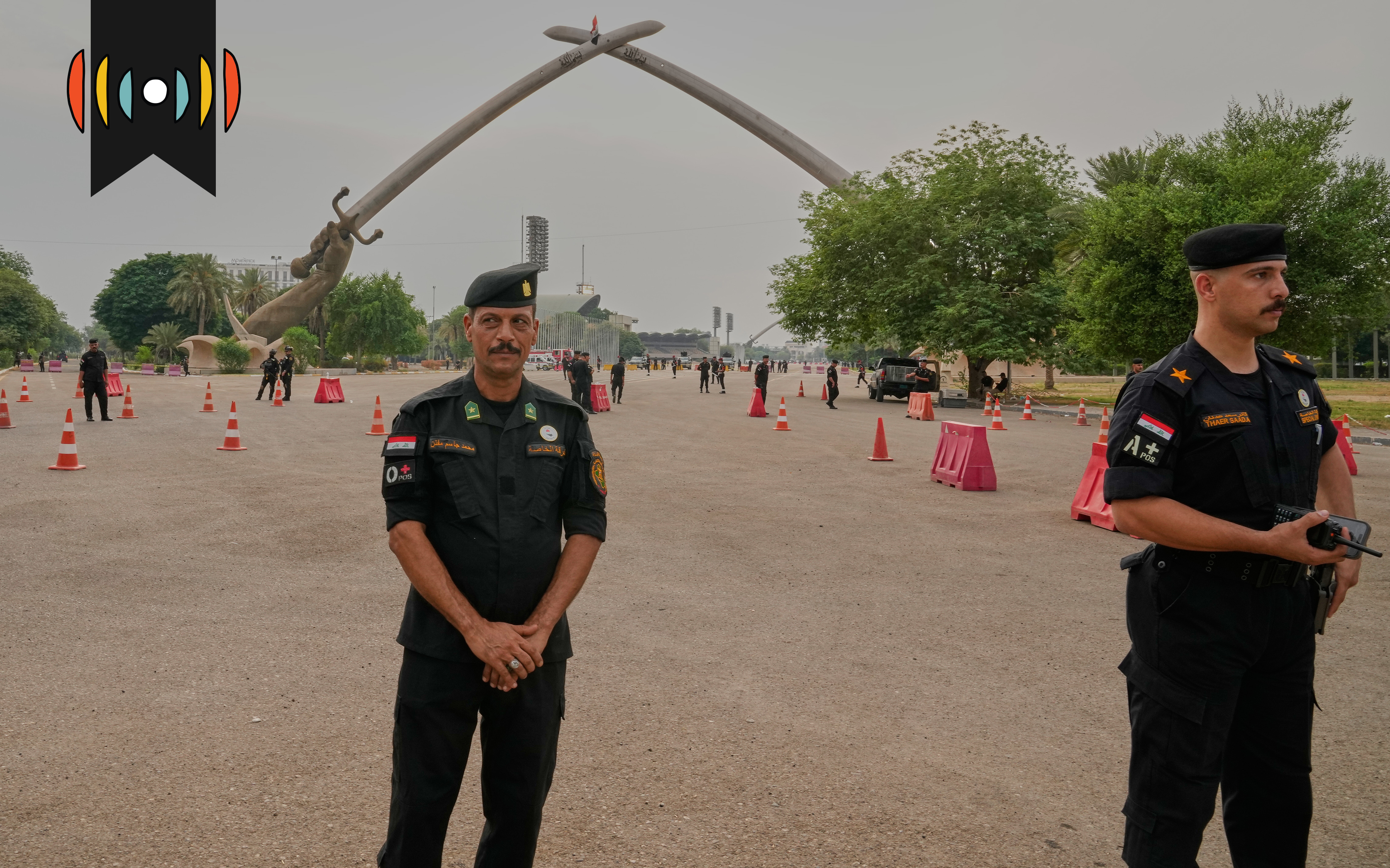
Iraqi security forces stand guard at the Crossed Swords monument in Baghdad's green zone, Iraq, Friday. Associated Press / Photo by Hadi Mizban
Editor's note: The following text is a transcript of a podcast story. To listen to the story, click on the arrow beneath the headline above.
LINDSAY MAST, HOST: Up next: World Tour.
SOUND: [Independence celebration]
That’s the sound of celebration in Iraq after the last U.S. forces withdrew last week… Most of the demonstrations were peaceful, though at one, an Iran-backed militia desecrated the American flag.
NICK EICHER, HOST: The last time U.S. forces withdrew in 2011, it left a power vacuum ISIS filled. This time, analysts say Iraq may have enough strength to hold them off.
WORLD’s Mary Muncy reports.
MARY MUNCY: In 2014, Asseel Yako and his family lived in a small town outside Nineveh, Iraq. He had been watching ISIS’s progress for months, keeping his family’s important documents packed.
Then one day in August.
ASSEEL YAKO: I just looked outside, and there are bombs everywhere.
ISIS had arrived in the majority-Christian town.
YAKO: They said you either convert to Islam or we kill you.
So Yako, his pregnant wife, and three children put as much as they could in the car and started driving.
YAKO: And they were like bombing behind us, so we were just speeding up to get to to save our life.
They headed north, to a refugee camp.
The U.S. invaded Iraq in 2003 as part of the Global War on Terror and ousted the former president Saddam Hussein. Leaders at the time said he supported al-Qaida. The Pentagon later said that wasn’t true, though he did support other terrorist groups. In 2011, the U.S. said it accomplished its mission and withdrew.
But in 2014, militias started taking ground again, and U.S. forces began Operation Inherent Resolve.
WOOD TV8: Breaking news in the Iraq crisis, the U.S. dropped bombs on insurgent artillery.
NBC NEWS: More than 30 rockets fired at a military base north of Baghdad Wednesday… killing two American troops and one British soldier.
CBS: Aid worker Peter Hassig has reportedly been beheaded by ISIS militants.
Most soldiers on the ground were in advisory positions and remained on U.S. bases. In 2024, President Joe Biden announced a deal: the U.S. would leave if the militias disarmed. The disarmament deadline has been pushed back to June of next year, but the last American troops left last week.
TRUMP: This day is a victory for the United States. It's a victory for Iraq and a decisive victory over ISIS.
President Trump last Wednesday.
TRUMP: We leave with Iraq having a wonderful new Prime Minister Ali al-Zaidi.
The Iraqi parliament approved al-Zaidi in May, and so far analysts say Iraqis are happy with him, and al-Zaidi says he has reached agreements with some militias.
But Bill Roggio with the Foundation for Defense of Democracies thinks the situation is tenuous.
ROGGIO: You've had militia leaders say that they would kill Iraq's president and prime minister if the Iran's supreme leader ordered them to do so.
One of the biggest militias in Iraq has an estimated 230,000 plus members and it’s controlled by Iran.
ROGGIO: Our influence has waned year after year as the as as the Iranian influence has skyrocketed.
Roggio says after 2003 “mini” Saddam Husseins started popping up all over the country. They’re just as brutal, more unpredictable, and now leading militias.
ROGGIO: Saddam Hussein was a horrible person, but I don't think U.S. leadership really thought about the aftermath of him being gone.
Roggio thinks the area was ready-made for recruitment.
In 2014, over half of the country’s 35 million people followed Shia Islam, that’s the majority religion in Iran.
But Iraqi Prime Minister al-Zaidi was confident as U.S. troops left:
ALI AL ZAIDI : (Arabic) Our security forces, across all their branches, have established control over the security and operational landscape throughout Iraq.
Saying his military has established control throughout the country.
Roggio thinks Iraq will be different than the disastrous U.S. pullout in Afghanistan. It immediately fell to an insurgent force, but he thinks life will stay fairly consistent for most Iraqis for now. If Shia influence continues to rise, oppression of Sunni Muslims and Kurds will probably rise too. And he thinks growing militias will mean more violence outside of the country.
Refugee Yako and his family eventually made it to Australia. He doesn’t think he’ll ever return to Iraq.
YAKO: Even now, people are still leaving the town because they don't feel safe there. Nothing is secure there.
He still has nightmares about returning, but for now, he thanks God for his escape.
Reporting for WORLD, I’m Mary Muncy.
WORLD Radio transcripts are created on a rush deadline. This text may not be in its final form and may be updated or revised in the future. Accuracy and availability may vary. The authoritative record of WORLD Radio programming is the audio record.
Please wait while we load the latest comments...
Comments
Please register, subscribe, or log in to comment on this article.