
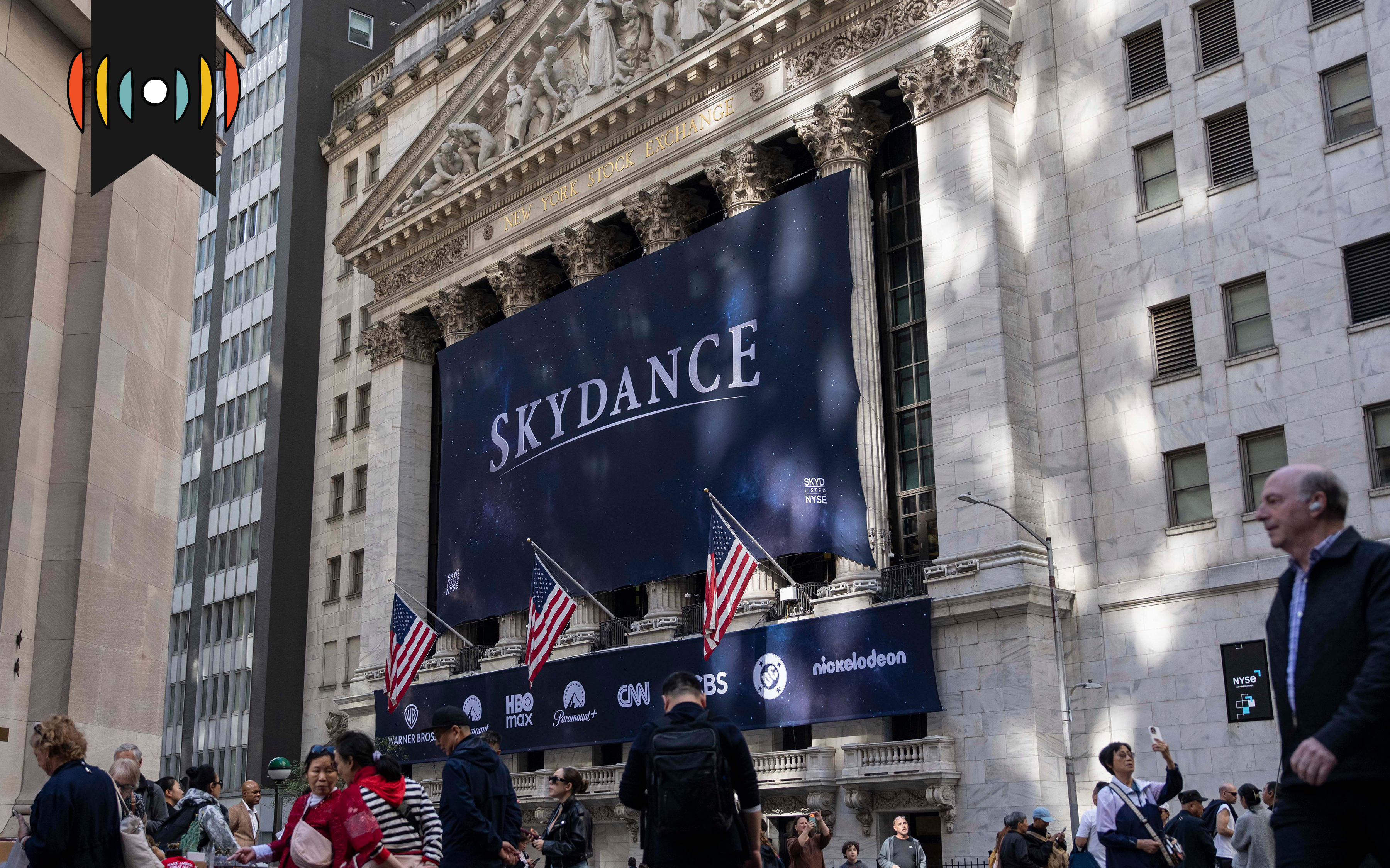
Skydance's company logo is displayed outside the New York Stock Exchange in New York, Oct. 8. Associated Press / Photo by Yuki Iwamura
Editor's note: The following text is a transcript of a podcast story. To listen to the story, click on the arrow beneath the headline above.
MARY REICHARD, HOST: Coming up next on The World and Everything in It:
Film finances.
Last week, Paramount closed its merger with Warner Brothers and rebranded as Skydance Corporation. And it now controls more than 11% of the U.S. TV market.
The merger also includes some iconic film franchises like Top Gun, Harry Potter, Star Trek, and Lord of the Rings.
GANDALF: A wizard is never late, Frodo Baggins. He arrives precisely when he means to!
MYRNA BROWN, HOST: But what will this corporate marriage mean for moviegoers? And is the audience the winner or the loser in this deal?
WORLD’s Lauren Smyth has the story.
LAUREN SMYTH: The satirical Tom Cruise comedy Digger was the last Warner Bros. movie produced before the merger.
DIGGER TRAILER: When all else fails, you hit ‘em with the hard truth. You know, the hard truth, just bang-bang-bang! Woo! Woo!
Newly rebranded Skydance Corporation has its own hard truth: $80 billion of debt leftover from the October 6th merger.
And Digger, by the way, is only digging a deeper hole. Analysts say the box office bust could lose as much as a quarter of a billiondollars for Warner – and now Skydance. Still, theaters have seen a resurgence lately, with 2026 on track to be the strongest year at the box office since before the pandemic.
And some see the Paramount–Warner Bros. merger as another victory for movie theatres over streaming services. Warner Brothers had originally agreed to sell out to Netflix. In response, Paramount launched a hostile takeover, appealing directly to shareholders with an all-cash offer. Netflix dropped out of the bidding war, leaving Paramount and its theatre-first model the victor—and a major debtor.
NAVEEN SARMA: These guys are trying to combine two companies—call it rebuilding a plane while it’s still in the air.
That’s Naveen Sarma, analyst at S&P Global Ratings.
Paramount’s bonds were already junk, meaning there was a slight default risk. After the merger, S&P further downgraded Skydance’s credit rating because of its new debt burden. That will make it more expensive for Skydance to borrow money, since they’ll have to compensate investors for the increased risk.
But it could be good news for moviegoers. Sarma says Skydance’s best chance to raise cash now is to focus on making good movies that people actually want to watch.
SARMA: You're going to see a lot of movies being made that, frankly, have disappeared from the movie theaters. And I'm talking about dramas. I'm talking about romances. I'm talking about comedies.
Skydance has promised to produce at least 30 movies annually for the next five years. That’s a big step up from Paramount’s 12 theatrical films in 2025 and could bring in a lot more cash.
Still, some worry that saving money and making more films are conflicting goals.
CURT HERSEY: I do think that the five-year expiration on some of these is really a band-aid. It’s meant to delay what was probably the inevitable.
Curt Hersey is a media history teacher at Berry College. He says the Skydance merger wraps up a trend that started in the 1980s.
CURT HERSEY: You had about 50 major media corporations in 1983, and by the time you got to 1990, that was cut in half to about 23.
Now, there are only three.
CURT HERSEY: The result is that we have very little choice in terms of the kinds of media we consume.
Moviegoers have never had more options in terms of how many films are available to watch. But all those options are curated by a small group of people.
CURT HERSEY: So the fairy tales of today are corporately owned intellectual property that we as everyday people do not have access to, and so one of the results of that means that we have this kind of closed system that the stories that our society tells are only controlled by these companies.
Hersey says that’s why it seems like so many recent movies are remakes and sequels.
Naveen Sarma has noticed that trend too. But he sees the merger as a solution to a curated selection. Huge franchises like Mission Impossible and the DC Universe require big budgets—something Skydance doesn’t have now. Instead, Sarma says, Skydance will likely focus on more niche and original movie genres. They might not sweep the box office, but could draw from a wide spectrum of audiences.
NAVEEN SARMA: You could see 30 kinds of movies that are all going to be different, rather than 30, you know, superhero movies, and those are going to be cheaper than superhero movies.
Sarma also sees opportunities for innovation in the filmmaking process that will likely involve AI.
NAVEEN SARMA: It isn't about eliminating those jobs—it's about taking a task that might take two days to do, and you're doing it in one day or a couple of hours, which is what we've seen from a lot of AI…. [10:40] In that way, it might reduce costs.
Meanwhile, Sarna says the real story isn’t in the movies.
NAVEEN SARMA: At the end of the day, we’re numbers people. So we’ll look at how cash flow will improve, or how revenues will grow.
If that growth materializes as Sarna expects, that will mean moviegoers are still buying tickets—and still enjoying the show.
Reporting for WORLD, I’m Lauren Smyth.
WORLD Radio transcripts are created on a rush deadline. This text may not be in its final form and may be updated or revised in the future. Accuracy and availability may vary. The authoritative record of WORLD Radio programming is the audio record.
Please wait while we load the latest comments...
Comments
Please register, subscribe, or log in to comment on this article.