
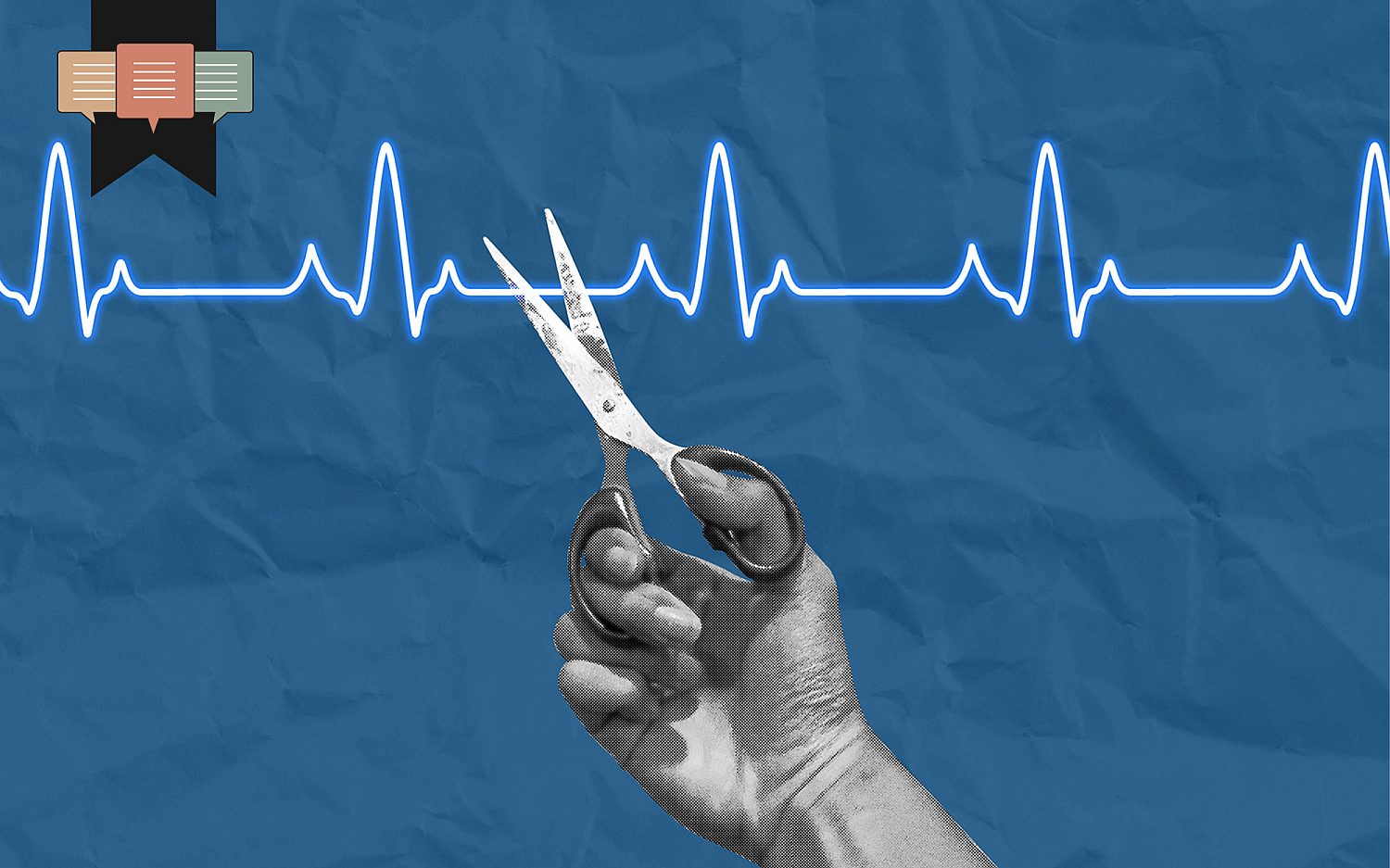
Who is the arbiter of life?
With assisted suicide, human beings attempt to wield a power we aren’t meant to have
Mininyx Doodle / iStock / Getty Images Plus via Getty Images
Full access isn’t far.
We can’t release more of our sound journalism without a subscription, but we can make it easy for you to come aboard.
Get started for as low as $3.99 per month.
Current WORLD subscribers can log in to access content. Just go to "SIGN IN" at the top right.
LET'S GOAlready a member? Sign in.
Life’s trials, suffering, and pain are inevitable, including for people who follow Jesus.
Christian teaching on suffering is a paradox: God often uses it—in all its messiness, sorrow, and agony—to bring about good. He produces—just to name a few things—faith, character, steadfastness, a love for His presence, and an ability to comfort others in their distress.
Despite all this, many now embrace an inhumane option to escape suffering—assisted suicide. Thirteen U.S. states and the District of Columbia have authorized it. In those jurisdictions, we humans have tried to arrogate to ourselves God’s power over life and death.
Euphemisms abound in this space. Some call it “death with dignity,” “compassionate choices,” “MAID” (Medical Assistance In Dying). Always beware of euphemisms. When people avoid plain descriptions of what they’re doing, our “Spidey-sense” should kick in. If we hope to have an honest conversation about this topic, we must call assisted suicide what it is. It’s prematurely ending a life.
This is not a question of “pulling the plug” on comatose loved ones who are beyond hope—whose lives are sustained by machines. That’s very different from enlisting a doctor to access drugs for the purpose of intentionally ending a life—one that might well have gone on for years.
The advocates of assisted suicide sell it to the public using stories of people suffering extreme physical pain. But the truth is far more complicated. As Michael Brendan Dougherty points out, according to “surveys of people who choose assisted dying, the majority are not in severe pain or suffering a present horror; they are fearful of pain and depressed about the prospect of dying or their loss of ‘autonomy.’”
Foremost among this group are elderly grandparents who don’t want to burden their families—financially, emotionally, or physically—or don’t want to lose their ability to live on their own. Laws that allow (and some might even argue, incentivize) this population to choose death are treacherous and terrifying.
Also troubling is the fact that the legal guardrails designed to prevent abusing this suicide option are not as sturdy as some advocates suggest. Many states require proof of “terminal illness,” but that standard introduces loads of discretion and ambiguity. If a doctor thinks a person has a 51% chance to pass away within six months, is that enough? Who knows? Vagueness also plagues the requirement of mental “competence,” which is especially complicated in cases where people are deeply depressed.
What’s more, some states require only minimal accountability for the process. Patients need not be supervised by a medical provider when taking the fatal drugs, so no provider ensures that the patient is the one administering the lethal dose—or the one using it.
And, in some cases, those authorizing the use of these drugs have a vested interest in the decision to die. Insurance companies, for instance, often find it more profitable to cover lethal drugs than the ongoing costs of expensive life-sustaining treatments.
The harm from these laws isn’t limited to the destruction of people who seek their own demise. Assisted suicide also poses profound ethical considerations for physicians who take seriously the Hippocratic Oath to “do no harm.” Even the American Medical Association’s Code of Ethics declares assisted suicide “fundamentally incompatible with the physician’s role as healer.”
Yet some states are trying to force health professionals—whatever their personal beliefs or religious convictions—to aid and assist death, either by providing information about that option to inquiring patients or by referring them to others willing to pen lethal prescriptions.
That violates not only medical ethics but also an individual’s constitutionally protected religious freedom not to participate in taking a life. (Attorneys at my law firm—Alliance Defending Freedom—have successfully protected medical professionals from these laws in states such as Vermont, New Mexico, and California.)
Beyond the conscience concerns of medical professionals lies the pernicious message these laws teach our culture: that the choice between life and death is ours to make. This is the apex of radical self-autonomy.
But God’s ways are not ours. His plans are better. Sometimes, He uses pain and suffering to achieve the chief end of humanity—revealing Himself to us and opening our eyes to know Him. This is especially true in end-of-life settings. We should pause long and hard before claiming the power to determine when life should end. Left to our own devices, we might terminate a life before God’s work is done.
We should not endeavor to insert ourselves into God’s place or presume to vaunt our compassion above His. Too much is at stake—including matters of eternity—for us to claim this role. We can’t trust ourselves with that power. We weren’t meant to wield it.


These daily articles have become part of my steady diet. —Barbara
Sign up to receive the WORLD Opinions email newsletter each weekday for sound commentary from trusted voices.Read the Latest from WORLD Opinions
Thaddeus Williams | America’s “existential crisis of meaning” is similar to the Babylonian king’s crisis, and the solution is the same, too
A.S. Ibrahim | In pointing to the attitudes of Muslim immigrants, Trump says what Europe’s leaders still won’t
Colin J. Smothers | The liberal religion of Senate candidate Adam Hamilton
Denny Burk | A recent article on Elisabeth Elliot is way over that line
Please wait while we load the latest comments...
Comments
Please register, subscribe, or log in to comment on this article.