
What volleyball can teach us
Fun and competitiveness can go together, in sports and in cultural discourse
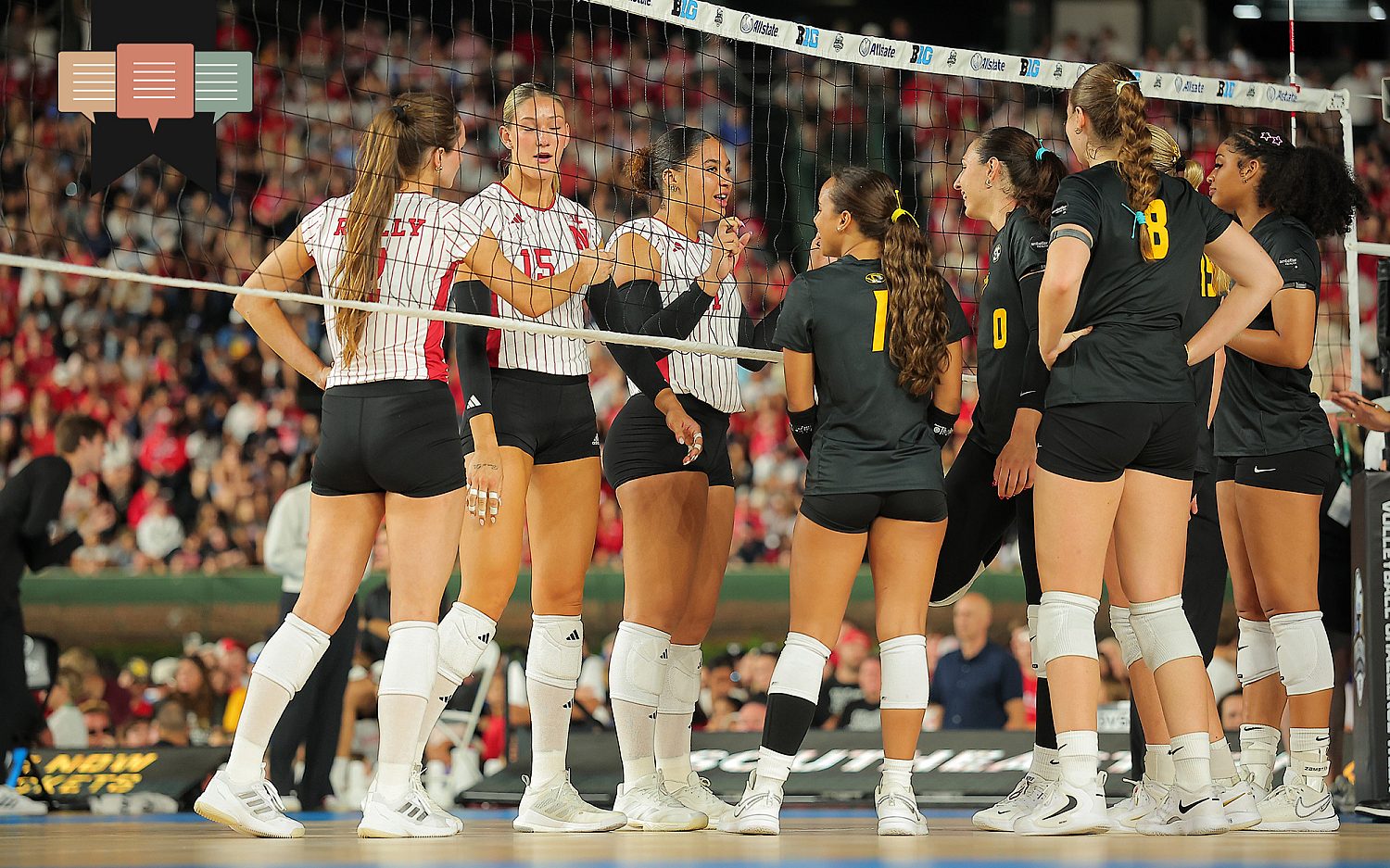
College volleyball players from Nebraska and Missouri chat during a match delay on Sept. 6. Associated Press / Photo by Melissa Tamez
Full access isn’t far.
We can’t release more of our sound journalism without a subscription, but we can make it easy for you to come aboard.
Get started for as low as $3.99 per month.
Current WORLD subscribers can log in to access content. Just go to "SIGN IN" at the top right.
LET'S GOAlready a member? Sign in.
It was about five minutes into a recent Union University volleyball game (featuring a couple of my journalism students) that I realized I love volleyball. I texted the following to a buddy, who was also in the building: “This sport is shocking in its civility, manners, and positivity. There’s like no occasion for hatred or acrimony. It’s honestly unnerving.”
To wit: In the leadup to the game, there’s this moment where everyone on our team shakes hands and says “good luck” to everyone on their team. Also, when the other team’s starters get introduced, in our gym, everyone on our team claps twice for them. This could seem, at face value, pretty inconsequential. Except that in the leadup to the game everyone on both teams seemed to be, for lack of a better term, enjoying themselves very much. There was dancing and smiling and laughter in abundance.
In my football career the leadup to a game was a physical, mental, and emotional siege that included not getting too tired during our coach’s 90-minute “warmup” and sometimes puking because of nerves. The nervousness stemmed from the reality that as a 17-year-old kid I was about to go out and do some really violent stuff for three hours—during which I would try not to embarrass myself and my family. It’s like getting into a street fight in front of all of your friends and your parents, while wearing spandex. Pretty stressful stuff.
Here’s another true thing: The day after the volleyball game, I would coach a small-college football game, during which there would be real hatred, acrimony, and trash talk before, during, and after the game. I also love every second of this experience. Just because one thing is true (in this case), it doesn’t mean the other thing isn’t.
In general, because of Christ, but also just because of how I’m wired, I hate hatred and acrimony. Discourse-wise, hatred and acrimony are at an all-time high, culturally. Just turn on the television or visit a comments section anywhere online or … talk to people. It’s as bad as I’ve ever seen it in my 50 years of being a person. And sadly, in the Christian space, we don’t do much better most of the time.
Now this isn’t some sort of Jackie Moon, “Everybody love everybody!” kind of message. Things still have to be debated (see: Paul), stands have to be taken (see: Daniel), and, sadly, rhetorical and actual wars continue to be waged—sometimes nobly, but often poorly and in a way that makes you think, “Everybody involved in this is the ‘bad guy’.”
But about volleyball: Nobody looked miserable, nobody was at risk of dying of heat exhaustion, and while injuries in volleyball happen, they are never directly caused by another person. This is pretty cool. Also cool is the way they kind of huddle up and either celebrate after every point they score, or kind of collectively lament/encourage after they lose a point.
Concurrent with my relatively deep thoughts vis-à-vis volleyball, I’m reading the book Away Game: A Christian Parent’s Guide to Navigating Youth Sports, by Brian Smith and Ed Uszynski. It’s rare that I read something and think, “I wish I’d written that,” but it’s true in this case. The book is full of reasonableness and wisdom and insight that is sorely lacking across our entire sports landscape, but especially youth sports. Loosely stated, its thesis is, Hey parents, you’re the literal adult in the room, so it’s your job to keep some things in perspective. It’s a book that every sports parent should read (Christian or not), but they probably won’t because people don’t like being disabused of their idols and they generally don’t like seeing their bad behavior called out.
Football is awesome, but football, in general, really isn’t “fun” in the moment unless you’re playing really well and also winning. Football is fun afterward. It’s fun to have done it and survived it. Volleyball looks really fun, in the moment. And it proved to me that fun and competitiveness (this was pretty high-level college volleyball) aren’t mutually exclusive. Kudos to our team (and the other team, too) for teaching me this, and kudos to the culture our coach has created.
And maybe it’s naïve, but I think discourse could be fun again, too. It could be fun to be a person in a culture where people disagree. It could be possible to disagree and not hate the other side every minute we’re drawing breath. That would be pretty cool.


These daily articles have become part of my steady diet. —Barbara
Sign up to receive the WORLD Opinions email newsletter each weekday for sound commentary from trusted voices.Read the Latest from WORLD Opinions
Thaddeus Williams | America’s “existential crisis of meaning” is similar to the Babylonian king’s crisis, and the solution is the same, too

A.S. Ibrahim | In pointing to the attitudes of Muslim immigrants, Trump says what Europe’s leaders still won’t

Colin J. Smothers | The liberal religion of Senate candidate Adam Hamilton

Denny Burk | A recent article on Elisabeth Elliot is way over that line

Please wait while we load the latest comments...
Comments
Please register, subscribe, or log in to comment on this article.