
The politics of Humpty Dumpty
The president should be more careful about how he employs language and power
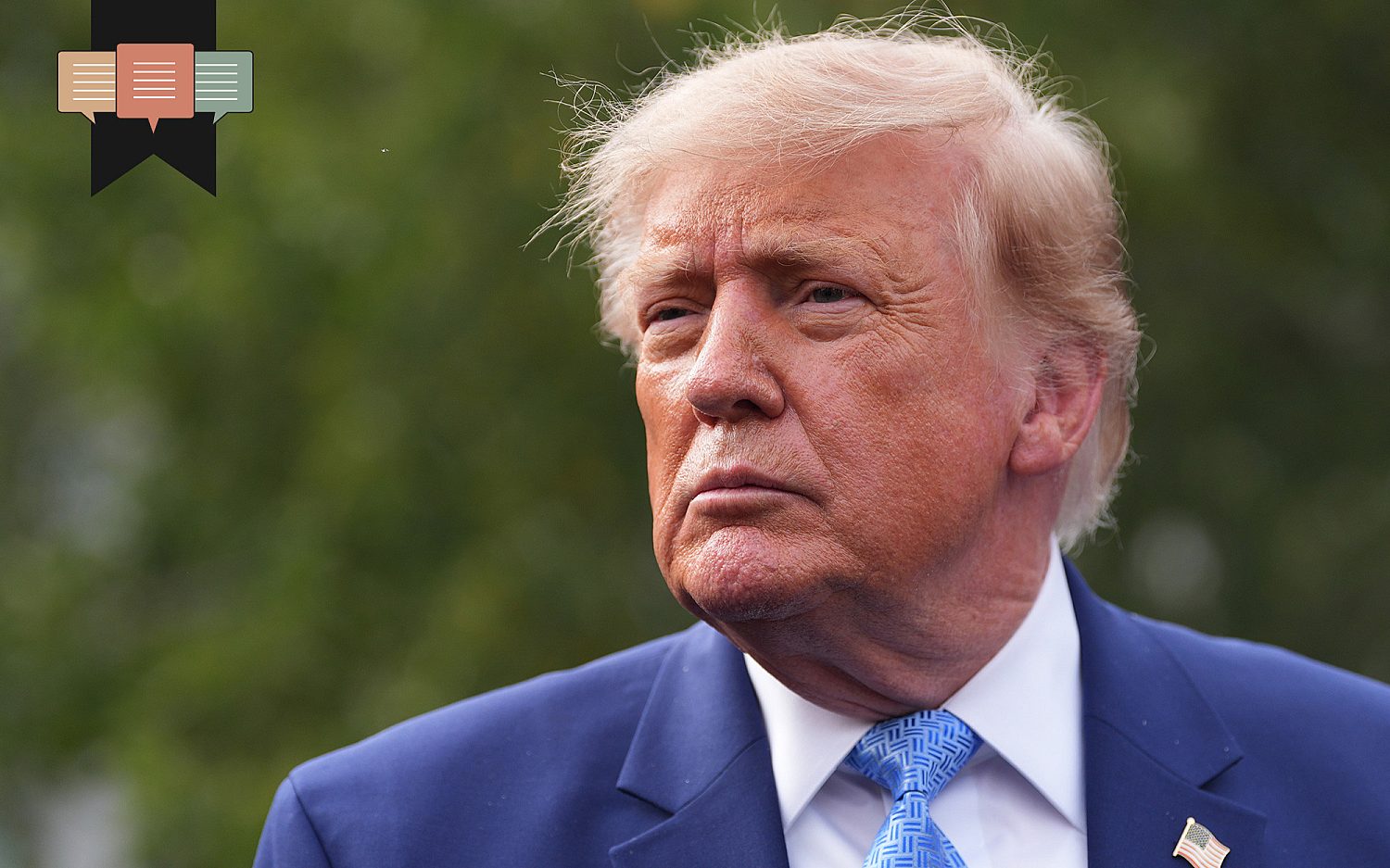
President Donald Trump speaks to reporters after meeting with top executives of AI firms on Sept. 29 in Washington, D.C. Associated Press / Photo by Alex Brandon
Full access isn’t far.
We can’t release more of our sound journalism without a subscription, but we can make it easy for you to come aboard.
Get started for as low as $3.99 per month.
Current WORLD subscribers can log in to access content. Just go to "SIGN IN" at the top right.
LET'S GOAlready a member? Sign in.
On Sept. 22, President Trump delivered an address to the United Nations. Near the end, the president turned to the topic of artificial intelligence. In a stunning sweep of linguistic hubris, the president summarily declared that he was “changing the name.” He claimed that “the use of the word ‘artificial’ makes intelligence fake … and it is not fake.” He continued: “From this point forward, all of United States’ documents, and hopefully the world’s, will be changed to use the much more accurate term ‘super intelligence.’”
One might be tempted to say we are quickly moving Through the Looking Glass. Here’s an exchange between Alice and Humpty Dumpty from Lewis Carroll’s novel of inversions. Humpty Dumpty is a haughty character who is, as one might guess, sitting on a wall:
‘When I use a word,’ Humpty Dumpty said in rather a scornful tone, ‘it means just what I choose it to mean—neither more nor less.’ ‘The question is,’ said Alice, ‘whether you can make words mean so many different things.’ ‘The question is,’ said Humpty Dumpty, ‘which is to be master—that’s all.’
Humpty Dumpty, as we all know, had a terrific fall from his high and haughty wall. One might even imagine that Carroll puts these arrogant words into Humpty’s mouth as an explanation for the ensuing collapse.
It is not merely eggs on high walls that the president’s speech brings to mind. Consider the story of Nebuchadnezzar, king of Babylon who had a troubling dream. The Hebrew prophet Daniel was brought in to interpret it. In the dream, a tree grew and “its top reached to heaven, and it was visible to the end of the whole earth.” The dream was a warning of coming judgment, for Nebuchadnezzar imagined himself without peer on earth or in heaven. In his pride he refused to heed the warning.
Some time later, Nebuchadnezzar was strolling on the roof of his palace—like Humpty Dumpty, he was high on a wall—admiring himself and his handiwork. He said to himself: “Is not this great Babylon, which I have built by my mighty power as a royal residence and for the glory of my majesty?” While those proud words were “still in the king’s mouth” a voice “from heaven” declared judgment on the king and his hubris: “The kingdom has departed from you, and you shall be driven from among men, and your dwelling shall be with the beasts of the field.” The mighty king was brought low and became like a beast. He remained in this sub-human state until he acknowledged One greater than himself: “I lifted my eyes to heaven, and my reason returned to me, and I blessed the Most High.”
Nebuchadnezzar’s punishment was the loss of his reason; which is to say, he lost access to language—the logos—by which intelligible communication is made possible and by which human communities are made functional.
Babylon is the Greek version of an older term: Babel, and it is with the Tower of Babel story that the pieces fall into place. Babel was built on the plain of Shinar in the aftermath of Noah’s flood. According to tradition, Nimrod, the mighty hunter, was the instigator. Denying God’s command to fill the earth, the people instead schemed to build a city with a tower “with its top in the heavens, and let us make a name for ourselves.” The author deems it significant that a technology was employed to render the project plausible: bricks and mortar, which are seemingly primitive to us, but allowed for the effective construction of a tower of hubris.
The builders set out to construct a tower to “make a name for ourselves,” which is to say hubris was the motive behind the impious project. Of course, the enterprise was stymied when God confused the languages, and the people were dispersed. One might say that they fell from a high wall and were fragmented into confusion just like Humpty Dumpty and Nebuchadnezzar.
Today, artificial intelligence is playing the role that bricks and mortar played in the ancient tale of Babel. And our president, like Humpty Dumpty, is changing names as an indication of who “is to be master.”
Our president is also playing the role of Nebuchadnezzar. He’s boasted, in various ways, about the power he wields: “The power of this office is crazy.” Trump is sitting on a high wall, and it is not a wall on the border but rather a high wall of his own hubris. And like Nimrod of old, he made a career of building towers to make a name for himself.
But here’s the sobering fact: Each of these stories ends with a fall. The fall is both a natural consequence of hubris and a divine judgement whereby language, the instrument of rationality, is removed or confused. But unlike Humpty Dumpty, Trump is the leader of a nation, and when leaders fall, nations suffer. The president is traveling down a well-trodden but dangerous path, and we are all along for the ride. The growing sense of confusion and fragmentation are plausible indications that the consequences are already emerging. If these old stories are true, the end will not be good; although, as with Nebuchadnezzar, repentance is always possible.
As a wise king once put it, “Pride goeth before destruction.”


These daily articles have become part of my steady diet. —Barbara
Sign up to receive the WORLD Opinions email newsletter each weekday for sound commentary from trusted voices.Read the Latest from WORLD Opinions
Thaddeus Williams | America’s “existential crisis of meaning” is similar to the Babylonian king’s crisis, and the solution is the same, too

A.S. Ibrahim | In pointing to the attitudes of Muslim immigrants, Trump says what Europe’s leaders still won’t

Colin J. Smothers | The liberal religion of Senate candidate Adam Hamilton

Denny Burk | A recent article on Elisabeth Elliot is way over that line

Please wait while we load the latest comments...
Comments
Please register, subscribe, or log in to comment on this article.