
The bridge no government can build
We need something other than welfare programs to help Americans escape poverty
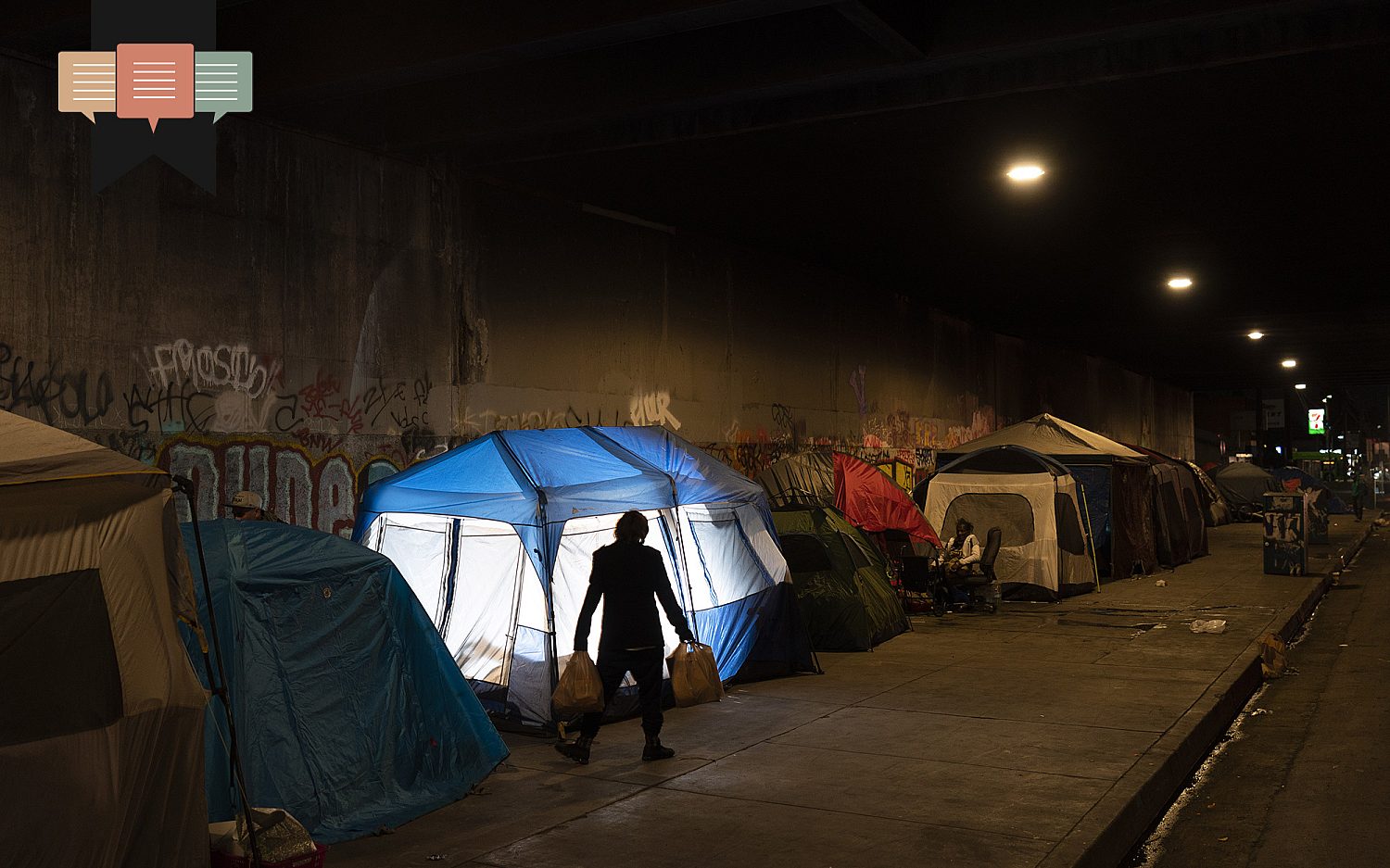
A man walks past a homeless encampment underneath a bridge in Los Angeles on Feb. 9, 2023. Associated Press / Photo by Jae C. Hong, file
Full access isn’t far.
We can’t release more of our sound journalism without a subscription, but we can make it easy for you to come aboard.
Get started for as low as $3.99 per month.
Current WORLD subscribers can log in to access content. Just go to "SIGN IN" at the top right.
LET'S GOAlready a member? Sign in.
Although the United States’ federal government successfully builds more than 2,000 bridges every year, there’s one bridge that has proven far too complex for even its sharpest engineers and architects. For nearly 100 years, Washington’s planners and builders have worked to construct this specific bridge—some spending their entire lives working toward it, only to prove that this project is not going to be accomplished by the federal government.
Where is this bridge? It’s actually in your community, and my community, and every community around the United States. It’s the bridge for people to escape poverty and cross into the American Dream.
Since we started the measurement in 1964, a poverty rate above 10 percent has stubbornly persisted, leaving nearly 36 million Americans in its clutches today. The recalcitrance of the issue is certainly not due to a lack of investment. To build this bridge, the government has spent about $50 trillion on programs that currently enroll nearly 100 million Americans in one or more of at least 100 federal antipoverty programs.
It’s a miserable and costly failure that can be traced to a major design flaw. The current building plans are intended to solve a math problem rather than a human one, as if poverty is just a lack of cash rather than a lack of relationships. The result is a failed bridge pieced together through wealth redistribution by welfare programs, rather than a bridge that inspires wealth creation through personal accountability and empowerment. The former fails to provide a proper incentive for anyone to cross it, while the latter leads to purpose and prosperity. The government cannot build that one. Only civil society can—that is you, and me, our churches, and our other community institutions outside of government.
This was the point clearly made by my colleague, Misty Kelso, who testified last month before the U. S. House of Representatives at the Work and Welfare Subcommittee hearing, “Welfare Reform at 30: Restoring the Promise of Work and Personal Responsibility in Federal Welfare Programs.”
Misty grew up in a traumatic household, experiencing abuse and addiction at a young age. As an adult, she became homeless, but eventually she came to our mission, where she was loved, educated, and challenged to develop the skills required to escape poverty. She now serves as operations manager for one of our residential facilities, where she regularly helps others catch a vision for their own brighter future.
Misty has also developed a keen understanding of how bridges are built. At the hearing, she set the Washington lawmakers straight:
People need a bridge. A bridge from survival to stability, from stability to healing, from healing to work, and from work to independence. That bridge has to be built on relationship, redemption, hope, and human dignity.
Alas, those are building blocks the government lacks—and ones that no amount of money can ever buy. Yet there seems to be no end in sight to the government’s costly efforts to try to purchase alternative building supplies, spending more than a trillion dollars per year building failed bridges that go nowhere and simply draw more people to sit idly on them, waiting for the next government handout.
Misty’s experience is that it keeps people stuck. “It did keep me stuck for a long time … living in low-income housing,” she said. “It was easier to stay dependent without looking at the barriers.”
Millions of Americans are stuck in poverty today with no bridge to escape until civil society retakes its position as the general contractor, hauling in the building blocks Misty spoke of: relationship, redemption, hope, and human dignity. They formed the bridge for her escape from a life of destitution and despondency. She explained,
Through relationships, hard work, accountability, and community, I began to understand that my life could have purpose and value. When I started to work, I built the community that I needed to be successful today. For a long time, I saw work as just a way to survive. When I started looking at work like it gave me purpose, something inside my brain changed. It really empowered me to want to do better in all aspects of my life.
When asked by U.S. Rep. Aaron Bean, R-Fla., to identify the missing ingredient to welfare reform, Misty quickly pointed out that the solution is not one the government can provide. She pointed to the individual complexity of poverty, which often includes trauma, addiction, and mental health issues.
Indeed, those complex issues are impossible for the federal government to solve. The bridge that leads out of poverty can’t be constructed with welfare programs; it’s built through relationships that inspire work, awaken human dignity, and restore purpose. It’s not a bridge the government can build, but civil society does this kind of bridge-building quite well.


These daily articles have become part of my steady diet. —Barbara
Sign up to receive the WORLD Opinions email newsletter each weekday for sound commentary from trusted voices.Read the Latest from WORLD Opinions
Thaddeus Williams | America’s “existential crisis of meaning” is similar to the Babylonian king’s crisis, and the solution is the same, too

A.S. Ibrahim | In pointing to the attitudes of Muslim immigrants, Trump says what Europe’s leaders still won’t

Colin J. Smothers | The liberal religion of Senate candidate Adam Hamilton

Denny Burk | A recent article on Elisabeth Elliot is way over that line

Please wait while we load the latest comments...
Comments
Please register, subscribe, or log in to comment on this article.