
One year after Charlie Kirk’s murder
A heartening religious trend, a disheartening political turn, and some important truths stand out
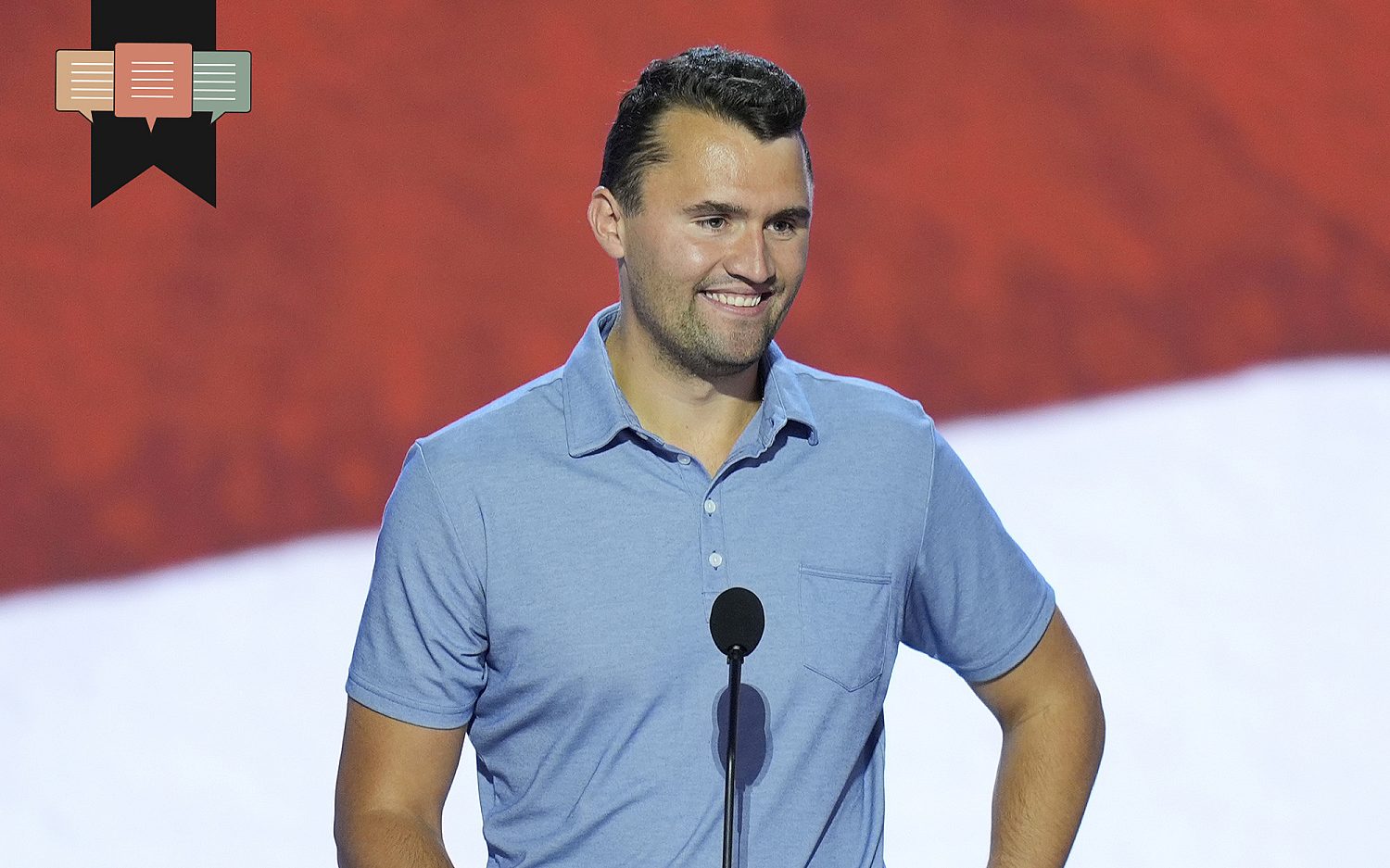
Charlie Kirk Associated Press / Photo by J. Scott Applewhite
Full access isn’t far.
We can’t release more of our sound journalism without a subscription, but we can make it easy for you to come aboard.
Get started for as low as $3.99 per month.
Current WORLD subscribers can log in to access content. Just go to "SIGN IN" at the top right.
LET'S GOAlready a member? Sign in.
I was in fifth grade, sitting at the breakfast table when the phone rang. My mother gasped, ran over to the remote, and turned on the TV. She burst into tears as we watched the South Tower collapse.
Where were you?
I was 34 years old, sitting on a bench, waiting for my lunch appointment to show up. I scrolled X on my phone, when a grisly image of someone getting shot in the neck flashed across my screen. “Charlie Kirk? No way,” I thought, “These AI videos are getting out of hand. I wonder what idiot put this one together?” Then, other posts corrected my assumption—this was real and Charlie was dead or dying.
Where were you?
My lunch appointment arrived. In May, the group of a dozen or so young men he’d been discipling weekly since they were 6th graders had graduated high school. Charlie had been highly influential on them—not so much his political engagement—but his unashamed defense of Christian beliefs and ethics.
The next few hours were a whirlwind of “reports” and “takes.” One in particular is burned into my memory. A mere hour after Charlie was shot, before he was officially pronounced dead, an MSNBC commentator said, “You can’t have awful thoughts and say awful things and not expect awful actions.” My blood boiled.
In the next 24 hours, the onslaught of people cheering his death online was disorienting. It was hard to keep up with; it was hard not to keep up with. Then, an old tweet from Charlie Kirk himself acted as a balm: “When things are moving very fast and people are losing their minds, it’s important to stay grounded. Turn off your phone, read scripture, spend time with friends.”
The next day was 9/11. I remembered pastors reflecting in past years how full their churches were. We pivoted our Sunday plan, which we almost never do, and the other teaching pastor and I taught on Five Crucial Questions in a Violent World. We had over 200 guests that Sunday.
What were those guests looking for? Did they find it? I spoke with one man, we’ll call him Zach, who ended up getting saved and subsequently baptized about six months later. He grew up in a completely secular home and has two young kids. He said,
I was mostly unfamiliar with Charlie Kirk. When it was on the news that he’d been killed, I looked him up. I saw people calling him hateful, racist, and transphobic. I spent a lot of time investigating those claims and looked at all his quotes in context. I didn’t agree with his worldview, but nonetheless I could see that he was being horribly misrepresented. I was sad for his kids, which were the same age as my daughters. I quickly went from sad to angry, however, when I saw how not only was he assassinated, which is obviously cruel, but at seeing how comfortable people where with assassinating his character was doubly disorienting. These “rational” and “secular” people I’d previously identified with disgusted me. I went on a journey searching for basic moral coherence.
Zach wasn’t alone in that. We baptized more people that fall and spring than in any other previous year of our church. I officiated multiple weddings for couples who’d gone back and listened to Kirk’s advice against cohabitation and in favor of marriage. Many of them went to church or back to church for the first time in the aftermath of Kirk’s murder. “The blood of martyrs is the seed of the church,” as Tertullian said.
As heartening as the fruit of Kirk’s legacy has proven in local churches, what came in the political wake following his death on the right has been equally disheartening. Division, discord, and foolish conspiratorial pontification stemming from actors who’ve proved themselves to be foolish grifters has only served the purposes of Kirk’s political enemies and, I can only assume, added stress and suffering to his wife, children, and former colleagues.
Our secular world has certainly set itself against all that is basic and true. G.K. Chesterton, writing in 1908, said, “We shall soon be in a world in which a man may be howled down for saying that two and two make four, in which furious party cries will be raised against anybody who says that cows have horns, in which people will persecute the heresy of calling a triangle a three-sided figure, and hang a man for maddening a mob with the news that grass is green.” One year post Kirk’s murder, we must honor his legacy by resolving to go on saying what is obviously true despite it being labeled “problematic.” Jesus is Lord, a woman is an adult human female, laws should be enforced, and quality marriages are the foundation of a healthy society. Basic reality.
Let’s honor Kirk by remembering him how he wanted to be remembered. “I want to be remembered for courage for my faith. That would be the most important thing. The most important thing is my faith.” Let us share that aspiration.


These daily articles have become part of my steady diet. —Barbara
Sign up to receive the WORLD Opinions email newsletter each weekday for sound commentary from trusted voices.Read the Latest from WORLD Opinions
Thaddeus Williams | America’s “existential crisis of meaning” is similar to the Babylonian king’s crisis, and the solution is the same, too

A.S. Ibrahim | In pointing to the attitudes of Muslim immigrants, Trump says what Europe’s leaders still won’t

Colin J. Smothers | The liberal religion of Senate candidate Adam Hamilton

Denny Burk | A recent article on Elisabeth Elliot is way over that line

Please wait while we load the latest comments...
Comments