
No longer second tier
The Department of Justice rightly lifts burdens from faith-based social service providers
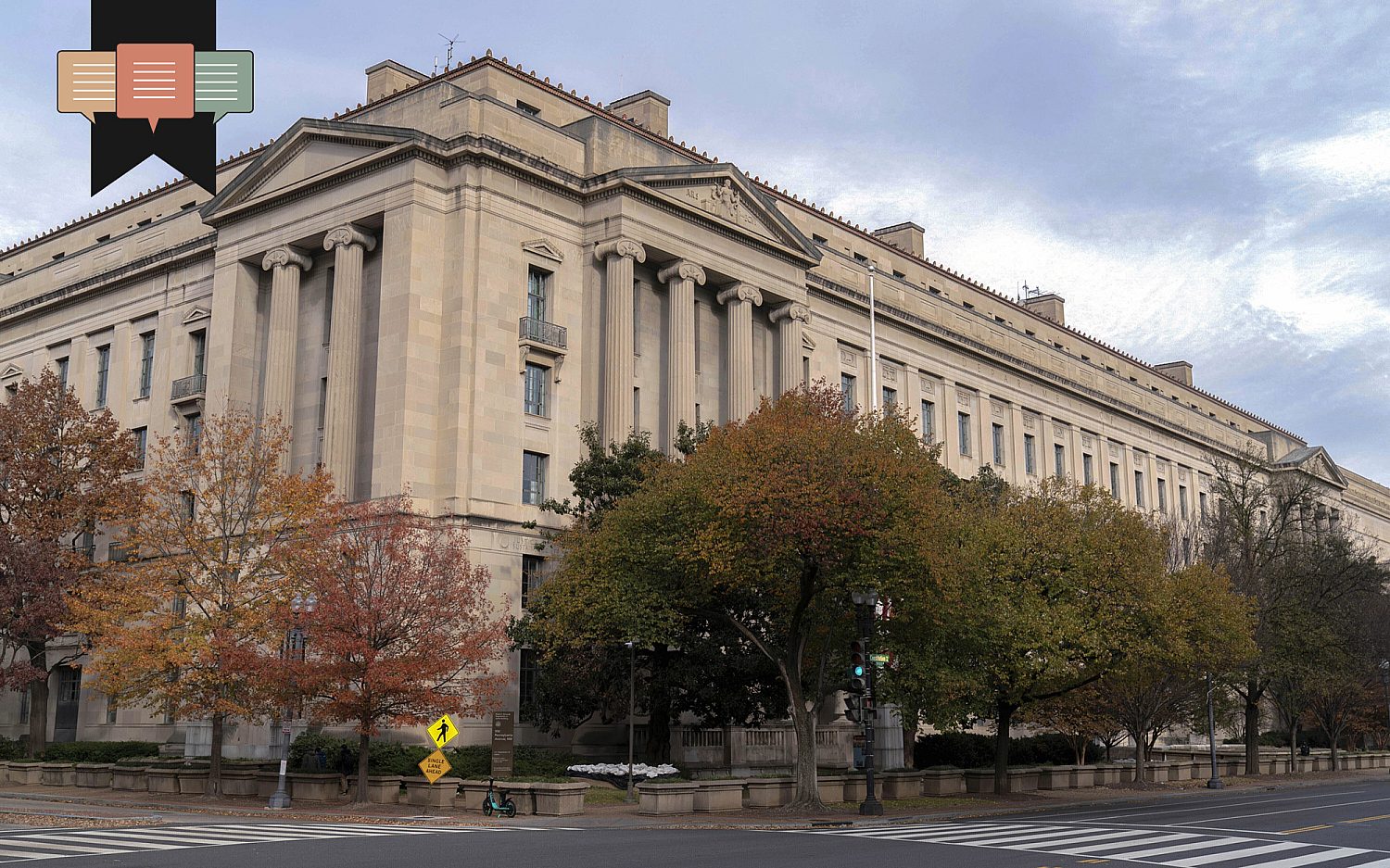
The U.S. Department of Justice building in Washington D.C., where the Office of Legal Counsel is located Associated Press / Photo by Jose Luis Magana, file
Full access isn’t far.
We can’t release more of our sound journalism without a subscription, but we can make it easy for you to come aboard.
Get started for as low as $3.99 per month.
Current WORLD subscribers can log in to access content. Just go to "SIGN IN" at the top right.
LET'S GOAlready a member? Sign in.
Throughout American history, social services were often religious. Religious groups built hospitals and schools, operated soup kitchens and homeless shelters, and ran after-school sports programs. That’s still true today. Local and state and federal governments often provide funds and grants to private groups that offer programs with so many obvious benefits to society.
But for many years, the religious groups—despite playing such an important part in providing these social services—found themselves in a corner by themselves, disadvantaged in participating in government programs. The Department of Justice’s Office of Legal Counsel has taken an important step to remedy this, ending the second-class treatment of religious groups in government grants.
The Supreme Court played an important role in creating the problem. In the mid-20th century, the Supreme Court embarked on a project of constitutional interpretation that put the First Amendment’s two religion clauses in tension, and sometimes on a collision course with each other. If the free exercise of religion would seem to guarantee that religious groups shouldn’t be subjected to government disadvantages, the Supreme Court seemed intent on pushing the Establishment Clause in a different direction. It said that, to prevent the creation of a government establishment of religion, the government would be strictly prohibited from providing benefits to religious groups, even when those benefits might be provided to others.
In the influential case of Lemon v. Kurtzman (1971), the Supreme Court said that a program would only be constitutional if it had a secular purpose, a secular effect, and no entanglement with religion.
Take, for example, a set of grant programs created by the state of Pennsylvania in the 1970s. Seeking to ensure that all elementary school students—even those in private schools—had essential resources for learning, the state offered free textbook loans and also grants for a panoply of programs—teaching, testing, speech and hearing therapy, and programs “for exceptional children, for remedial students, and for the educationally disadvantaged.” The Supreme Court, reviewing these programs in a 1975 case, said that any aid that went directly to a teacher at a religious school was unconstitutional because, no matter the subject matter, “a teacher remains a teacher, and the danger that religious doctrine will become intertwined with secular instruction persists.” Textbook loans at least were safe; if the book was secular to begin with, it would stay clear from religious influences.
Over time, the Supreme Court’s attempt to ensure that no government funds ever ended up in religious hands began to crack. Increasingly, the Court came to recognize that when “the religious, irreligious, and areligious are all alike eligible for governmental aid,” the state is not “establishing” religion in violation if it lets the religious participate in these open-to-everyone programs.
In the last decade, a series of decisions have recognized as well that excluding religious participants from programs open to everyone else is discriminatory, in violation of the Constitution’s guarantee of the free exercise of religion. And the Supreme Court rightly abandoned its old precedent in Lemon, with its requirement of secular purpose and secular effect, in favor of a more historically informed understanding of the Constitution’s Establishment Clause. On this view, the Establishment Clause was designed to prevent the state from enforcing religious conformity. The Clause was not designed to keep faith in private.
Yet there are still more than a few government programs that try to parse religious from nonreligious participants. The federal Department of Health and Human Services (HHS) administers several statutes that restrict the use of federal funds when faith-based organizations are involved. One program offers aid to needy families, using grants to support a wide range of programs from vocational classes to transportation aid to emergency assistance in finding housing to family counseling. Another program funds substance abuse and prevention services, ranging from counseling to treatment to recovery housing. A third program specifically supports childcare for low-income families.
In each of these areas, faith-based organizations are often important providers. For years, HHS has policed how religious groups participate, with regulations prohibiting “organizations from engaging in explicitly religious activities ... as part of the HHS-funded program or service.” This could lead to considerable difficulties for religious groups.
Consider an easy one: You’re a faith-based organization running a vocational program; can you pray with participants? Maybe you have to separate out prayer time from the training program to respect the HHS grant. Maybe, out of your religious convictions, you can’t separate that out (and then can you participate in the grant?).
HHS’s lawyers had questions about this, and they turned to the Department of Justice’s Office of Legal Counsel for help. The Office of Legal Counsel plays a crucial role in providing legal advice throughout the executive branch.
In a formal opinion issued on Aug. 25, the Office of Legal Counsel’s head Elliot Gaiser and attorney Joshua Craddock explained that the days of putting special burdens on faith-based organizations are over. The grant programs are open to private social service providers of all sorts. Religious providers are not to be put at a disadvantage or forced to artificially separate their faith from their service.
The OLC opinion correctly traces the source of the old rules to the Supreme Court’s misguided quest in years past to enforce an overbroad view of the Establishment Clause. The Supreme Court has rightly abandoned that approach. Now, thanks to the OLC opinion, federal programs will abandon those restrictions too.
No longer do faith-based organizations have to be treated as suspect or second-class participants when they interact with federal agencies. They can be appreciated for the crucial work they do in serving those in need and in loving neighbors well. Federal agencies are not promoting religion, but they are collaborating with faith-based aid providers regularly. Now they can do so without the misguided burdens of bad constitutional interpretation.


These daily articles have become part of my steady diet. —Barbara
Sign up to receive the WORLD Opinions email newsletter each weekday for sound commentary from trusted voices.Read the Latest from WORLD Opinions
Eric Patterson | Marx-inspired candidates say some radical things about faith, but they don’t say much about protecting fundamental liberties

Ray Hacke | A male cross country runner, his female teammates, and the need for truth and justice on Nov. 3

Jonathon Van Maren | The life and work of Dr. Hugh Hodge provide a powerful example to pro-life advocates

Thaddeus Williams | America’s “existential crisis of meaning” is similar to the Babylonian king’s crisis, and the solution is the same, too

Please wait while we load the latest comments...
Comments
Please register, subscribe, or log in to comment on this article.