
It’s time to speak plainly and clearly
Twenty-five years after the 9/11 attacks, the West still can’t say what it saw
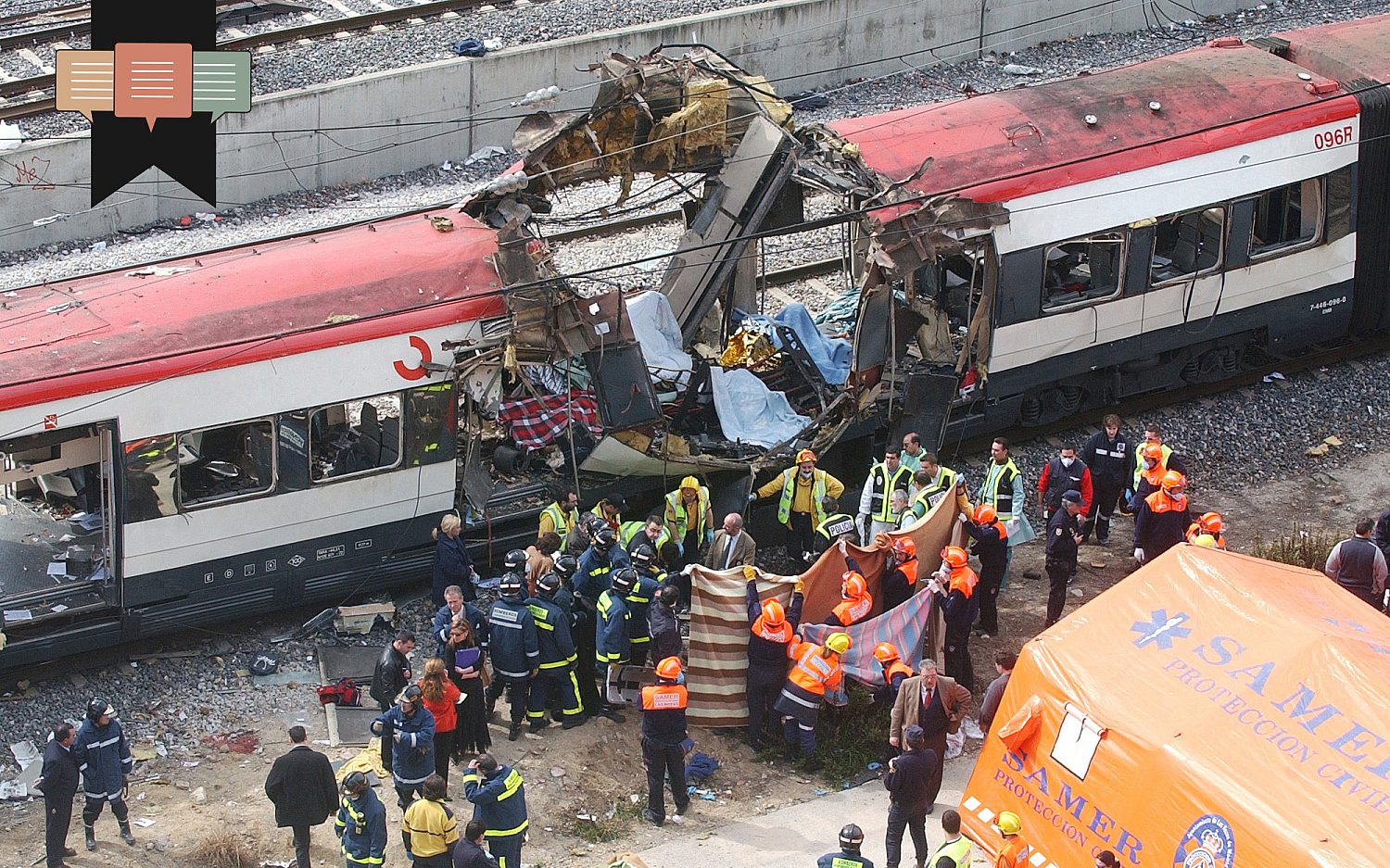
Rescue workers cover up bodies alongside a bomb-damaged passenger train on March 11, 2004, following a number of explosions in Madrid, Spain. Associated Press / Photo by Paul White, file
Full access isn’t far.
We can’t release more of our sound journalism without a subscription, but we can make it easy for you to come aboard.
Get started for as low as $3.99 per month.
Current WORLD subscribers can log in to access content. Just go to "SIGN IN" at the top right.
LET'S GOAlready a member? Sign in.
Madrid, March 2004: 191 dead on commuter trains, the bombers citing the same jihad they believed to be obligatory. London, July 2005: 52 dead on the Underground and a bus, a martyrdom video invoking Quranic language released before the attack. Paris, November 2015: 130 dead, an ISIS released a statement citing the Quran’s sanction for war against “Crusaders.” Brussels, March 2016: 32 dead at an airport and a metro station, the same network, the same citations. And in between, in June 2014, the formal declaration of an Islamic caliphate—a state that published theological justifications for slavery, executions, and territorial conquest sourced directly from classical Islamic jurisprudence, not invented by its propagandists but assembled from it.
Twenty-five years since 9/11, and the pattern has never actually broken. Different cities, different cells, the same textual citations recycled by new actors who read the same verses as the 9/11 attackers and drew the same conclusions. That repetition reflects the lesson the West has refused to learn.
Still, some things did somewhat improve. Intelligence services learned to share information about Muslim terrorism across borders in ways that likely prevented attacks we’ll never hear about. Aviation security hardened considerably. Governments got more serious about terrorist financing—the 2007–2008 prosecution of the Holy Land Foundation, which traced money flows connected to Hamas through a network of American Islamic charities and organizations, remains one of the more instructive case studies of what happens when investigators are permitted to follow the institutional threads to their source.
These are real gains, and they are worth naming plainly rather than folding into a narrative of pure failure. But notice what they have in common: They are operational, financial, procedural. None of them required anyone in government or media to say a true sentence about the theological content of the Islamic ideology being financed, trained, and exported. The investigations improved, but the vocabulary didn’t.
Here is what actually failed to develop over the last 25 years: the willingness to name the source of such terrorism.
Western governments settled early on “violent extremism” and “radicalization” as the preferred vocabulary, shielding Islam itself against scrutiny. Both terms relocate the explanation from particular theology to fanciful psychology—poverty, alienation, grievance, identity crisis—as though a man who shouts Allahu Akbar or recites Quranic verses before flying a plane into a building has been “misguided” or “radicalized,” rather than correctly stating he was instructed by a coherent legal and scriptural tradition he can cite chapter and verse. Frameworks for countering violent extremism are often forced, under direct pressure from Muslim advocacy organizations, to explicitly avoid linking the ideology to Islamic texts. The compromise language that emerged insisted these men were not “true” Muslims at all—that a real, authentic Islam existed elsewhere, untouched by any of this, and that the killers had simply—wait for it—misunderstood their own religion.
This is a drastic inversion. The hijackers, the Madrid bombers, the Bataclan attackers, ISIS’s soldiers—none of them expressed confusion about their sources. Their recruiting material is saturated with the same Quranic and hadith citations: the Verse of the Sword, the jizya passage, the command to strike necks, the hadith on fighting until men testify there is no god but Allah. Their own words were never ambiguous. It was the West that manufactured the ambiguity, insisting on inventing a gentler Islam to stand between the public and the actual texts, so that anyone who noticed the connection could be waved off with a buzzword—Islamophobia, bigotry—before the conversation could even begin.
We can see the Islamic element in these attacks plainly. We have simply been trained not to say so.
And while the world is trying to shield Islam against scrutiny, a quieter institutional effort proceeded largely unexamined. Scholars documented how Muslim Brotherhood-linked networks built mosques and schools across Europe over these same 25 years, how Sharia councils proliferated in the United Kingdom operating a parallel legal track for family and civil matters, and how CAIR-style advocacy shaped what American institutions were permitted to say about Islam publicly. Western counterterrorism policy focused almost entirely on the dynamic threat—bombs, planes, guns—while the slower political penetrating project, one that shares the same theological end goals as its violent cousin and differs mainly in tactics and timeline, operated with far less scrutiny. Ultimately, one Muslim wears a suit and lobbies; the other wears a vest and detonates. Look under the surface and trace both back far enough, and they cite the same “sacred” book.
Honest engagement was never a call to suspect every Muslim neighbor next door. It was, and remains, a call for Western institutions—governments, universities, and churches alike—to read and expose the primary sources of Islam themselves rather than inventing fanciful unsubstantiated claims to suit reassurance campaigns built to keep everyone comfortable. It’s important to name the ideology, because false comfort has a body count.
Twenty-five years on, the debt we owe the dead of 9/11 is not sentimentality. It is clarity—the kind that finally stops arguing about what motivated their killers, exposes the texts that shaped them, stops funding the institutions that launder those texts into respectability, and stops calling a conquering, subjugating theology a religion of peace simply because saying otherwise is uncomfortable.
The dead deserve better than our comfort. They deserve the truth we’ve spent much of the past 25 years avoiding.


These daily articles have become part of my steady diet. —Barbara
Sign up to receive the WORLD Opinions email newsletter each weekday for sound commentary from trusted voices.Read the Latest from WORLD Opinions
Thaddeus Williams | America’s “existential crisis of meaning” is similar to the Babylonian king’s crisis, and the solution is the same, too

A.S. Ibrahim | In pointing to the attitudes of Muslim immigrants, Trump says what Europe’s leaders still won’t

Colin J. Smothers | The liberal religion of Senate candidate Adam Hamilton

Denny Burk | A recent article on Elisabeth Elliot is way over that line

Please wait while we load the latest comments...
Comments
Please register, subscribe, or log in to comment on this article.