
Fixing the federal judiciary
Is it time to reform the Supreme Court?
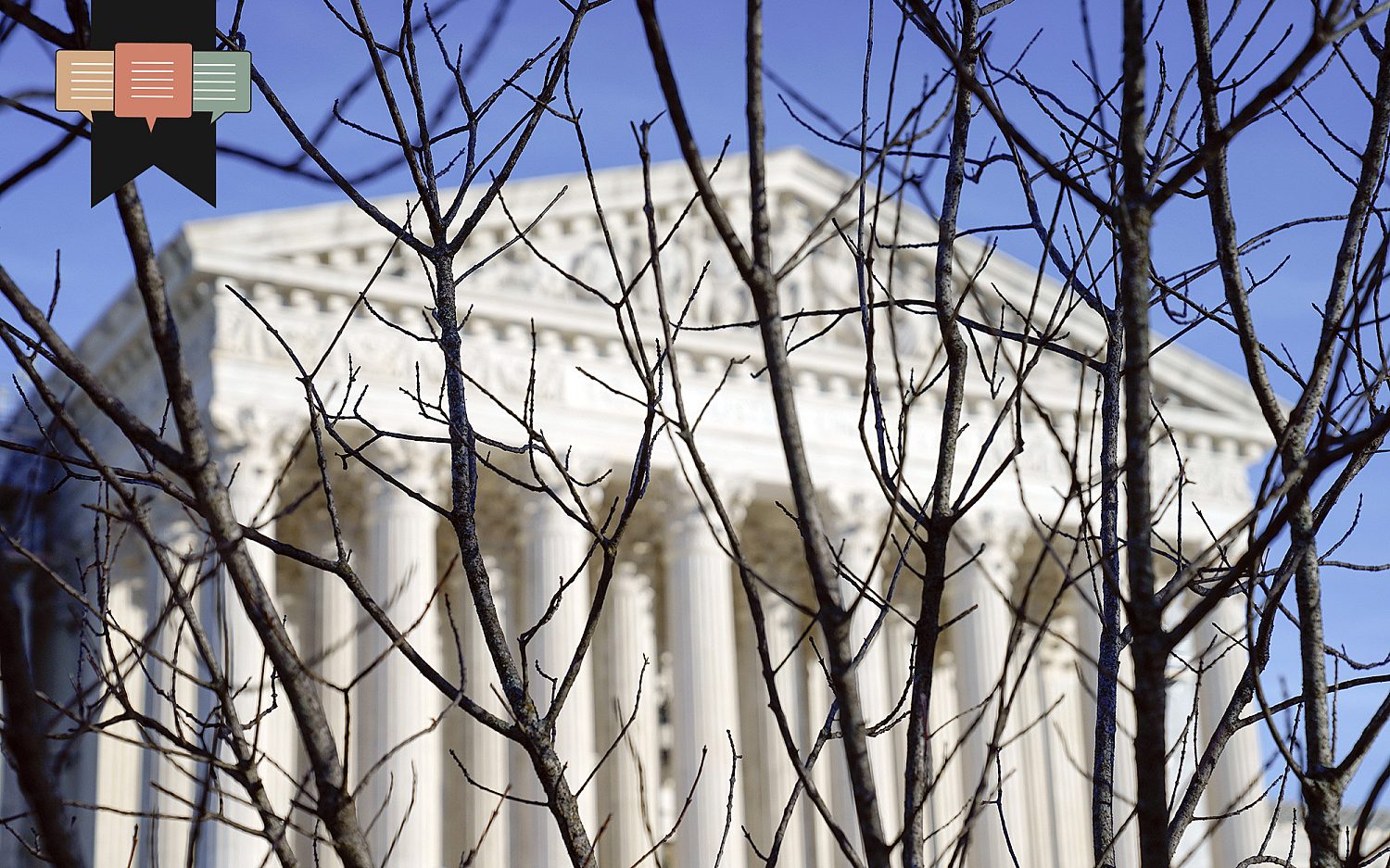
The U.S Supreme Court building Associated Press / Photo by Mariam Zuhaib
Full access isn’t far.
We can’t release more of our sound journalism without a subscription, but we can make it easy for you to come aboard.
Get started for as low as $3.99 per month.
Current WORLD subscribers can log in to access content. Just go to "SIGN IN" at the top right.
LET'S GOAlready a member? Sign in.
Signs of institutional and social decay abound these days. And while the causes of these indicators are not merely political, there is a significant political dimension to our current cultural malaise. To consider one example, our era of hyper-polarization has increasingly politicized the Supreme Court, in terms of its decisions as well as its deliberations. Some of this is an inevitable consequence of its own past decisions short-circuiting what might have been healthier democratic deliberation in older cases like Roe v. Wade (1973) and Planned Parenthood v. Casey (1992) to more recent holdings such as the Obamacare decision in NFIB v. Sebelius (2012) and codification of same-sex marriage in Obergefell v. Hodges (2015).
The federal judiciary is beset by criticism from both sides of the political aisle and for a variety of reasons. Attacks on the court tend to focus on results rather than procedure, however, and raise the specter of restricting the courts’ ability to fulfill their function as independent and counter-majoritarian institutions. Rather than focusing on the merits of decisions, leaders of both major political parties would apparently rather score points by criticizing the outcomes than work to remedy wrongs through legitimate political means. And the Supreme Court is still governed by some semblance of decorum that largely prevents justices from defending themselves when targeted by increasingly strident critics.
This politicization of the judiciary has borne some rotten fruit. Threats as well as actual violence against judges, including Supreme Court justices, are increasingly common. And popular perceptions of the Supreme Court are likewise becoming more jaundiced. A recent Marquette Law School poll found that approval of the nation’s highest tribunal dropped 4 points to 43% between July and September. A majority of respondents also think the court is driven more by political considerations than by the enacted law of the land.
Domestic support for judicial reforms is also increasingly popular. The Marquette poll found a majority of respondents are in favor of imposing a “strict ethics code” on the justices (89 percent), for removing life tenure for justices (79 percent), and for increasing the size of the court (53 percent). The popularity of many of these proposed changes to the court manifest a basic ignorance of the court’s unique constitutional purpose and function. Political criticisms of the court typically appeal to democratic and majoritarian sensibilities. But the court fulfills a critically important role in protecting minorities and individuals against the vagaries of majoritarian tyranny and populist angst.
Federal courts are governed by Article 3 of the Constitution, which is the shortest and least-detailed of all the provisions for the government’s three branches. One result of the Framers’ decisions here is that the shape and scope of the courts are subject to a relatively great deal of legislative discretion. The number of justices on the Supreme Court and their responsibilities have changed greatly over the centuries, for example, as have the size and number of federal circuit courts. Most often these changes have been driven by practical and pragmatic concerns related to the working of the judiciary. But sometime these changes, whether attempted or actualized, have been driven more by politics than principle. Most of the contemporary advocates for changes to the courts seem to be concerned more with results and political gamesmanship than with proper judicial procedure.
As legal scholar Josh Blackman has observed, there are a number of ways the federal judiciary might be reformed from within, irrespective of legislative or other action external to the court. But many proposed reforms would need to be imposed on the court. Some of these are more difficult to enact, even to the point of requiring amendment of the Constitution. Others could be achieved comparatively easily.
At the beginning of October, First Liberty’s Center for Religion, Culture & Democracy will be hosting a series of public lectures on federal court reform at the University of Texas at Austin. Along with the university’s Federalist Society chapter and the School of Civic Leadership, we will welcome Stephanie Barclay of Georgetown, Steven D. Smith of the University of San Diego, and John Yoo of Texas and UC-Berkley to share their insights regarding the prudence of various court reform proposals.
There’s much to be debated and discovered about whether and how to fix the federal courts. What is undeniable, however, is that we are facing a serious crisis of legitimacy in government in general and in the courts in particular. The key to restoring trust in the judiciary is recovering its constitutional purpose and grounding judicial independence in legal and moral reality. The need for this recovery is perhaps more urgent than ever.


These daily articles have become part of my steady diet. —Barbara
Sign up to receive the WORLD Opinions email newsletter each weekday for sound commentary from trusted voices.Read the Latest from WORLD Opinions
Thaddeus Williams | America’s “existential crisis of meaning” is similar to the Babylonian king’s crisis, and the solution is the same, too

A.S. Ibrahim | In pointing to the attitudes of Muslim immigrants, Trump says what Europe’s leaders still won’t

Colin J. Smothers | The liberal religion of Senate candidate Adam Hamilton

Denny Burk | A recent article on Elisabeth Elliot is way over that line

Please wait while we load the latest comments...
Comments
Please register, subscribe, or log in to comment on this article.