
Defending lawful authority and government
English constitutional history helps us understand the legality of American independence
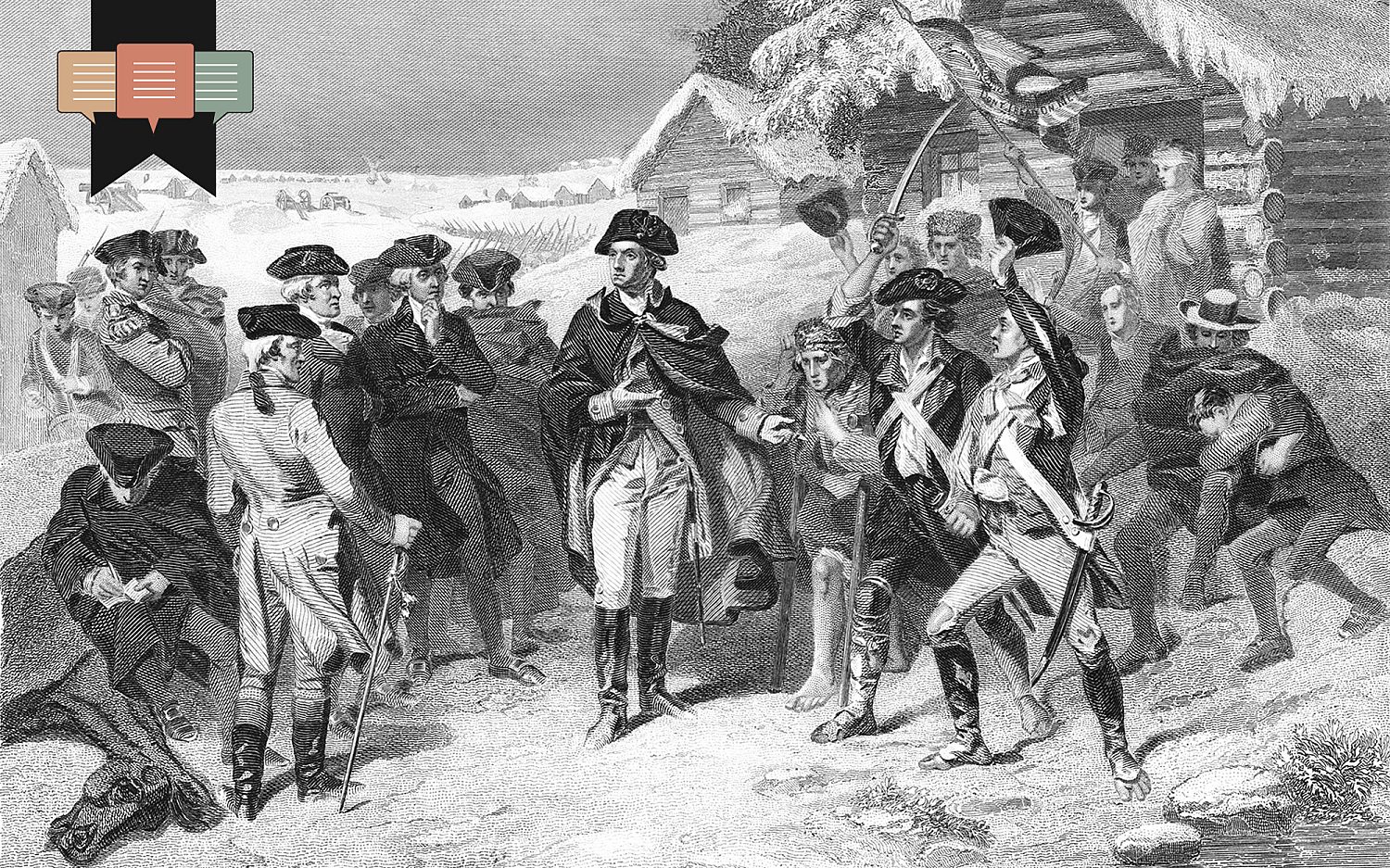
An 1874 illustration of Gen. George Washington meeting with the Continental Congress at Valley Forge. Christine_Kohler / iStock / Getty Images Plus via Getty Images
Full access isn’t far.
We can’t release more of our sound journalism without a subscription, but we can make it easy for you to come aboard.
Get started for as low as $3.99 per month.
Current WORLD subscribers can log in to access content. Just go to "SIGN IN" at the top right.
LET'S GOAlready a member? Sign in.
Summer concludes and kids go back to school. Celebrations of America’s 250th birthday over the summer feel like they are wrapping up. But we can hope the summer of celebration prompted many to keep learning and discussing the American experiment and why it is worth celebrating.
Looking back at American independence in 1776, I repeatedly found myself discussing the lawfulness of America’s break from England with fellow Christians. Scripture teaches the importance of respecting the governing authorities. But figuring out how to respect requires an understanding of that authority. Too rarely do histories of the American Revolution talk about the legal dispute at the heart of the conflict.
From the perspective of pro-independence Americans in the 18th century, law was central. In their view, they were not repudiating the English constitutional order. They were defending the proper understanding of English law and the principles of the English constitution.
To make sense of these claims, it is necessary to wind the clock back well before 1776, to the cataclysmic events of English constitutional history a century earlier.
Americans today think of constitutions as written documents. You can look at America’s Constitution on parchment at the National Archives in Washington, D.C. England, in contrast, has no written constitution.
The English Constitution is instead a constitution of accumulated practice, history, and custom. It is the inheritance of institutions, conventions, historical settlements, and long-established practices.
The English Constitution long involved both king and Parliament, and thus a mixed government. But precisely what authority each possessed was hotly contested over the course of the 17th century.
The Stuart monarchs of the 1600s held an expansive view of the authority of the monarchy. Charles I tested the outer limits of that authority by increasingly seeking to reign without the constraints of Parliament. The result was years of political conflict between the king and Parliament, which eventually turned into military conflict, the English Civil War. Oliver Cromwell led Parliament’s forces to victory over the Cavaliers of Charles I. Charles himself was executed for what Parliament regarded as his disregard of the English constitutional order.
Cromwell then reigned for roughly a decade as Lord Protector of England. He himself could not avoid falling into conflicts and controversies over the scope of his own authority vis-à-vis Parliament. After he died, the nation returned to monarchy.
King Charles II, and then James II, reigned with their own intermittent clashes with Parliament. These became serious during the reign of James II. Ultimately, Parliament again resisted a king whom it believed had overstepped his bounds and violated the time-honored principles of the English constitutional system.
James II was ousted, but the monarchy was not abolished. James was replaced by William and Mary, who established a new constitutional settlement in England.
This revolution of 1688–89 became known as the Glorious Revolution. Glorious because there was (almost) no bloodshed, and because it restored a stable balance of kingship and Parliament working together within the English constitutional order.
Fast forward three-quarters of a century to colonial America. Tensions were developing between the American colonies and Parliament. “Taxation without representation” is an accurate but incomplete statement of the colonists’ complaint. Their legal theory was that Parliament was reaching beyond its rightful authority to make law for the colonies.
Americans believed that their colonial charters made them self-governing political communities, each with its own miniature parliament in the form of a colonial legislature. They answered to the king, but Parliament itself had only limited authority in the colonies—or so the colonists believed. (Scholars like John Phillip Reid, Jack Greene, and Akhil Amar have documented this at length.)
Accordingly, when Parliament insisted that it possessed authority to levy taxes on matters that the colonists viewed as the prerogative of their own legislatures, the colonies objected. More important than money (the taxes were trivial) was the dispute about authority. Parliament insisted that it possessed the authority to legislate for the colonies “in all cases whatsoever.” The colonies thought that there were limits to this authority.
Parliament thought that the lesson of the Glorious Revolution was that Parliament had all the authority. The Americans thought the lesson of the Glorious Revolution was that no one had total authority, but that it was all a matter of checks and balances.
Who could resolve this dispute? The king. As historian Brendan McConville has explained, the American colonists turned to the king to redress their grievances. They believed they were legally in the right and that the king could push back against Parliament’s constitutional overreach. The Americans understood themselves to be engaged in a kind of checks-and-balances contest among the different components of the mixed government that constituted the English constitutional system.
Only when it became clear that George III was firmly on the side of Parliament did Americans abandon their hope—and their veneration for the monarch. (This explains what has puzzled some modern readers—why the Declaration of Independence pins blame on the king rather than Parliament.)
This history of legal disagreement matters for how we understand the American Revolution today. In essence, the American Revolution was not an effort by Americans to fight legal authority. It was not an effort to transform their system of government.
The Revolution was an understandable effort to vindicate what the colonists believed were their rights as English subjects under the terms of the English constitution. It was a constitutional conflict. It reflected a fundamental disagreement about law, reviving disputes that had divided England during its Civil War and exposing ambiguities in what everyone had thought was the great constitutional settlement of the Glorious Revolution. The ultimate separation from England came as much from intransigence in London as it did from the stubbornness of the colonists. The Revolution was no simple rebellion against authority.
For Christians who care about both history and Scripture, this constitutional interpretation of the American Revolution is important in rightly evaluating the lawfulness of America’s War for Independence. One may or may not be fully persuaded by the legal arguments put forth by the colonists, but they cannot be ignored. For it is only by taking their arguments seriously that we can see what the colonists thought they were doing as the conflict with England led towards independence. They did not see themselves as resisting lawful authority but as defending it.


These daily articles have become part of my steady diet. —Barbara
Sign up to receive the WORLD Opinions email newsletter each weekday for sound commentary from trusted voices.Read the Latest from WORLD Opinions
Thaddeus Williams | America’s “existential crisis of meaning” is similar to the Babylonian king’s crisis, and the solution is the same, too

A.S. Ibrahim | In pointing to the attitudes of Muslim immigrants, Trump says what Europe’s leaders still won’t

Colin J. Smothers | The liberal religion of Senate candidate Adam Hamilton

Denny Burk | A recent article on Elisabeth Elliot is way over that line

Please wait while we load the latest comments...
Comments
Please register, subscribe, or log in to comment on this article.