
Conservatism divided
A proposal for government benefits for poor married mothers exposes fractures on the right that will grow in the next two years
Vice President J.D. Vance on Aug. 21 Associated Press / Photo by Jon Cherry
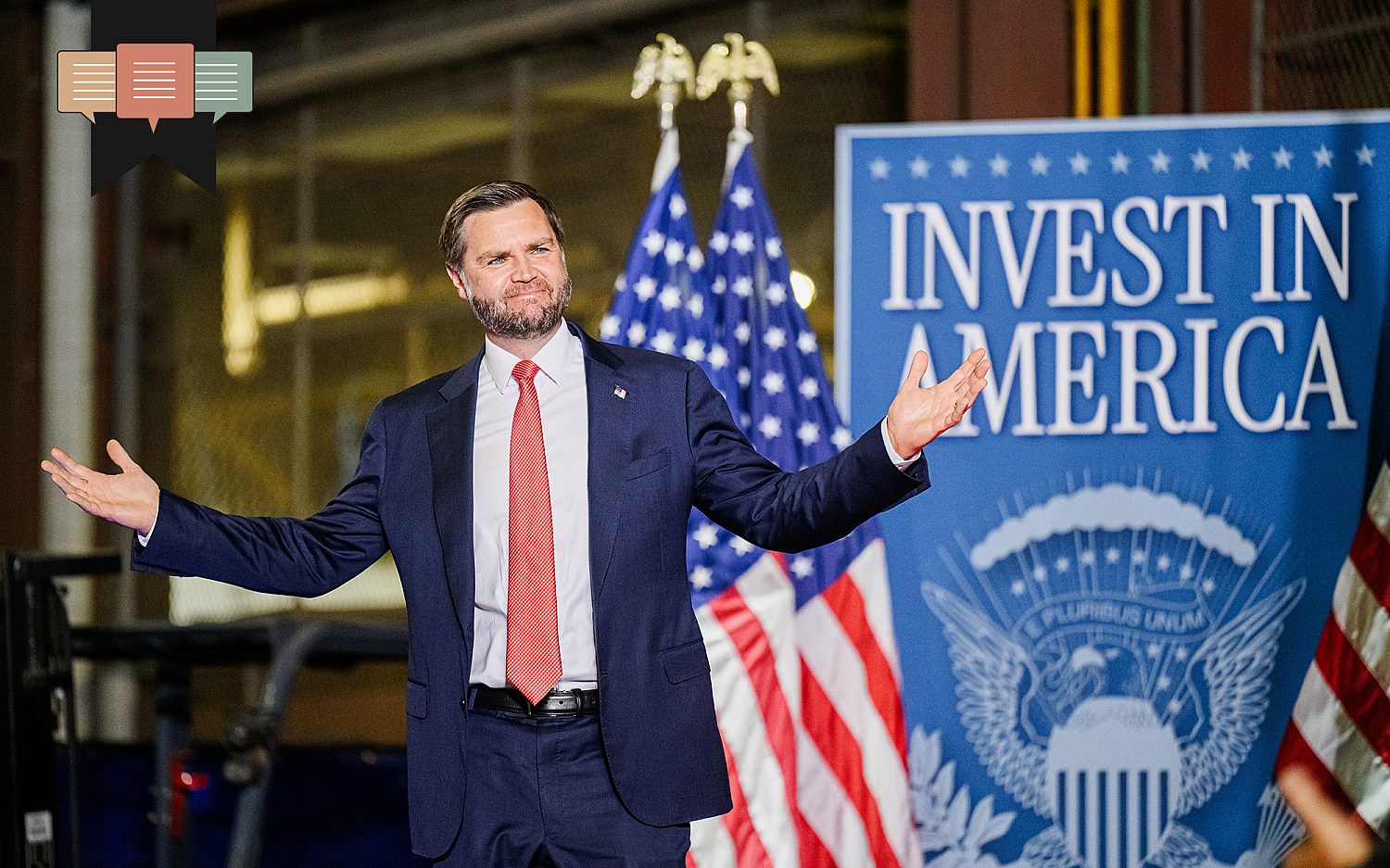
The latest skirmish in the ongoing war over the future of the conservative movement flashed on X over the weekend after a New York Times report that the Trump administration was preparing a plan to pay stay-at-home parents. The Times credits Vice President Vance for driving the initiative, though President Trump initially teased the proposal at a Mother’s Day event in May.
The rumored plan would allow states to decide whether to deem stay-at-home spouses to be eligible for funds as part of an existing federal program called the Child Care and Development Fund, a $12 billion block grant allocated to states that provides as much as $9,000 per child per year. Married couples with one stay-at-home parent and eligible dependents would still need to meet income-limit requirements to qualify.
This policy tweak is not new. In 2022, Utah Gov. Spencer Cox requested permission from the Biden administration to test pilot a similar approach (his request was denied), and Marco Rubio introduced another form of the legislation when he was a senator in 2024. Still, if implemented, the proposal would have significance surpassing its relatively small policy status. Supporting marriage and parents is a top priority of the so-called “New Right” and this would be a bona fide pro-family policy innovation. For that reason, what might otherwise be regarded a relatively small policy tweak landed like a bombshell. Pundits and policy analysts representing conservatism’s various factions leapt into the fray.
Those representing Bush-era conservatism, like Advancing American Freedom economist Richard Stern and National Review’s Pradheep Shanker, lambasted the rumored proposal as an expansion of the welfare state and compared proponents to “big government progressives.” They mourned what they see as another example of the collapse of conservative principles wrought by the Trump administration and the New Right.
Supporters of the plan rushed to the administration’s defense. Noah Wall, president and founder of the State Leadership Initiative, pointed out that 2/3 of the federal government’s $7.5 trillion annual spending consists of transfer payments and a plan to redirect a small amount of that money—with no additional spending—is hardly socialism. Inez Stepman of the Independent Women’s Forum pointed out that current policy heavily subsidizes two-parents in the workforce, thereby punishing more traditional family choices.
What are believers to make of all of this?
The first step is to organize the questions at hand. At the most practical level this is a policy debate. Will this shift in eligibility help low-income married couples with dependent children? Does it make current policy more equitable by removing one of the many “marriage penalties” that exist throughout America’s welfare system? Will it encourage parents to wed? Will it afford parents who desire to stay-at-home the financial resources necessary to do so? What are the trade-offs, and do the benefits outweigh the costs? Are there other means of accomplishing these same policy goals with fewer drawbacks? If so, are they politically feasible? This is policymaking 101.
Upstream from this exists the real fight.
For decades, the conventions of the conservative movement have assumed a libertarian mindset towards government, best encapsulated by the constant invocation of Reagan’s cliche about the most terrifying words in the English language being, “I’m from the government, and I’m here to help you” (a quip belied by Reagan’s actual policy, but that’s an op-ed for another day). This libertarian mindset insists that too much government is the problem. Therefore, the only acceptable policy solutions are those that reduce the size and scope of government. So, for 50 years, tax cuts have dominated Republicans’ domestic policy agenda.
Out the wake of John McCain and Mitt Romney’s losses emerged the New Right, which I prefer to think of as the “Renewed Right.” This emerging movement recognizes that conservatism is not and has never been libertarian, but places government in its proper place as one of many institutions endowed by God for the good of its people, alongside the family, church, and other aspects of civil society. One of the many reasons conservatism and Christianity find such common cause is that neither rejects government as inherently bad, but asks rather how much government, where, when, and why? On this, conservative luminaries from Burke to Kirk agree.
Ethics and Public Policy fellow Michael Fragoso, former counsel to Sen. Mitch McConnell (hardly an icon of the “New Right”) argues in National Review that the rumored plan stands firmly in a long line of conservative thought.
The next step is to reflect on your own political dispositions and ask, “Is this biblical?” No single verse will answer this question. In prayerful discernment, faithful believers may arrive at different conclusions regarding the relative balance of freedom and duty, government and liberty, the primacy of debt and deficits, or the feasibility of political solutions to social problems.
Finally, we need to remember that there are no carveouts from the Bible’s admonitions about believers’ conduct, even if the subject is politics. The next two years are going to be contentious, including infighting on the right and left. Our countenance ought always to reflect the truth of which we are most aware—the lovingkindness of our Lord and Savior.


These daily articles have become part of my steady diet. —Barbara
Sign up to receive the WORLD Opinions email newsletter each weekday for sound commentary from trusted voices.Read the Latest from WORLD Opinions
Thaddeus Williams | America’s “existential crisis of meaning” is similar to the Babylonian king’s crisis, and the solution is the same, too

A.S. Ibrahim | In pointing to the attitudes of Muslim immigrants, Trump says what Europe’s leaders still won’t

Colin J. Smothers | The liberal religion of Senate candidate Adam Hamilton

Denny Burk | A recent article on Elisabeth Elliot is way over that line

Please wait while we load the latest comments...
Comments
Please register, subscribe, or log in to comment on this article.