
Berlin had better pay attention
The vote Germany can no longer ignore
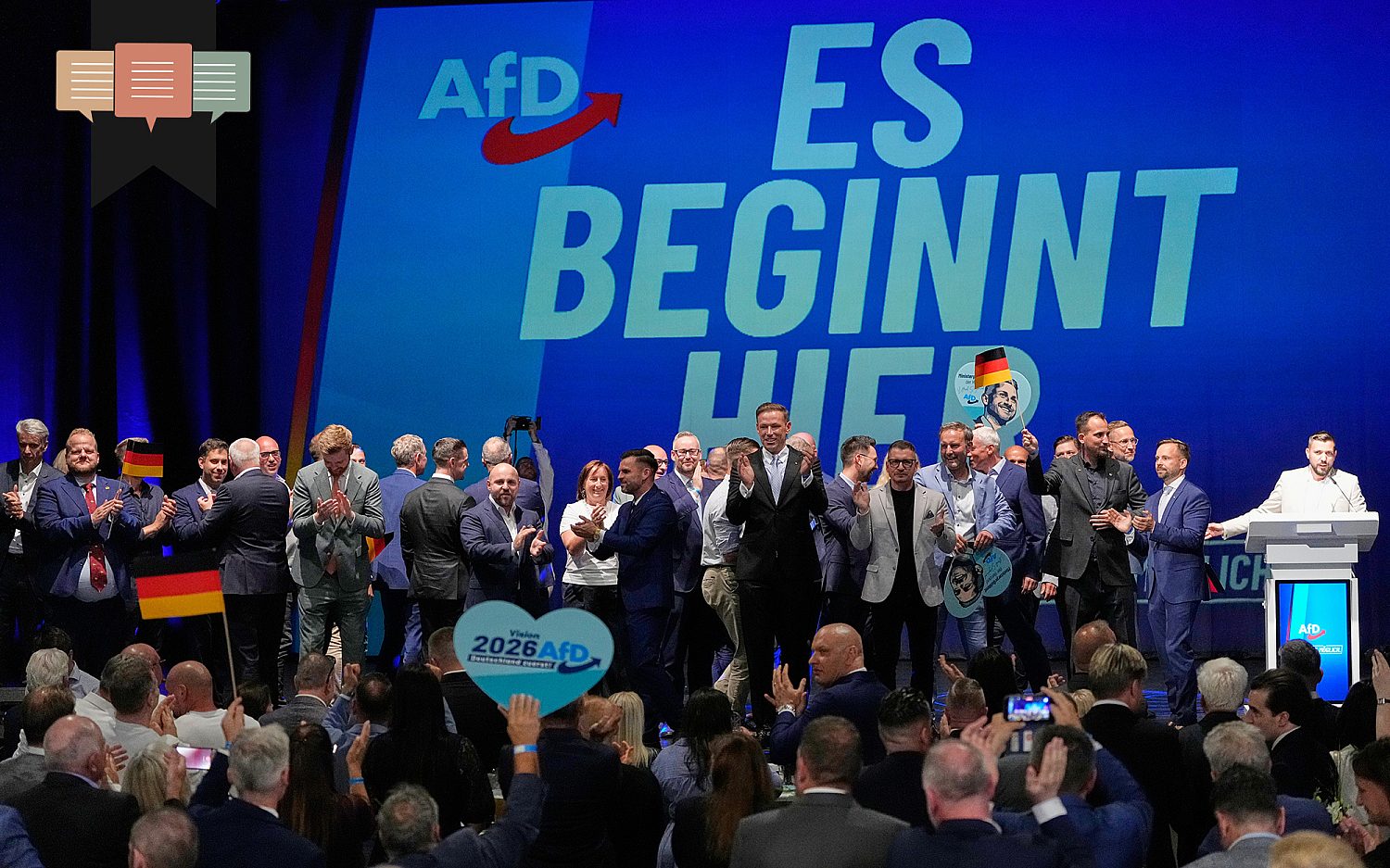
AfD party members celebrate after the Saxony-Anhalt state elections on Sept. 6. Associated Press / Photo by Matthias Schrader
Full access isn’t far.
We can’t release more of our sound journalism without a subscription, but we can make it easy for you to come aboard.
Get started for as low as $3.99 per month.
Current WORLD subscribers can log in to access content. Just go to "SIGN IN" at the top right.
LET'S GOAlready a member? Sign in.
For a decade, Germany’s political establishment told itself a comforting tale: that concern over mass migration was a marginal pathology, confined to a loud but shrinking “far-right” minority, destined to fade as integration worked itself out. Just a few weeks ago, in Saxony-Anhalt, that fanciful tale died. Not at the hands of extremists, but at the hands of ordinary German voters—including retirees and first-time voters—who walked into polling stations and delivered the Alternative for Germany a first-place finish unmatched by any conservative party in a German state election since before the Second World War.
The numbers alone tell a historic victory.
The AfD won 43.8% of the vote—more than double its 2021 result—on a turnout of 77.8%, the highest in the state’s post-reunification history. This was a clear mobilization for a long-awaited breakthrough: a governing platform built substantially on immigration enforcement, accelerated deportations, and a demand that national priorities finally outrank open-border sentimentality. Saxony-Anhalt did not vote for radicals, as liberals claim, but for the return of common sense on borders, identity, and national priorities. And Berlin would be foolish to mistake the size of that vote for anything less than a national signal—a vote with a clear message.
Whatever else this election was, it was not a fluke. It was a rebuke.
Years of open-border policy have left visible strains on housing, welfare, security, and social cohesion—strains felt even in a low-migration eastern state, where liberal policies translate into skyrocketing costs. Exit polling found that 91% of AfD voters said they were very worried too many foreign people live in Germany. That is not irrational anxiety, for it is the rational, dominant sentiment of the plurality that just won the state. Add to it 66% dissatisfaction with the outgoing state government and 83% of voters believing the federal government in Berlin is insufficiently concerned with the problems of ordinary people, and you have the full picture: a decade of accumulated grievance, channeled at last through the ballot box rather than dismissed by it.
Germany, and much of Europe with it, is waking from a long, self-congratulatory slumber. The optimism of the past political generation—the conviction that generosity alone could absorb any number of newcomers without cost—has run headlong into the realities of strained public services, socially particular crime patterns, and daily cultural friction that ordinary citizens have lived with for years while elites debated definitions and deployed buzzwords about integration and assimilation. Naming this reality is not xenophobia. It is self-preservation, and it is democratic accountability doing exactly what it is supposed to do—forcing a governing class back toward the concerns of the people who elected it.
Several forces converged to produce this remarkable outcome. Immigration was the central current, but not the only factor—economic stagnation in the former East has compounded a lingering, post-reunification sense of being treated as second-class citizens within their own country. Layered on top was a straightforward protest against Berlin, whose approval numbers in this region are now dismal. And it was not simply protest energy recycled from past cycles, for the AfD drew heavily from voters who had sat out previous elections entirely. Voters were mobilized in part by a disciplined campaign and a lead candidate, Ulrich Siegmund, whose message reached voters mainstream parties had stopped bothering to court. Security concerns—crime and disorder linked to immigration, and the sense that authorities had lost the thread—ran underneath all of it.
What should a corrective shift actually look like? Not a rush to the opposite extreme, lest it end in chaos, and not revenge—but in practical governance. Germany must enforce stricter border controls and accelerate returns for those, including many Syrian nationals, whose original protection claims no longer hold now that conditions in Syria have changed and Damascus itself says it is willing to receive its citizens back. Practically, this also means benefit reforms that reduce the incentives drawing migration flows in the first place. None of this requires cruelty—only that the state must do what states exist to do: set and enforce boundaries in the interest of the people who constitute them. Whether Syrians who have built lives in Germany over the past decade will actually choose an uncertain homeland over a stable one is a fair question, and the honest answer is that many won’t without real pressure. That is precisely why enforcement, not persuasion, has to be the instrument.
Predictably, liberals and progressives will object, reaching for the “far-right” label and the historical analogies to the 1930s, crying extremism. But a decade of treating legitimate voter concerns as unspeakable did not make those concerns disappear—it made them louder, and it delivered this result. Healthy democracies absorb discontent and channel it into policy; they do not pathologize the voters who express it and then act surprised when the pathologizing fails.
Zoom out, and Saxony-Anhalt is not an eastern anomaly. It is one data point in a continental realignment already visible in Germany’s federal polling, in France, and in Britain. The question now is whether the CDU and other mainstream parties treat this as a warning to finally govern on border control as a core state responsibility—or whether they double down on the very posture that produced Sunday’s result.
Democracies get the chance to correct course before they get the chance to collapse. Saxony-Anhalt just took that chance. Berlin had better take the hint.


These daily articles have become part of my steady diet. —Barbara
Sign up to receive the WORLD Opinions email newsletter each weekday for sound commentary from trusted voices.Read the Latest from WORLD Opinions
Ericka Andersen | Writer turns linguistic and ideological cartwheels to make the case that a woman can be “a little bit pregnant”

David Closson | Safeguards fall away as assisted suicide expands in Australia and Canada
Eric Patterson | Marx-inspired candidates say some radical things about faith, but they don’t say much about protecting fundamental liberties
Ray Hacke | A male cross country runner, his female teammates, and the need for truth and justice on Nov. 3

Please wait while we load the latest comments...
Comments
Please register, subscribe, or log in to comment on this article.