
Anatomy of a pro-life victory
The death of an assisted suicide bill in the United Kingdom shows the value of sustained scrutiny grounded in truth
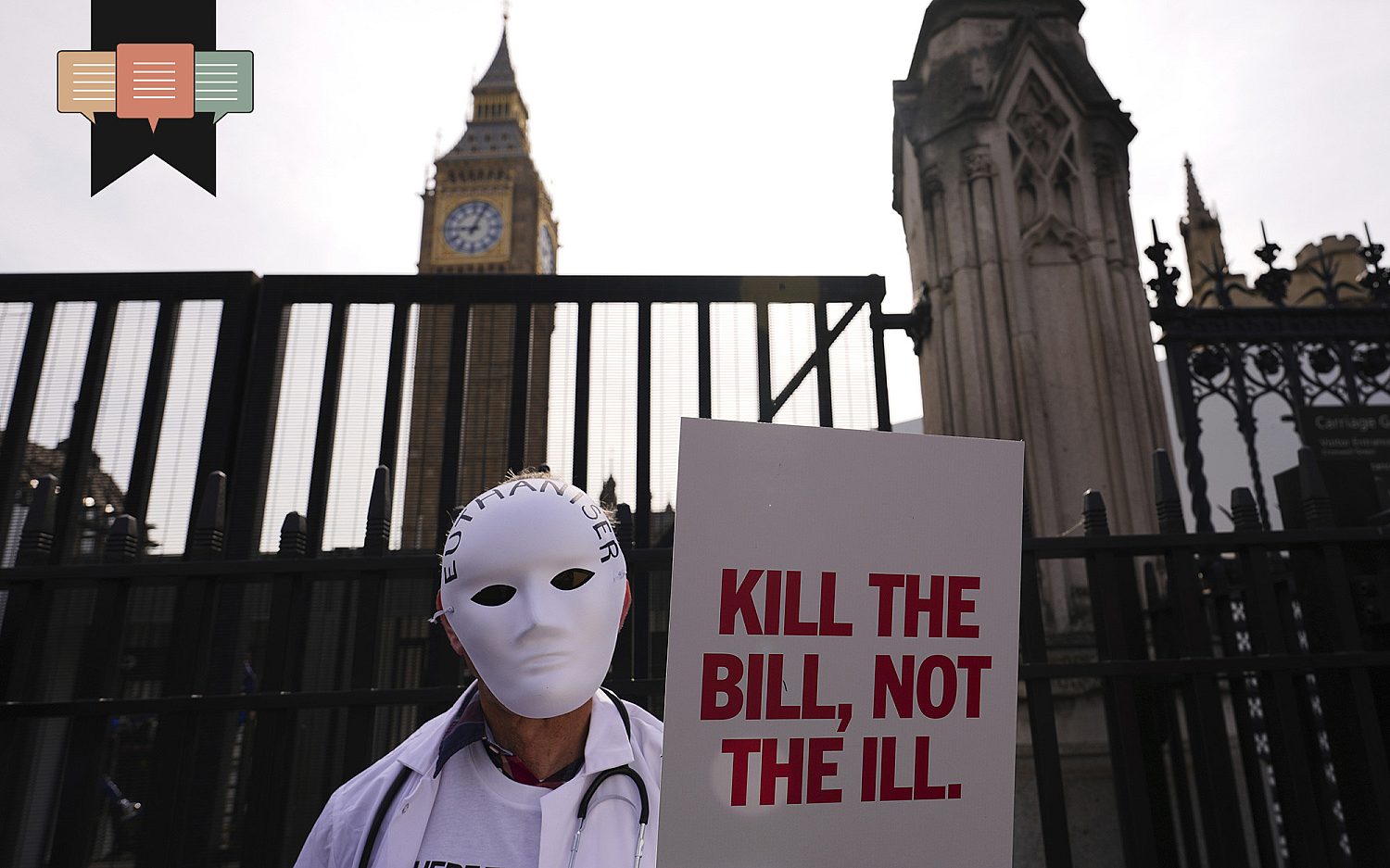
A demonstrator against assisted dying protests outside Parliament on June 20, 2025. Associated Press / Photo by Kirsty Wigglesworth
Full access isn’t far.
We can’t release more of our sound journalism without a subscription, but we can make it easy for you to come aboard.
Get started for as low as $3.99 per month.
Current WORLD subscribers can log in to access content. Just go to "SIGN IN" at the top right.
LET'S GOAlready a member? Sign in.
The latest effort to legalize assisted suicide in the United Kingdom is dead—at least for now. On Sept. 11, the House of Commons narrowly defeated an expansive medical aid in dying bill. The surprising result concluded a year-long legislative battle that divided the nation, fractured political parties, and created tension between the House of Commons and House of Lords. As the debate over assisted suicide continues in the United States, the British experience merits close attention—not least because it demonstrates how sustained scrutiny can reverse legislative momentum.
The story begins with the Labour Party’s landslide victory in 2024. Before the election, Keir Starmer had pledged to allow a vote on assisted suicide if Labour gained the majority. Following Labour’s victory, Kim Leadbeater introduced the Terminally Ill Adults (End of Life) Bill in October 2024.
Leadbeater’s bill would have legalized assisted suicide for terminally ill adults. In terms of purported safeguards, the bill required individuals requesting assisted death to have an irreversible, progressive illness expected to cause death within six months. Additionally, individuals had to possess mental capacity and demonstrate a clear, informed, and voluntary wish to die. Eligibility required two medical assessments separated by a reflection period, approval by a multidisciplinary panel, and a second signed declaration after an additional waiting period.
The assisted suicide bill passed Second Reading in November 2024. In the United Kingdom, Second Reading is when the bill’s overall purpose is considered. The 330-275 vote was historic because it marked the first time the House of Commons had advanced assisted-dying legislation. The bill then proceeded to committee.
In June 2025, the House approved an amended bill at Third Reading by a vote of 314-291. The narrower margin appeared to reflect growing unease among lawmakers about the legislation. Nevertheless, the bill appeared on course to become law.
In the United Kingdom, a bill approved by the House of Commons moves to the House of Lords, Parliament’s unelected upper chamber. The Lords consists primarily of members appointed for life based on political service, professional expertise, or distinguished achievement. The assisted suicide bill passed Second Reading there in September 2025 and advanced to committee.
Throughout the remainder of 2025 and into 2026, the Lords proposed more than 1,000 amendments addressing eligibility, safeguards, and implementation. Supporters accused some members of deliberately filibustering the bill, while opponents argued that life-and-death legislation required exhaustive scrutiny. When the 2024-2026 parliamentary session ended in April, the Lords had not completed its consideration, and the bill died.
Supporters of assisted suicide were furious. “If all the Lords does is talk and come to no conclusions, which is what’s happening here, then what’s the point of the Lords?,” complained Charles Falconer, the bill sponsor in the upper chamber.
The next parliamentary session began this past May, and a nearly identical bill was introduced in June. But scrutiny of its predecessor had taken a political toll. Although former U.K. Prime Minister Keir Starmer had supported the earlier legislation, his successor, Andy Burnham, declined to endorse the new bill. The government remained neutral, allowing MPs a conscience vote.
Against this backdrop, on Sept. 11, the House of Commons rejected the new bill, 286-270, reversing the position it had taken just two years earlier. Several lawmakers who had previously supported the proposal voted against it or abstained.
Among them was Labour MP Ashley Dalton, who revealed in a moving speech that she was living with stage-four incurable metastatic breast cancer. Dalton argued that the bill failed to protect terminally ill people whose desire to die might stem from treatable depression. She also rejected claims that terminally ill patients should expect agonizing deaths. “It is nothing short of irresponsible to scaremonger people like me into believing our deaths will be horrific when all the evidence suggests that, with access to good palliative care, deaths are, on the whole, gentle,” she said.
Another lawmaker, Labour MP Janet Daby, related experiencing “nightmares about dying and death” following her earlier vote in favor of assisted suicide. “I had to wrestle with the knowledge that I was not entirely comfortable with the decision I had made,” she explained. “My conscience was not at peace, and I cannot again in good conscience vote for the bill.”
Notably, as the debate intensified before September’s vote, medical organizations and religious leaders also objected. For instance, Archbishop of Canterbury Sarah Mullally framed the moral stakes by asking, “Do we really want a society that involves healthcare professionals in the deliberate ending of lives, which offers death as though it were medical treatment?”
Back in the United States, medical-aid-in-dying laws took effect in Delaware, Illinois, and New York in 2026. Although the contexts differ, Britain’s experience demonstrates the value of sustained scrutiny. Attention to depression, coercion, palliative care, eligibility, and safeguards changed minds and reversed the U.K. bill’s momentum.
For Christians committed to protecting life, the lesson is clear: arguments grounded in truth, compassion, and concern for the vulnerable can still shape public debate.


These daily articles have become part of my steady diet. —Barbara
Sign up to receive the WORLD Opinions email newsletter each weekday for sound commentary from trusted voices.Read the Latest from WORLD Opinions
Ray Hacke | A male cross country runner, his female teammates, and the need for truth and justice on Nov. 3

Jonathon Van Maren | The life and work of Dr. Hugh Hodge provide a powerful example to pro-life advocates

Thaddeus Williams | America’s “existential crisis of meaning” is similar to the Babylonian king’s crisis, and the solution is the same, too

A.S. Ibrahim | In pointing to the attitudes of Muslim immigrants, Trump says what Europe’s leaders still won’t

Please wait while we load the latest comments...
Comments
Please register, subscribe, or log in to comment on this article.