
An engine for the pursuit of happiness
The research is clear: Marriage is a key incubator of the virtue that makes people happier
jacoblund / iStock / Getty Images Plus via Getty Images

Full access isn’t far.
We can’t release more of our sound journalism without a subscription, but we can make it easy for you to come aboard.
Get started for as low as $3.99 per month.
Current WORLD subscribers can log in to access content. Just go to "SIGN IN" at the top right.
LET'S GOAlready a member? Sign in.
We have now embarked on America’s 251st year of living under the declaration of being endowed by our Creator with the unalienable rights of life, liberty, and the pursuit of happiness.
Is “happiness” too shallow and transitory a value to be listed among “life” and “liberty” as foundational human values? Thomas Jefferson was certainly not referring to mere feelings of happiness, but something much deeper. The great Founding Father was likely inspired by George Mason’s Virginia Declaration of Rights penned just weeks prior, guaranteeing “the enjoyment of life and liberty, with the means of acquiring and possessing property, and pursuing and obtaining happiness and safety.”
Years later, a Maine school master wrote to Jefferson seeking enduring life wisdom to pass on to his students. The retired president offered insight from Cicero’s Tusculan Disputations, that happiness is impossible without virtue. Cicero stated, “It is certain that without virtue there can be no happiness” and as such, “a happy life is the consequence of virtue.”
This is historically what happiness has meant. Not the pursuit of pleasure or a fleeting feeling that puts a smile on one’s face. It is the pursuit of virtue—the practice of a life that refines our character and makes us better people.
Let us consider marriage as a primary institution that accomplishes this work.
Unfortunately, few today would consider marriage an important schoolhouse for happiness and virtue, but it certainly is. It has long been so, since the beginning of human experience. A rich storehouse of social science data documents this fact. The character-shaping nature of marriage leads to greater overall life happiness, especially when husband and wife share and practice a serious faith together.
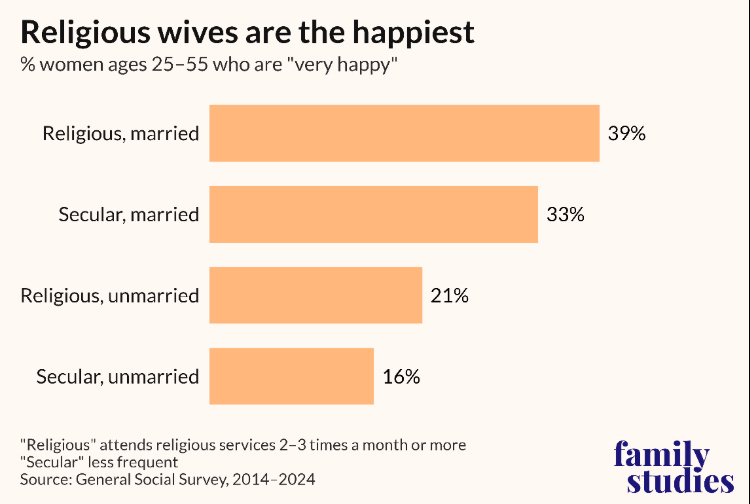
Findings from the General Social Survey, the gold standard of sociological population research, show us that wives who regularly attend church are more likely to report being “very happy” compared to their unmarried and secular peers.
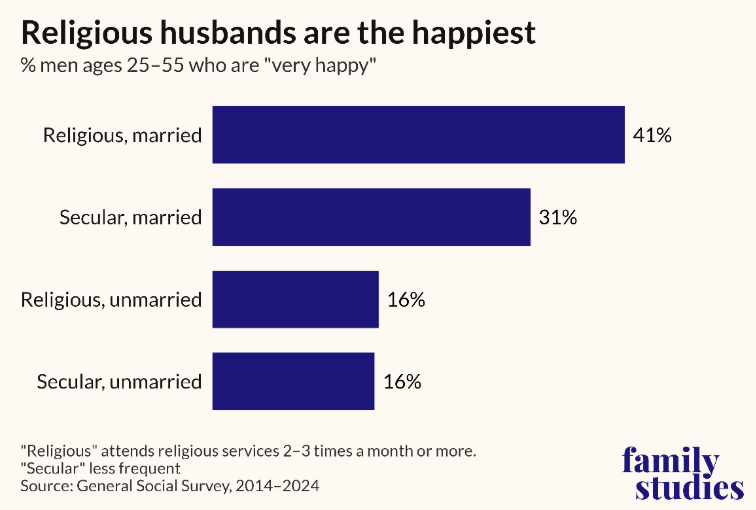
The Institute for Family Studies (IFS) recently reported that “religious, married women and men aged 25 to 55 are more than twice as likely to report being ‘very happy’ in life compared to unmarried religious counterparts” (emphasis added).
The happiness differentials for Christian married men are even stronger.
A 2025 IFS report on life factors leading to strong, stable marriages explains,
Our analysis found that wives who attended church regularly with their husbands had odds of being very happy in marriage that were 112% higher than women who attended less often or not at all. For husbands, regular shared church attendance was associated with a 212% boost in their odds of being very happy in marriage compared with their less religious or non-religious peers.
Of course, these data demonstrate that marriage and faith are a powerful producer of life happiness. Additional research augments this conclusion.
Professor emeritus Sam Peltzman of the University of Chicago is a widely respected economist. In 2023, he examined all major life characteristics for how they contribute to overall life happiness. He states, “Being married is the most important differentiator with a 30-percentage point happy-unhappy gap over the unmarried.” His data show marriage is a more powerful happiness boost than high income and a college education.
And this has remained consistently true across the decades when married men and women are compared to their cohabiting and single peers.
Marriage is a profound and consistent happiness boost. In fact, Peltzman calls it a “landslide.”
The happiness landslide comes entirely from the married. Low happiness characterizes all types of non-married. No subsequent population categorization will yield so large a difference in happiness across so many people.
Peltzman adds, “Conservatives are distinctly happier than liberals,” indicating married conservatives enjoy an even higher happiness dividend.
But it is not just happiness that marriage improves. Research published by leading university-based relationship scholars for the American Psychological Association concludes, “Compared with those who were cohabiting or dating, married individuals generally reported better mental and physical health than those in less committed relationships, and most differences remained when controlling for putative selection factors.”
When the Lord God said, ““It is not good that the man should be alone…” He was not speaking of the problem of mere loneliness. He was referring to something much deeper and theologically anthropological. In his solitary state, Adam was not yet fully imaging the divine Trinitarian nature of relational community. Yet, Adam was made in God’s image. The Lord’s answer to that original problem was a God-imaging wife and their life-giving complementarity. This is a primary reason the writer of Hebrews tells us, “Let marriage be held in honor among all.”
Greater human happiness is just one of marriage’s rich fruits. It’s imaging of the union of Christ and His Church tells us how truly powerful marriage is.


These daily articles have become part of my steady diet. —Barbara
Sign up to receive the WORLD Opinions email newsletter each weekday for sound commentary from trusted voices.Read the Latest from WORLD Opinions
Thaddeus Williams | America’s “existential crisis of meaning” is similar to the Babylonian king’s crisis, and the solution is the same, too

A.S. Ibrahim | In pointing to the attitudes of Muslim immigrants, Trump says what Europe’s leaders still won’t

Colin J. Smothers | The liberal religion of Senate candidate Adam Hamilton

Denny Burk | A recent article on Elisabeth Elliot is way over that line

Please wait while we load the latest comments...
Comments