
Acknowledgement and blasphemy
Sometimes, critics have a good point
iStock / Getty Images Plus / oersin
Well, it is now apparent to me that I have kicked a hornet’s nest on issues of religious liberty, blasphemy laws, constitutional self-government, and the Baptist tradition. That’s all. The fracas is not what I intended. Nevertheless, the issues are important, and I need to respond. I genuinely hope this response is helpful. The issues are really important.
I recently participated in a book project that has attracted a good deal of attention. I was invited to join with Doug Wilson, Joe Rigney, Russ Reno, and Paul Miller in a project entitled, Five Views on Christian Nationalism. I thought the issues at stake are genuinely important and urgent, and I thought the “five views” approach could be fruitful. Joe Rigney, who was both contributor and editor, is fellow in theology at New St. Andrews College in Idaho, where Doug Wilson is pastor of Christ Church. Rusty Reno is editor of the journal First Things, and he regularly engages these issues. Similarly, Paul Miller, professor of the practice of public affairs at Georgetown University, has already contributed helpfully to this discussion.
The discussions were fruitful, and I hope the book will be helpful to Christians trying to think through these issues. The setup for the book was a bit awkward for me, since it asked the contributors to respond to a hypothetical future scenario in which the United States has failed and small regional nations have emerged. In one of these nations, evangelical Protestants comprise about 75% of the population. The U.S. Constitution no longer operates. What order should be put in its place?
I have never responded to any similar context, and one effect of a hypothetical is that a writer is allowed some freedom to address issues that otherwise might be conscribed by the present order of things. I am not built to address hypotheticals like this. I have been asked some really direct questions. I am thankful for the questions, and I will try to be equally direct in response.
My main concern in the project was to argue for some form of constitutional acknowledgment that its claims about human dignity, human rights, and the rule of law exist on a foundation more solid than thin air or a majority vote at your local law school. I have been concerned with this issue for many years. Years ago, I addressed in one of my books, The Gathering Storm, what was known in some political circles as the “Böckenforde Dilemma.” Ernst-Wolfgang Böckenforde was a German legal scholar and jurist who framed one of the central questions of our times: “Does the free, secularized state exist on the basis of normative presuppositions that it itself cannot guarantee?”
His argument was that modern secularized European societies were making moral and legal assertions that had been grounded in a Christian culture and are now hanging in thin air. I think Böckenforde was profoundly right. Liberal governments are making claims about human dignity that their own secular worldview subverts. Similarly, I was fascinated by the debate that took place in the early years of this century within the European Union. That debate centered in whether a constitution for the union should acknowledge Christianity as being of historic importance to European values. The idea of such an acknowledgement was popular among many leaders, but figures such as Jacques Chirac, the former president of France, bitterly opposed even the mere acknowledgment that Christianity was in any way foundational to Europe today. Once again, the radical secularism of the French Revolution reared its head. In any event, the constitution failed to be enacted, but Chirac had won his victory anyway. The concept of acknowledgement was really helpful, however, since it was not in any way a personal profession of faith, but simply an acknowledgement that the values of European civilization had been birthed, nourished, and shaped by the Christian tradition—later expanded, quite helpfully I think, to acknowledge the historic influence of Judaism as well. How else can you explain the Western notions of human dignity and human rights?
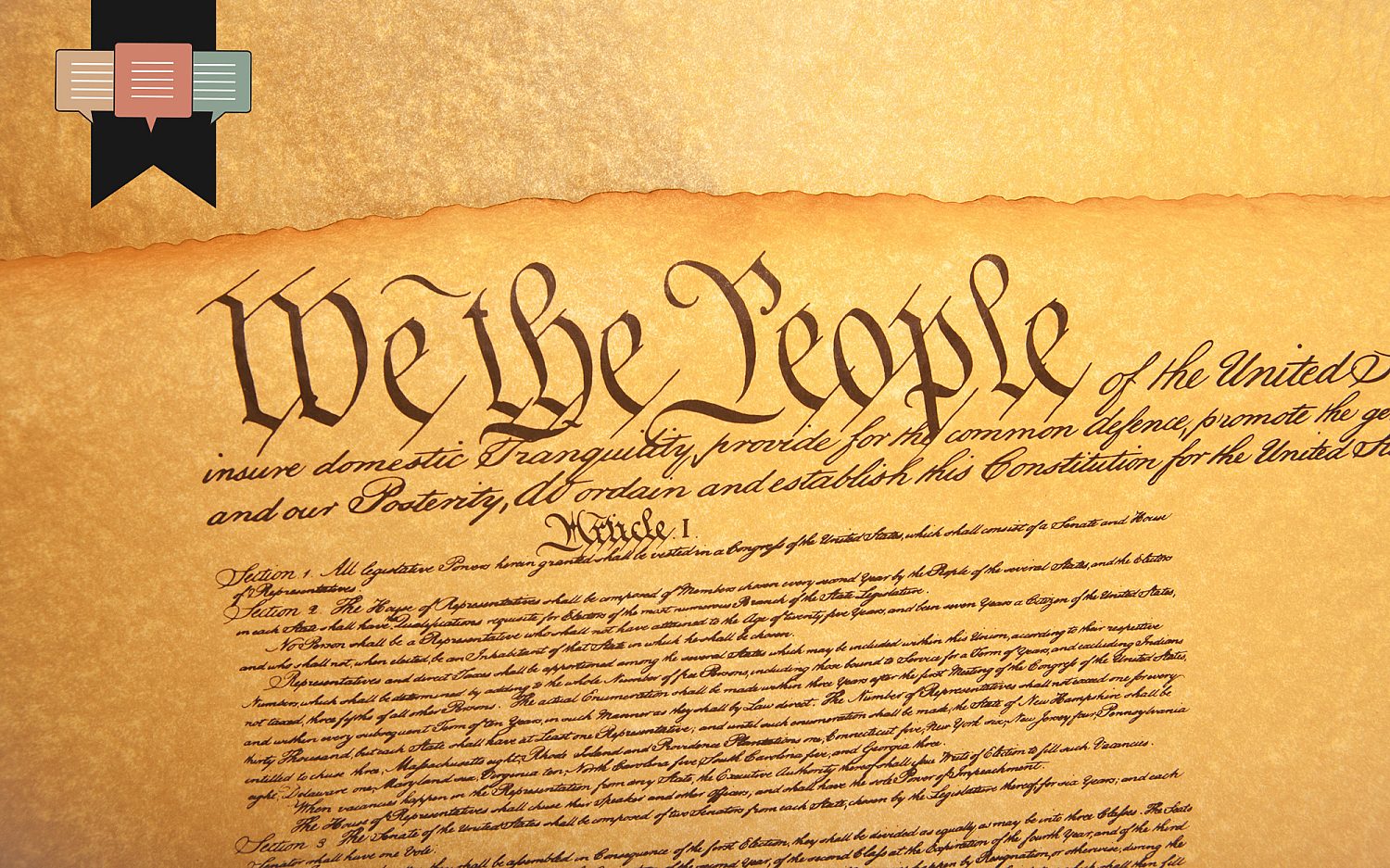
In any event, the Declaration of Independence includes just such an acknowledgement with references to the fact that human beings are “endowed by their Creator with certain unalienable rights.” Sadly, the Constitution includes no such language, and no such acknowledgement. I would not claim that such an acknowledgement, taken alone, would resolve our problems or prevent all judicial activism, but I do think it would help. Current antipathy to any ontological grounding of claims to human dignity and human rights and the rule of law has been evident for decades. Just consider, for example, the outrage poured out against Justice Clarence Thomas in his confirmation hearings in 1991, just for stating belief in the natural law.
My purpose is to make clear that, as a Baptist, I would never want to coerce religious belief—period. The concept of acknowledgment would not bar Thomas Jefferson or any other president from the White House, since it is not a test of personal religious beliefs.
I stand by my argument on acknowledgement, though it is at this point in history, in the real world, not a matter of political possibility. It is, I think, a fruitful tool for thinking through the issue.
In the project, we were also asked to answer questions based on this hypothetical. A short section asked about the possibility of blasphemy laws. In the book, based in a hypothetical situation, I argued for blasphemy laws to be effectively redefined in the context of constitutional acknowledgement. On this score, to state the matter plainly, I think I blew it.
In the first place, I should not have attempted to use an old word in a new context (memo to the editor). In the larger sense, I should have just stated that doctrinal and theological judgments are matters for the believing church and left the government out of it. It is a complex and complicated question when seen in the span of Christian history and constitutional development. But Baptists have been on the wrong side of the lash and the law throughout our history and have learned to separate the roles of church government. I was not calling for conventional blasphemy laws, and I have never advocated or supported any such legislation. I have supported religious liberty for all citizens energetically and forcefully. Needless to say, I fully support our current constitutional order. That is not in question.
My dear friend, Dr. Richard Land, whose colleagueship I hold dear, took me to task on the issue of blasphemy laws, even within a hypothetical scenario. He made the point that, in this age, gospel Christians are most at risk of being punished under such laws at the hands of aggressive secularists. The Baptist Faith & Message, our Southern Baptist Convention confession of faith, effectively answers the question: “The state has no right to impose penalties for religious opinions of any kind.” I am gladly regulated by the confession of faith, and agree with its clear assertion. Confessional accountability is a basic principle of my life. I make that statement publicly and gladly and from the heart. I have made clear the dangers of anti-blasphemy legislation. That means that I must be thankful for those who have raised hard questions. God bless you all.


These daily articles have become part of my steady diet. —Barbara
Sign up to receive the WORLD Opinions email newsletter each weekday for sound commentary from trusted voices.Read the Latest from WORLD Opinions
Thaddeus Williams | America’s “existential crisis of meaning” is similar to the Babylonian king’s crisis, and the solution is the same, too

A.S. Ibrahim | In pointing to the attitudes of Muslim immigrants, Trump says what Europe’s leaders still won’t

Colin J. Smothers | The liberal religion of Senate candidate Adam Hamilton

Denny Burk | A recent article on Elisabeth Elliot is way over that line

Please wait while we load the latest comments...
Comments
Please register, subscribe, or log in to comment on this article.