
A reality check for ideology
Having children will tend to bring the truths of conservatism into clarity
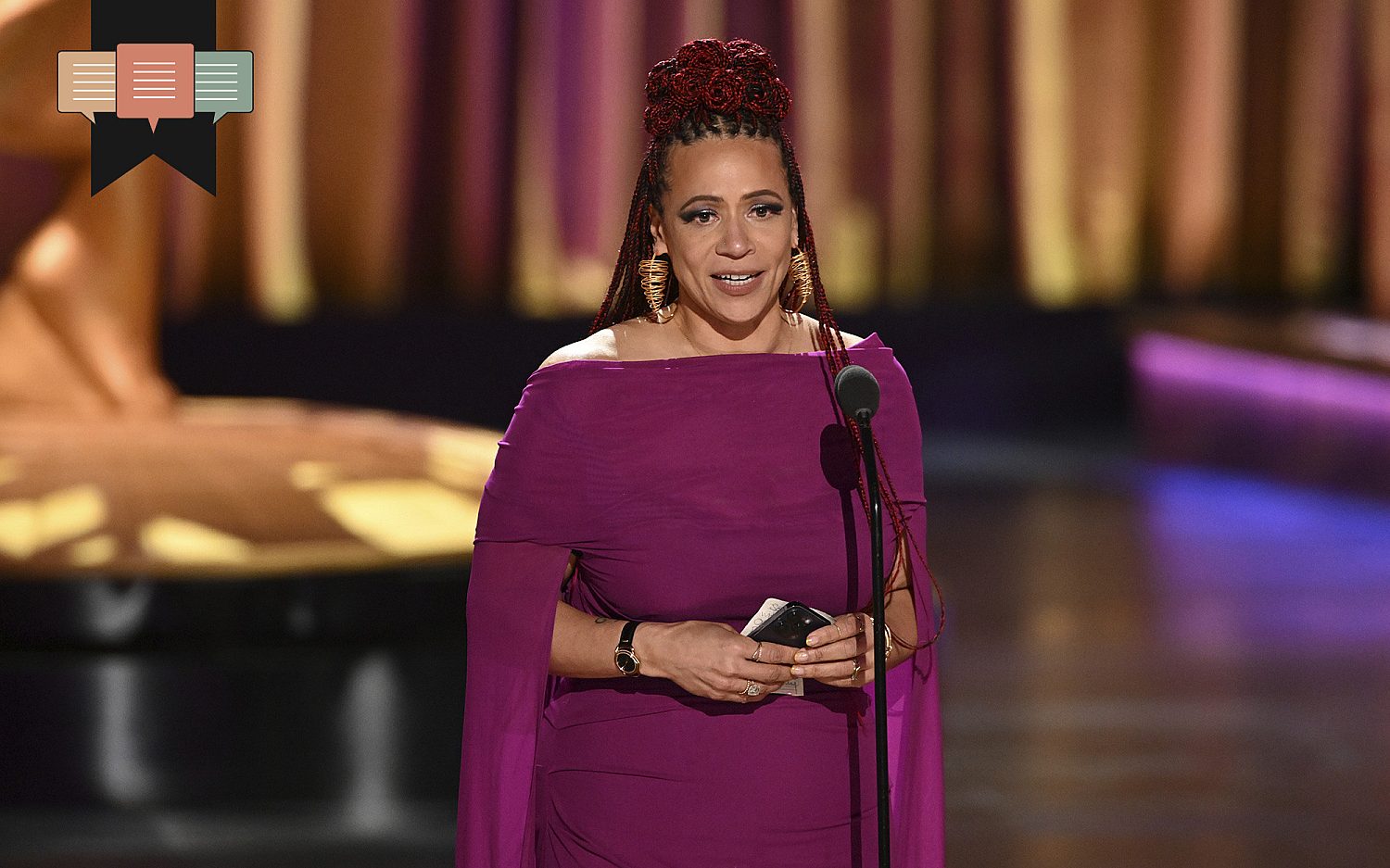
Nikole Hannah-Jones accepts an award during the Emmy Awards on Jan. 7, 2024, in Los Angeles. Associated Press / Photo by Phil McCarten / Invision for the Television Academy / AP Images
Full access isn’t far.
We can’t release more of our sound journalism without a subscription, but we can make it easy for you to come aboard.
Get started for as low as $3.99 per month.
Current WORLD subscribers can log in to access content. Just go to "SIGN IN" at the top right.
LET'S GOAlready a member? Sign in.
If you want to turn someone conservative, you can give them a good book. If you really want to turn someone conservative, you should give them a child.
Parenting’s right-wing bias is well-attested. Though of course not every parent is a conservative, raising a human being creates plausibility structures for a traditional worldview like little else. Parenting makes all of us look reality in the eye, at which point we have a choice: Accept what we see, or rage against it.
The writer Nikole Hannah-Jones recently became a case study. Hannah-Jones is certainly no conservative. She’s a committed progressive, most famous for the “1619 Project,” which deconstructed American history into a slavery-centric narrative. She’s such a committed progressive, in fact, that a few years ago she made a bold and (genuinely) courageous decision to enroll her child in a troubled inner-city school, out of solidarity for the black students who had no other choice. Nikole’s daughter, Najya, had plenty of higher quality options, given her family’s financial well-being. Her mother, however, believed that it was more important for Najya to share in an impoverished black experience than to get a better education.
That was then. Now, writing again in The New York Times, Nikole Hannah-Jones confesses that she grossly underestimated the price her daughter would have to pay for solidarity. Hannah-Jones writes, with admirable honesty, about the shocking problems with her daughter’s school: from the students’ unchecked violent behavior, to piles of ungraded assignments, to the revelation that Najya’s math abilities were significantly behind what Hannah-Jones believed.
For her part, Najya believes her parents made a mistake. Hannah-Jones recounts her daughter telling her, “Putting me in this school didn’t change anything. I was not trying to be in this type of environment. It makes no sense.”
Hannah-Jones seems genuinely conflicted about her decision. She is not conflicted, however, about the real problem affecting poor American schools. Teachers would be more attentive, she believes, if they were paid more, instead of facing competition via school choice programs. The lesson that Hannah-Jones seems to have taken from her daughter’s trials is that, while she might have been wrong to force her into the role of child activist, the activism itself is right.
Her essay is worth reading, for it’s an unusually candid confession of what happens when an ideology collides with experience.
Like many parents, Hannah-Jones had no idea what was actually going on in her daughter’s school until the problems came home and were impossible to ignore. Her confidence in the intrinsic moral goodness of teachers and public bureaucracy proved ill-founded. What’s more, Hannah-Jones could not sweep this knowledge under the rug. It was her daughter’s well-being that was at stake. To Hannah-Jones’s credit, she intervened (something many parents are unable, or unwilling, to do).
Modern progressivism rests on ideological constructs that cannot hold up to the kind of scrutiny that a protective parent is capable of. Many public schools, propped up by functional state monopolies on education, simply have neither the ability nor the motivation to overcome human depravity—whether it shows up in unruly students, apathetic parents, or indifferent teachers. The accountability that school choice imposes on public education is not perfect, but it’s necessary, because people with power will, more often than not, misuse that power unless forced otherwise.
The point goes beyond education. Consider the “gentle parenting” phenomenon, popular among left-leaning, cosmopolitan parents. Gentle parenting’s first and fundamental error is that it treats children as micro-adults whose reasoning and desires need to be weighed equally with a parent’s. It’s precisely the kind of parenting philosophy that one would expect to emerge in a culture where caring for small children is both increasingly rare and increasingly outsourced (to daycares and full-time nannies).
Or consider gender ideology. A generation’s worth of harm will be litigated for years to come, due to progressive ideology’s belief that a sexually developing preteen should be able to decide she is trapped in the wrong body. The bare minimum contact with reality—the hormonal violence, social awkwardness, and psychological vulnerability of adolescence—makes this idea look absurd. Its plausibility depends on keeping reality at arm’s length.
Reality’s conservative bias can be clearly seen in our children. This is why a society that makes the raising of children seem strange or undesirable will soon lose touch with reality. Wealth, technology, and ideology are, for many, becoming substitutes for things like family. This is a recipe for more than population collapse. It’s a recipe for spiritual and intellectual hallucination.
Give Nikole Hannah-Jones some credit for acknowledging that the facts disagreed with her opinion. And let’s hope that eventually, she, and our reality-denying culture at large, will decide what she must change is her opinion, rather than the facts.


These daily articles have become part of my steady diet. —Barbara
Sign up to receive the WORLD Opinions email newsletter each weekday for sound commentary from trusted voices.Read the Latest from WORLD Opinions
Thaddeus Williams | America’s “existential crisis of meaning” is similar to the Babylonian king’s crisis, and the solution is the same, too

A.S. Ibrahim | In pointing to the attitudes of Muslim immigrants, Trump says what Europe’s leaders still won’t

Colin J. Smothers | The liberal religion of Senate candidate Adam Hamilton

Denny Burk | A recent article on Elisabeth Elliot is way over that line

Please wait while we load the latest comments...
Comments
Please register, subscribe, or log in to comment on this article.